
The Spice Market
Step into a spice market and your nose gets there first: cumin and cardamom, dried chillies that make you sneeze, cinnamon bark stacked like firewood,…
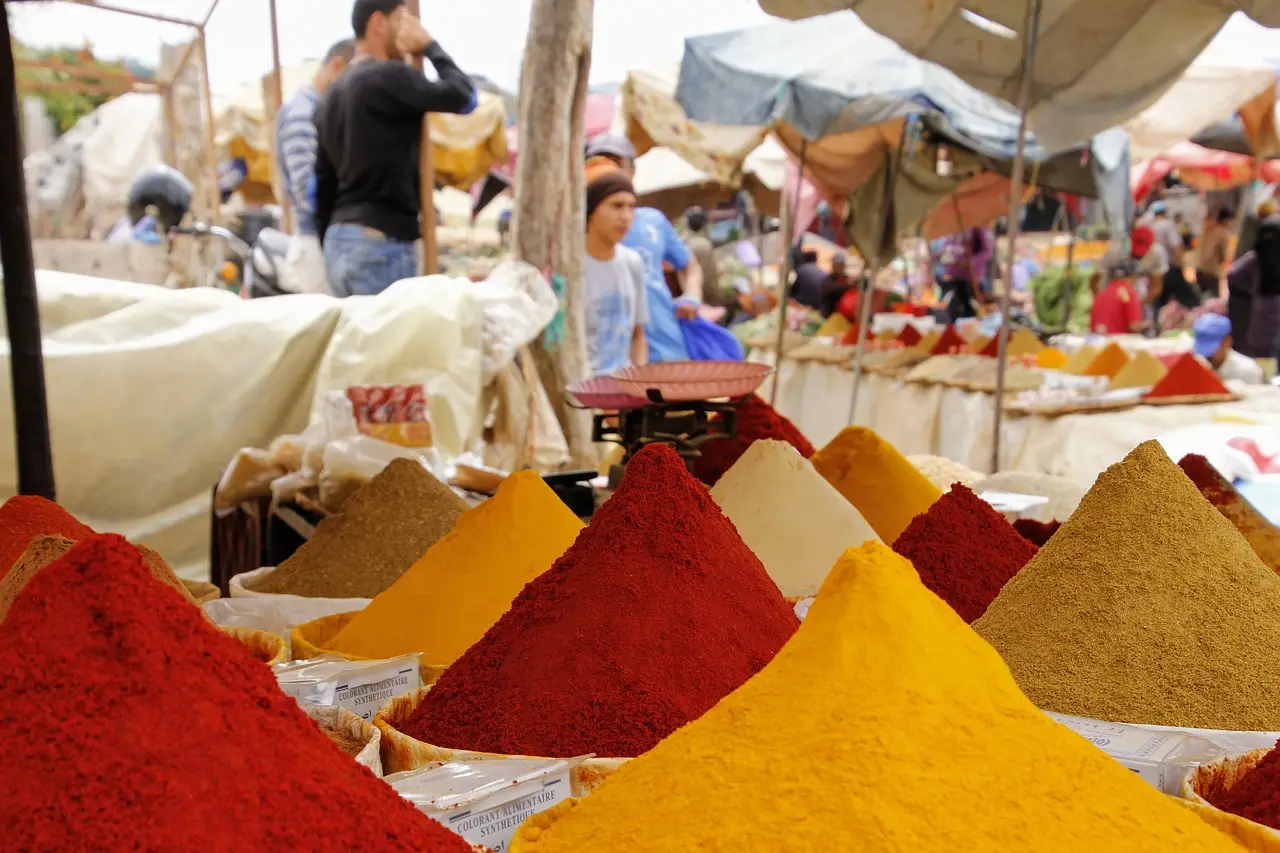
Step into a spice market and your nose gets there first: cumin and cardamom, dried chillies that make you sneeze, cinnamon bark stacked like firewood, saffron guarded behind glass. Sacks spill open in rust, ochre and green, traders call out prices, and somebody hands you a pinch of something to taste. Spice markets are where the world's flavours change hands, and the trade behind them built fortunes, launched fleets, redrew maps and, at its worst, destroyed whole peoples.
Background
The spice trade linked Asia, northeast Africa and Europe from ancient times, moving cinnamon, pepper, nutmeg and cloves across seas and deserts 1. Spices weren't only for flavour. Europeans also bought them as medicine and perfume: black pepper for coughs and asthma, nutmeg for wind 2. Wealthy households spent lavishly on them to show off 2.
The market is where all that trade touches the ground. Two famous ones still trade today:
- Istanbul's Spice Bazaar opened in the 1660s after the city's Great Fire of 1660. Turhan Hatice Sultan, mother of Sultan Mehmed IV, commissioned it as part of the New Mosque complex, and shop rents paid for the mosque's upkeep 5. Turks call it the Mısır Çarşısı, the "Egyptian Bazaar", because revenues from Ottoman Egypt paid for it. Since mısır also means maize, it's sometimes mistranslated as the "Corn Bazaar" 5. It has 85 shops 5.
- Khari Baoli in Old Delhi is known as Asia's largest wholesale spice market. It has traded since the 17th century beside Fatehpuri Masjid, built in 1650 6. Its name means "salty stepwell" in Persian, after a well built there in 1551 6. Some shops are run by the ninth or tenth generation of the founding family 6.
History
The sea routes are older than most people think. Austronesian sailors from Southeast Asia dominated the maritime trade from about 1500 BC, linking Southeast Asia with India and Sri Lanka and later China 1. In the first millennium AD, Arab and Indian merchants took the lead 1. From the 8th to the 15th century, Mediterranean maritime republics such as Venice held a near-monopoly on Europe's trade with the Middle East and grew rich passing Asian spices on to the rest of Europe 1.
Then the map changed. When the Ottomans took Constantinople in 1453, a main land route for spices into Europe closed 2. Europeans went looking for a way round. Vasco da Gama sailed around Africa and reached Calicut, on India's Malabar Coast, in 1498 12. Portugal declared a royal monopoly and built forts at Cochin in 1503, Goa in 1510 and Malacca in 1511 2. Pepper bought for 6 cruzados a quintal could sell for more than 20 in Europe 2.
The Dutch arrived from 1596, took Malacca in 1641 and Colombo in 1656, and gained control of the Spice Islands, shipping three times what Portugal had managed 2.
The darkest chapter came on the Banda Islands, the only place on earth where nutmeg and mace grew 3. Between 1609 and 1621 the Dutch East India Company, led by Jan Pieterszoon Coen, tried to force the Bandanese to sell only to them. When resistance continued, the company set out to remove the population. Of about 15,000 islanders, roughly 1,000 remained; about 2,500 were killed by violence, starvation and disease, and 1,700 were enslaved 3. Enslaved workers brought from across Asia then worked the nutmeg groves for Dutch planters 3. By 1681 only about 100 native Bandanese were left 3. Under the 1667 Treaty of Breda, England gave up its claim to the tiny Banda island of Run, and the Dutch dropped their claim to Manhattan 3.
Customs, rules and rituals
Markets need trust, and Islamic cities built an institution for it. The muhtasib, appointed under the system called hisba, inspected "markets and morals", keeping order among traders, shopkeepers and even doctors 4. A market inspector could settle disputes where the facts were admitted, though not hear court cases 4.
Many spice markets also tie trade to faith. Istanbul's Spice Bazaar was built to fund a mosque 5, and Khari Baoli grew up in the shadow of one 6. Family firms that pass from generation to generation turn a stall into an inheritance 6.
Place in human experience
The spice market is one of humanity's great meeting places. The trade carried not only pepper but sailing technology, crops and religious ideas between continents 1.
It's also a story about desire and its cost. Europeans wanted spices badly enough to sail around Africa, and that want funded empires 2. For the people of Banda it meant near-destruction 3. The pinch of nutmeg in your pantry has a heavy history.
And it's a story of continuity. In Old Delhi, families still sell spices from shops their ancestors opened three centuries ago 6. In Istanbul, shoppers still walk the aisles of a bazaar a sultan's mother built 5.
So next time you wander a market and someone offers you a taste, take it. You're standing in one of the oldest conversations people have ever had.
Sources
- "Spice trade", Wikipedia, Wikimedia Foundation. https://en.wikipedia.org/wiki/Spice_trade
- Mark Cartwright, "The Spice Trade & the Age of Exploration", World History Encyclopedia, 9 June 2021. https://www.worldhistory.org/article/1777/the-spice-trade--the-age-of-exploration/
- "Dutch conquest of the Banda Islands", Wikipedia, Wikimedia Foundation. https://en.wikipedia.org/wiki/Dutch_conquest_of_the_Banda_Islands
- "Hisba", Wikipedia, Wikimedia Foundation. https://en.wikipedia.org/wiki/Hisba
- "Spice Bazaar", Wikipedia, Wikimedia Foundation. https://en.wikipedia.org/wiki/Spice_Bazaar
- "Khari Baoli", Wikipedia, Wikimedia Foundation. https://en.wikipedia.org/wiki/Khari_Baoli