Bananas
Bananas: a berry from a giant herb, first farmed in New Guinea and grown almost entirely in Far North Queensland. History, customs and buying tips.
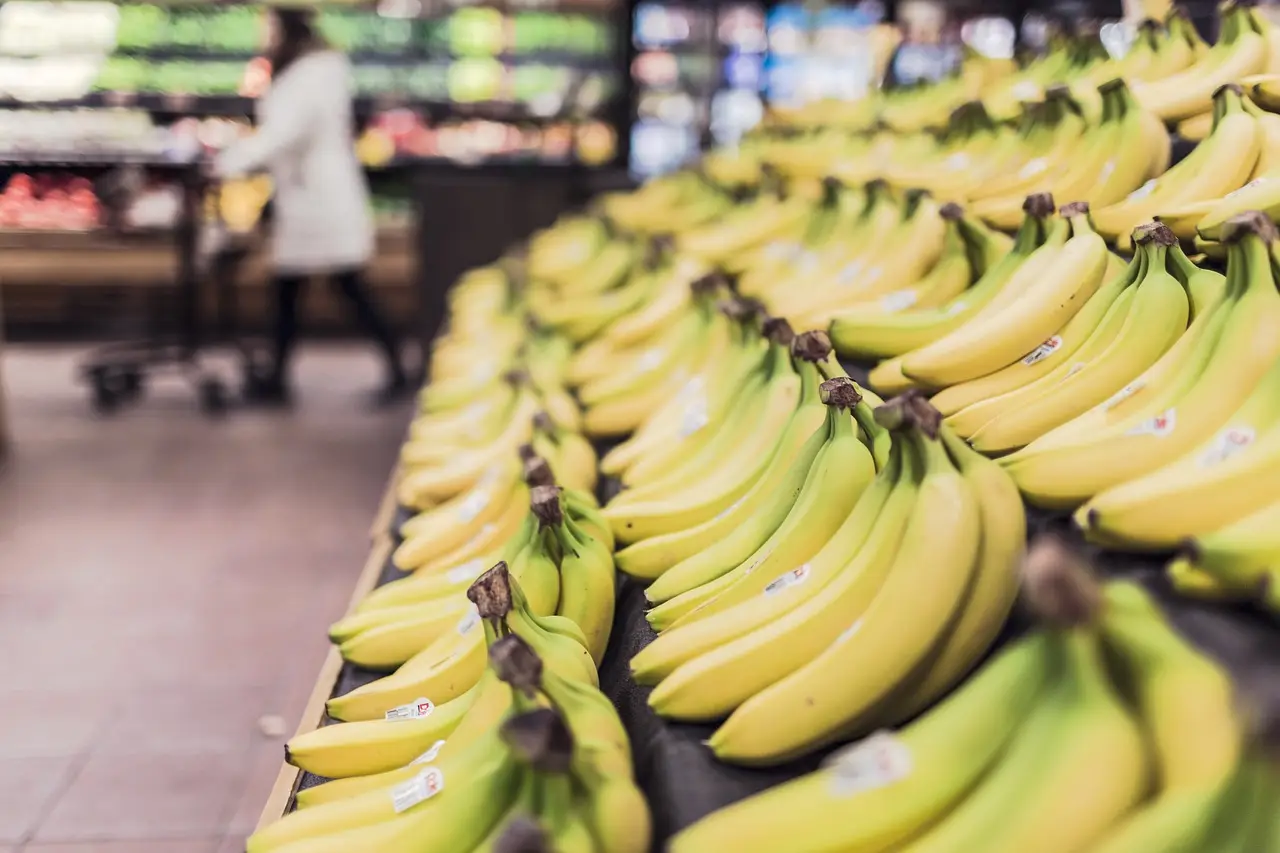
Australians eat five million bananas every day 3. That's a lot of lunchbox fruit, smoothies and banana bread. Yet the banana is stranger than it looks. It's a berry, the "tree" is actually a giant herb, and the banana in your fruit bowl has no seeds because it's a clone 1. Its story runs from a swamp in New Guinea 10,000 years ago to a cyclone in Queensland that sent prices through the roof.
Background
Banana plants belong to the genus Musa. They're large flowering herbs, not trees. What looks like a trunk is a "pseudostem" made of tightly wrapped leaf stalks, growing from an underground corm 1. The fruit is botanically a berry 1.
Modern eating bananas descend from two wild species, Musa acuminata and Musa balbisiana. They are parthenocarpic, which means the fruit forms without seeds, so growers plant offshoots instead 1. Every Cavendish is, in effect, a copy of every other Cavendish 1.
In Australia, 94% of bananas grow in Far North Queensland, mainly around Tully and Innisfail on the Cassowary Coast, the Atherton Tablelands and Lakeland 3. There are smaller crops near Coffs Harbour in New South Wales, around Carnarvon in Western Australia and in the Northern Territory 3. Cavendish makes up about 97% of Australian production and Lady Finger about 3% 3.
History
The earliest banana farmers lived in Papua New Guinea. Banana phytoliths, tiny mineral traces left by plants, from the Kuk Swamp archaeological site date to around 10,000 to 6,500 years ago 1. Austronesian sailors later carried bananas across Island Southeast Asia and on to Oceania, Africa and South Asia 1.
The English word probably came from West Africa, perhaps the Wolof banaana, and reached English through Spanish or Portuguese 1.
The banana your great-grandparents ate tasted different. Until the 1950s the main export banana was the Gros Michel 2. Then Panama disease, a fungal wilt, wiped out huge plantations in Central America, and by the 1960s exporters had switched to the disease-resistant Cavendish 2. The 1922 novelty song "Yes! We Have No Bananas" is said to have been inspired by early Gros Michel shortages 2. Today the same disease, in new forms, threatens the Cavendish too 1.
The banana also gave English an ugly phrase. The writer O. Henry coined "banana republic" in 1904 to describe countries such as Honduras and Guatemala, where fruit companies held political power 1.
Customs, rules and rituals
Much of the banana's ritual life happens on its leaf.
- South India. In Tamil Nadu and Karnataka, festival meals are still served on banana leaves. Diners fold the leaf inward after eating to say thank you, but outward at a funeral wake to show condolence 4.
- Hindu and Buddhist ceremonies. Banana leaves decorate weddings and ceremonies in southern India and Southeast Asia, and food offerings called prasadam are served on them 4.
- Thailand. For Loy Krathong, on the full moon of the twelfth lunar month, people shape banana leaves into floating bowls called krathong and set them on the water to carry away bad luck 4.
- Bali. Balinese Hindus fold banana leaves into small containers for daily flower offerings called canang 4.
Place in human experience
Bananas are exported in bigger volume and higher value than any other fruit 1. That makes them a quiet test of how connected we all are.
Australia learned this the hard way. Australia allows no banana imports, to keep out pests and disease, so every fresh banana here is grown here 3. When Cyclone Larry hit in March 2006, it destroyed 80 to 90% of the national crop. Prices rose by 400 to 500%, averaging $15 a kilo, and the shortage dragged on for the rest of the year 5. Plenty of Australians still remember the year bananas became a luxury.
A banana leaf can mean thanks, grief or a wish for luck 4. The fruit itself means something simpler: a cheap, easy snack almost everyone loves.
How to buy, store and use it
Picking good ones. Choose by when you'll eat them. Green-tipped bananas will last the week; yellow with brown freckles are sweetest now; heavily spotted ones are perfect for baking.
Where to find them. Every Australian supermarket sells Cavendish loose or bagged in the fruit section. Look for Lady Fingers too: they're smaller, naturally sweeter, and they don't go brown when cut, which makes them great for fruit salad 6. You may also spot red bananas and starchy plantains, which cook like a vegetable 6.
Ripening and storage. Export bananas are picked green and ripened with ethylene gas, then held at about 13 °C 1. To ripen hard bananas faster, put them in a brown paper bag overnight with an apple or tomato 1. Keep ripe ones in the fruit bowl, away from other fruit if you don't want everything ripening at once.
Using them.
- Mash into banana bread, pancakes or muffins.
- Freeze chunks for smoothies and "nice cream".
- Grill or pan-fry halves for a quick dessert.
- Swaps: one mashed banana stands in for an egg in many sweet bakes. No banana? Try apple sauce.
Sources
- "Banana", Wikipedia. https://en.wikipedia.org/wiki/Banana
- "Gros Michel banana", Wikipedia. https://en.wikipedia.org/wiki/Gros_Michel_banana
- "Our industry", Australian Banana Growers' Council. https://abgc.org.au/our-industry/
- "Banana leaf", Wikipedia. https://en.wikipedia.org/wiki/Banana_leaf
- "Cyclone Larry", Wikipedia. https://en.wikipedia.org/wiki/Cyclone_Larry
- "Banana varieties", Australian Bananas. https://australianbananas.com.au/Pages/all-about-bananas/banana-varieties