Bok choy
Bok choy is the little Chinese cabbage with fat white stalks and dark green leaves, and its name is as plain as it gets: Cantonese baak choi, "white…
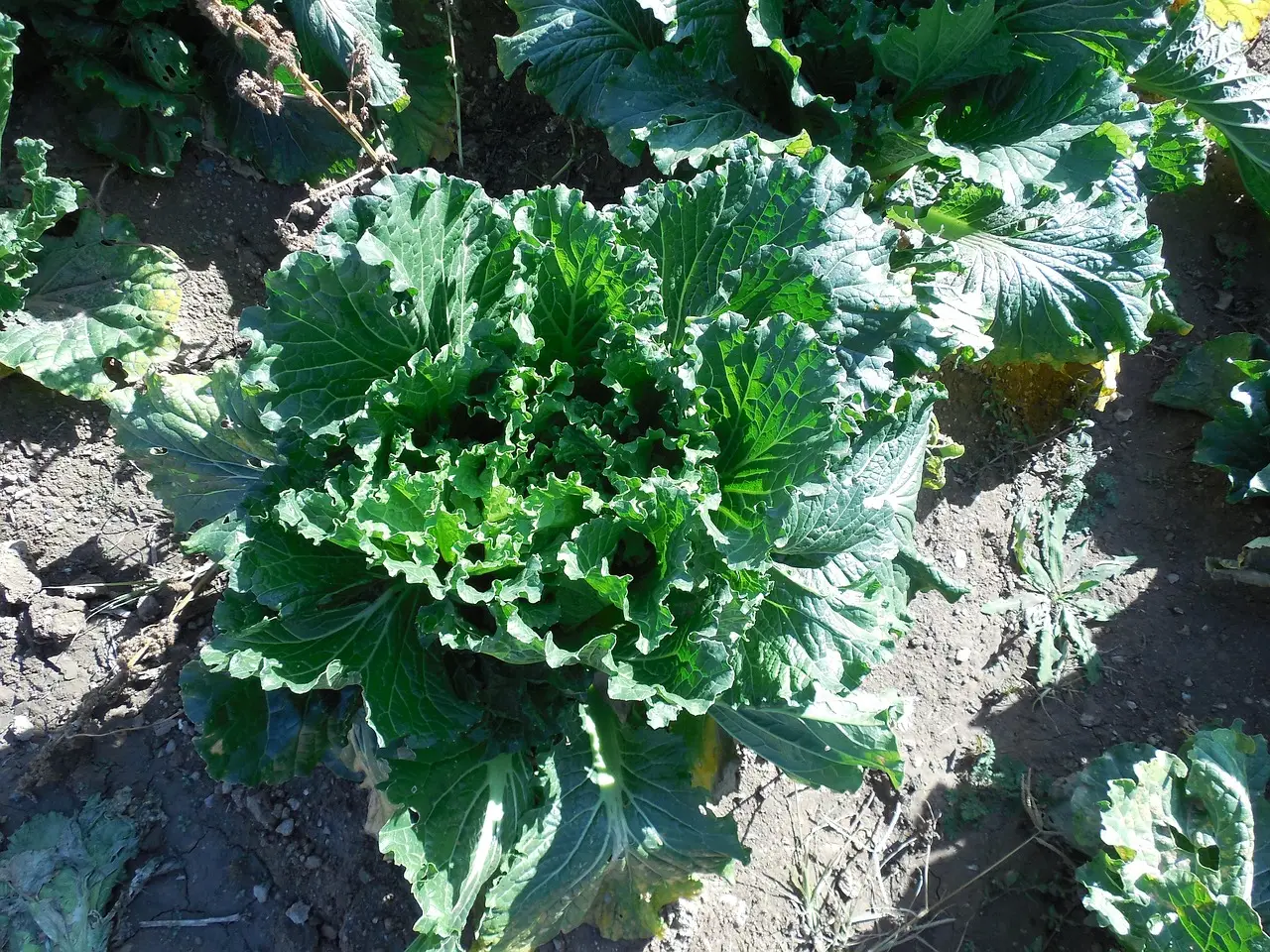
Bok choy is the little Chinese cabbage with fat white stalks and dark green leaves, and its name is as plain as it gets: Cantonese baak choi, "white vegetable", after those pale stems 12. Give it two or three minutes in a wok or steamer and it's done 1. Behind that speed sits a long story, from ancient Chinese poetry to the dawn shifts of migrant gardeners who grew it on the edge of Sydney, where it still grows today 34.
Background
Bok choy is a mustard-family plant, Brassica rapa subsp. chinensis 1. Here's the fun part: the same species gives us the turnip, the oil-seed sarsons of India and wombok, the tight-headed Chinese cabbage 135. Carl Linnaeus first gave it a species of its own, Brassica chinensis; botanists have since folded it back in with the turnip family 1.
You'll see it spelt pak choi, pak choy or bok choi, depending on who printed the label 1. In the same crate you'll often find its cousins: tatsoi, gai lan (Chinese broccoli) and mustard greens 5.
It's about 94 per cent water and roughly 20 calories per 100 grams, with a good hit of vitamin C 1. Young plants taste sweeter, and drying or pickling the leaves keeps a harvest going long after the season ends 1.
History
How old is bok choy? Depends who you ask. Duke Gardens places it in China's Yangtze River Delta about 3,500 years ago 2. Wikipedia's summary gives a much later date for written records of pak choi in China, the fifth century CE 1.
Genetics offers a clue. A team led by Xinshuai Qi and Hong An studied 126 samples of B. rapa from around the world 3. Their results suggest the species' crops began in Europe and Central Asia and reached Asia 2,400 to 4,100 years ago 3. Pak choi turned out to be one distinct family line, and Chinese cabbage seems to have come later, 1,200 to 2,100 years ago, when pak choi crossed with western types, possibly carried east along the Silk Road 3.
The researchers checked their dates against old books, and the books agreed. The Shi Jing, China's oldest poetry collection, mentions the turnip about 2,600 years ago, with a lovely bit of kitchen advice: don't throw the plant away just because the root is bitter, because the leaves and stems taste good 3. Chinese cabbage first appears as "Niu Du Song", "beef tripe cabbage", in an official pharmacy book from 659 CE 3. So a leafy green made it into a medical text long before it made it onto most of the world's dinner plates.
From there it travelled slowly. It reached Europe in the mid-1700s, Japan and Malaysia by the early 1800s, and North America in the 1800s with Chinese migrants 12. Wider American shoppers only caught on about a century later 1.
Customs, rules and rituals
A Chinese meal has two halves. The archaeologist K.C. Chang called them fan, the rice, noodles or other grains, and ts'ai, the dishes of vegetables and meat 6. A proper meal needs both, and a plate of quick-cooked greens is classic ts'ai 6. Chang also described foods sorted by yin and yang, where "food... is also medicine" 6.
Greens really shine in Chinese Buddhist cooking. The Brahmajāla Sūtra, circulating in China from the fifth century, banned the "five pungents", onion, garlic and chives among them, because their strong taste was thought to stir desire 7. In the sixth century, under Emperor Wu of Liang, monks at Jianye Temple in Nanjing were famous for turning a single melon into several dishes 7. Temple kitchens still cook seasonal vegetables simply, with oil, salt, soy sauce and vinegar 7. Mild, quick bok choy suits that kitchen perfectly; just leave out the garlic most home stir-fries begin with.
Place in human experience
Outside China, bok choy's story is mostly about hard work. Sydney's Botany area grew the city's vegetables from the early 1800s, and after the 1850s gold rushes Chinese gardeners took over most of those plots 4. Under the White Australia Policy, market gardening was one of the few jobs open to Chinese migrants. They pooled money in syndicates, lived in corrugated-iron huts on the gardens, and were out selling at the markets or door to door from about 4 am 4.
One of those gardens, at La Perouse, has fed Sydney since at least 1909, when Ah Choon leased four acres 4. It still grows bok choy, coriander and Chinese broccoli, it was heritage-listed in 1999, and fewer than five gardens like it are left in the city 4.
The twist? For decades those gardeners grew much of Australia's veg while their own greens stayed off most Aussie tables. Writer Susan Luscombe traces how Italian and Greek growers later took over many of the gardens, and how Asian migration from the 1990s finally put bok choy, wombok and tatsoi into everyday kitchens 5. In the United States, Duke Gardens notes the Chinese migrants who brought it there were often exploited labour, and that bok choy now ranks among the most popular Asian vegetables in the country 2.
So that bunch on the supermarket shelf carries a lot: a probable Silk Road crossing, a pharmacy entry from 659 CE, monastery rules, and the early mornings of gardeners who kept cities fed while the law kept them on the outside.
Sources
- "Bok choy", Wikipedia, https://en.wikipedia.org/wiki/Bok_choy
- "Bok Choy", Sarah P. Duke Gardens, Duke University, https://gardens.duke.edu/bok-choy-eng/
- Xinshuai Qi, Hong An et al., "Genomic inferences of domestication events are corroborated by written records in Brassica rapa", bioRxiv (2017), https://www.biorxiv.org/content/10.1101/118372v1.full.pdf
- "Chinese Market Gardens", NSW State Heritage Register, NSW Government, https://apps.environment.nsw.gov.au/dpcheritageapp/ViewHeritageItemDetails.aspx?ID=5044696
- Susan Luscombe, "Let's talk about Asian greens", The Illawarra Flame (2023), https://www.theillawarraflame.com.au/lets-talk-about-asian-greens/
- David Chung, "Food in Chinese Culture: An Introduction" (on K.C. Chang, ed., Food in Chinese Culture, Yale University Press, 1977), Postcolonial Web, https://postcolonialweb.org/uk/mo/food1.html
- Liu Shuman, "Chinese Buddhists Don't Eat Meat. Can They Convince Others to Do the Same?", Sixth Tone (2023), https://www.sixthtone.com/news/1014148