Chocolate
Chocolate: from bitter frothy cacao drinks and bean money to bars, bilbies and Easter eggs, plus how to buy, store and cook with it.
Snap a square of chocolate and you're holding thousands of years of history. Before it was a bar, it was a bitter, frothy drink; before it was a treat, it was money. Cacao grows only in a hot, wet belt around the equator 3, yet somehow it has ended up in every lunchbox, cake tin and Easter basket in Australia.
Background
Chocolate comes from the seeds of the cacao tree. The International Cocoa Organization says cocoa grows in a belt between 10° north and 10° south of the equator, where trees get 1,500–2,000 mm of rain a year and dry spells of no more than three months 3. The three largest producers are Côte d'Ivoire, Ghana and Ecuador 3; Côte d'Ivoire alone supplies about 35% of the world's cocoa 1.
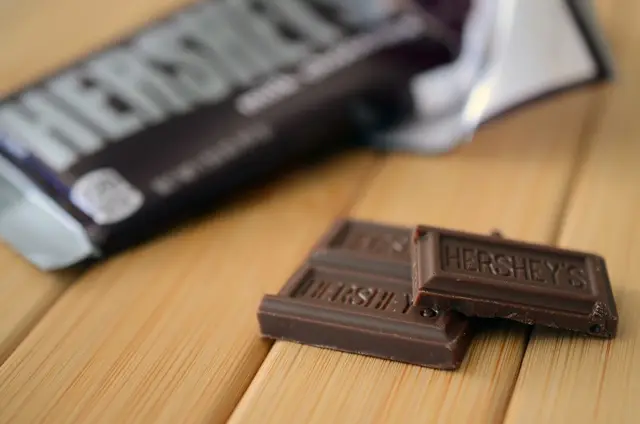
Making chocolate means fermenting, drying and roasting the beans, grinding them into a paste, then sweetening and smoothing it. Dark, milk and white chocolate differ mainly in how much cocoa solids, cocoa butter, milk and sugar go in.
History
Cacao was domesticated about 5,300 years ago in what is now Ecuador, by the Mayo-Chinchipe culture 1. By around 1900 BC, the Mokaya people on Mexico's Pacific coast were drinking "bitter frothy watery cacao drinks" 2. Pottery from Puerto Escondido in Honduras, dated 1851–1045 BC, holds cacao residue, a sign it was served at gatherings of high-status people 2.
The Maya and Aztecs treated cacao as a gift from the gods 1, and the beans worked as money. Spanish writers recorded that 30 beans bought a small rabbit and 100 bought a turkey hen 2. Among the Aztecs, drinking it was mostly for the elite and for soldiers, who got chocolate rations 2.
Hernán Cortés saw chocolate at Moctezuma II's court in 1520 1. In 1544 Kʼeqchiʼ Maya nobles, travelling with Dominican friars, introduced it to the Spanish court 2, and the first shipment to Europe followed in 1585 1.
Then came the machines. Van Houten's hydraulic press (1828) separated cocoa butter from the paste 1. J. S. Fry & Sons is credited with introducing eating chocolate to Britain in 1847 2. Daniel Peter made modern milk chocolate in 1875 using powdered milk, and Rodolphe Lindt invented conching in 1879, which made chocolate smooth instead of gritty 2.
Australia joined in. Alfred E. Haigh opened Haigh's in Adelaide on 1 May 1915, and it still makes chocolate from the bean today 4.
Customs, rules and rituals
- Fasting. For roughly two centuries, from the 1500s to the 1700s, Catholic thinkers argued about whether drinking chocolate broke a religious fast 2.
- Easter. Easter eggs and bunnies are now chocolate across much of the world 1. J. S. Fry & Sons made the first hollow chocolate egg in 1873, and Cadbury followed in 1875 5.
- The Easter Bilby. Since 1993, Haigh's has made chocolate Easter Bilbies as an Australian alternative to the bunny, with proceeds supporting rabbit control 4. Rabbits are a pest here, and bilbies are ours.
- Gifts. Chocolate coins at Hanukkah and boxes on Valentine's Day are customs in many countries 1.
Place in human experience
Chocolate has always said something about who gets to have it. Aztec warriors and nobles drank it; ordinary people traded the beans 2. In Europe it began as a drink for courts. The factory changed all that, and now a bar costs less than a bus fare.
That cheapness has a cost somewhere else. About 2.1 million children were involved in cocoa farming in Ghana and Côte d'Ivoire as of 2017, and fair trade schemes grew in the 2000s partly to lift low wages for cocoa workers 1. Choosing certified chocolate is one small way to vote with your trolley.
And there's Roald Dahl's Charlie and the Chocolate Factory (1964) 1, proof that a golden ticket in a wrapper can make a whole generation dream.
How to buy, store and use it
Picking a good one. Check the ingredients: cocoa solids or cocoa mass near the top, and the percentage on the front. Higher numbers mean more cocoa and usually less sugar. For baking, choose cooking chocolate or a bar you'd happily eat.
Where to find it. Australian supermarkets stock chocolate in the confectionery aisle and cooking chocolate, cocoa powder and chips in the baking aisle. Vegan and fair-trade bars often sit in the health food section.
Storing it. Keep chocolate cool, dry and away from strong smells. A whitish coating is called bloom: fat bloom comes from cocoa butter shifting, sugar bloom from moisture 6. Bloomed chocolate is still safe to eat, just less pretty 6. If you must refrigerate in an Australian summer, wrap it well and let it come to room temperature before opening, so condensation doesn't cause sugar bloom.
Swaps.
- Milk chocolate: a dairy-free "mylk" chocolate, or a dark bar for more flavour.
- Chocolate chips: a chopped block, which melts into pools instead of holding shape.
- Melted chocolate in a pinch: cocoa powder plus a little oil or vegan butter.
Sources
- "Chocolate", Wikipedia. https://en.wikipedia.org/wiki/Chocolate
- "History of chocolate", Wikipedia. https://en.wikipedia.org/wiki/History_of_chocolate
- "Growing cocoa", International Cocoa Organization. https://www.icco.org/growing-cocoa/
- "Haigh's Chocolates", Wikipedia. https://en.wikipedia.org/wiki/Haigh%27s_Chocolates
- "Easter egg", Wikipedia. https://en.wikipedia.org/wiki/Easter_egg
- "Chocolate bloom", Wikipedia. https://en.wikipedia.org/wiki/Chocolate_bloom