
Palm oil
Palm oil: West African cooking oil turned biscuit and soap staple. Its history, its rituals, the forest question, and how Australian labels name it.
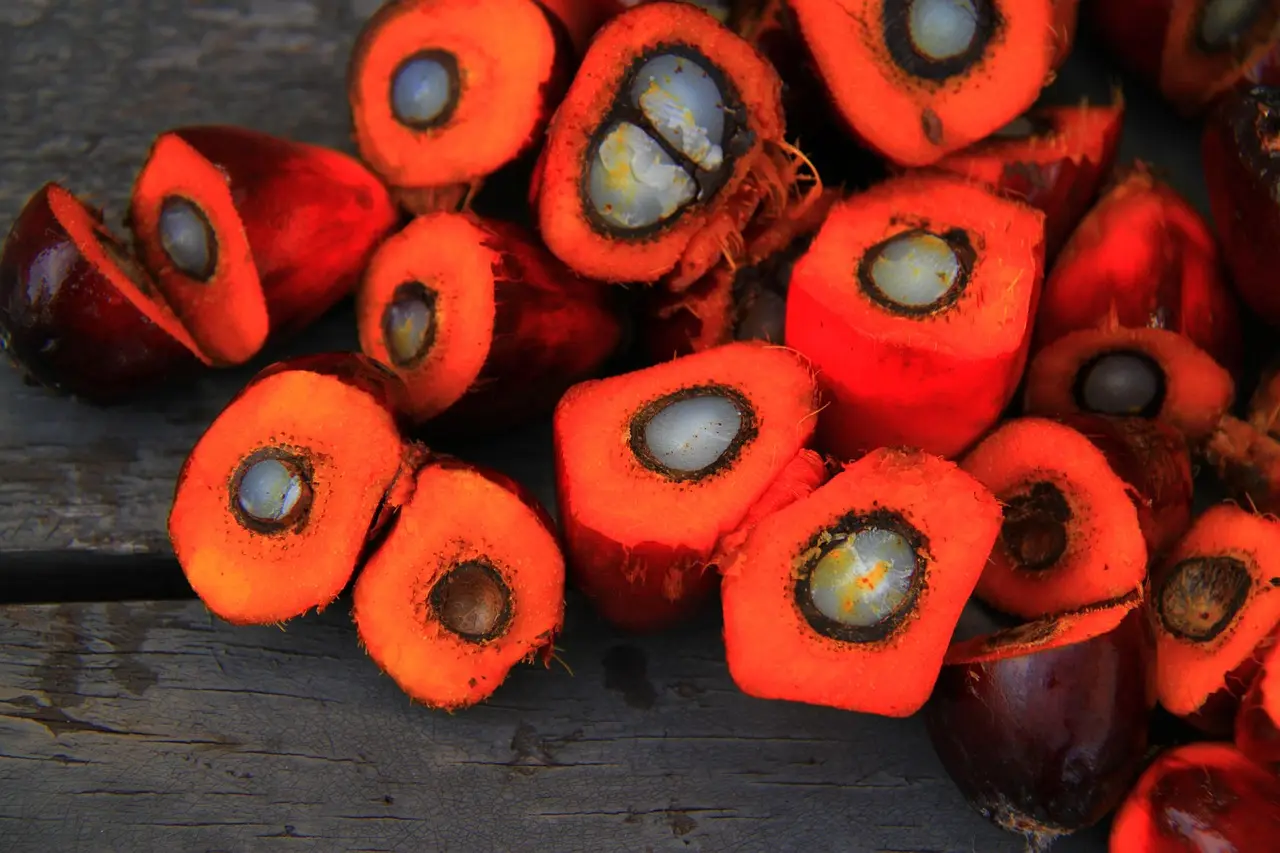
Palm oil leads two lives. In West Africa and Brazil it's a proud, brick-red cooking fat that colours stews and fritters and carries centuries of tradition. In the rest of the world it's mostly invisible: a refined, pale fat hiding in biscuits, margarine, chocolate, soap and shampoo. It makes up more than a third of the world's vegetable oil 3, and also one of the most argued about. Here's what the records say, so you can decide for yourself.
Background
Palm oil comes from the African oil palm, Elaeis guineensis, native to west and south-west Africa between Angola and the Gambia 2. The tree gives two different oils. Palm oil is pressed from the fruit's orange pulp, about 22 kilograms per 100 kilograms of fruit bunches. Palm kernel oil comes from the seed, just 1.6 kilograms per 100 2. The deep red colour of unrefined palm oil comes from natural carotenoids 2.
The palm is astonishingly productive. Our World in Data reports about 2.9 tonnes of oil per hectare, roughly four times more than sunflower or rapeseed and ten to fifteen times more than coconut or peanut 3. In 2017, palm made up 36% of the world's vegetable oil while using only 8.6% of the land planted to oil crops 3.
World production reached 77.3 million tonnes in 2023–24 1. Indonesia produced 44 million tonnes and Malaysia 19.7 million 1. Together they grow more than 80% of the world's supply 3. About 68% goes into food, 27% into soaps, cosmetics and detergents, and 5% into bioenergy 3.
History
Palm oil is old. Archaeologists concluded that a tomb at Abydos in Egypt, dating to about 3000 BC, held palm oil 1.
Its global career began with the Industrial Revolution. British traders bought it as a machine lubricant, and it became the base of soaps such as Lever Brothers' "Sunlight", the company now called Unilever 1. By 1870, palm oil was the main export of some West African countries 1.
Then the palm travelled. Dutch growers took it to Java in 1848, and it reached Malaysia around 1910, the start of Southeast Asia's plantation industry 2.
Customs, rules and rituals
- West African cooking. Palm oil is a key fat in West African dishes such as egusi soup and okra soup 1.
- Acarajé in Bahia. In the Brazilian state of Bahia, cooks deep-fry acarajé, fritters of mashed black-eyed peas with onion, in dendê, the local name for palm oil 5. The dish descends from akara, from the Yoruba people of present-day Nigeria, Benin and Togo, and crossed the Atlantic through the slave trade 5. In the Candomblé religion, smaller acarajé are offered to the orisha Iansã 5. The women who sell them, the Baianas do Acarajé, wear white cotton dresses and headscarves, and Brazil listed acarajé as national intangible heritage in 2004 5.
Place in human experience
Palm oil shows how one ingredient can mean different things in different hands. In Bahia, it fries a sacred offering 5. In a factory, it's a cheap, stable fat that turns up in margarine and chocolate 3.
The cost of that cheapness has fallen on forests. In Indonesia, oil palm plantations drove about 23% of deforestation between 2001 and 2016, peaking at 40% in 2008–09 3. Around 45% of Southeast Asian plantations sit on land that was forest in 1989 3. The Sumatran orangutan is listed as critically endangered, with habitat lost to palm oil plantations among the causes 1.
There's a counterweight, and it's the same yield figure. Because palm produces so much oil per hectare, replacing it with another oil crop would take far more land to make the same amount of oil 3. The Roundtable on Sustainable Palm Oil (RSPO) began in 2004 to promote sustainable production and certification 1.
How to buy, store and use it
Reading Australian labels. Under Food Standards Australia New Zealand rules, palm oil can appear in an ingredient list as plain "vegetable oil" 4. Companies may name it, and some do so voluntarily. Some also source from RSPO members 4. Ministers have reviewed mandatory palm oil labelling, but the rules haven't changed 4. One earlier application was rejected because it was about the environment, which sits outside FSANZ's food-safety job 4.
Nutrition. Palm oil is high in saturated fat, and the Nutrition Information Panel must show saturated fat, which captures it 4.
Finding red palm oil. Unrefined red palm oil is sold in African and Brazilian grocers and some health-food shops. Look for jars that say "unrefined" and name the country of origin. Check for RSPO certification if that matters to you.
Storing. Keep it sealed in a cool, dark cupboard.
Using it. Use red palm oil as the base of a West African stew, or to fry acarajé-style fritters. A spoonful brings colour and a savoury, earthy flavour.
Swaps. In baking, swap palm-based shortening for butter, or coconut oil for a vegan option. For frying, use any neutral oil, though you'll lose the red colour.
Sources
- "Palm oil", Wikipedia. https://en.wikipedia.org/wiki/Palm_oil
- "Elaeis guineensis", Wikipedia. https://en.wikipedia.org/wiki/Elaeis_guineensis
- "Palm Oil", Our World in Data. https://ourworldindata.org/palm-oil
- "Palm oil", Food Standards Australia New Zealand. https://www.foodstandards.gov.au/consumer/our-safe-food-supply/palm-oil
- "Acarajé", Wikipedia. https://en.wikipedia.org/wiki/Acaraj%C3%A9