
Quince
Hard, golden and fragrant raw, ruby-red and jammy once cooked. The history, wedding customs and kitchen know-how behind the humble quince.
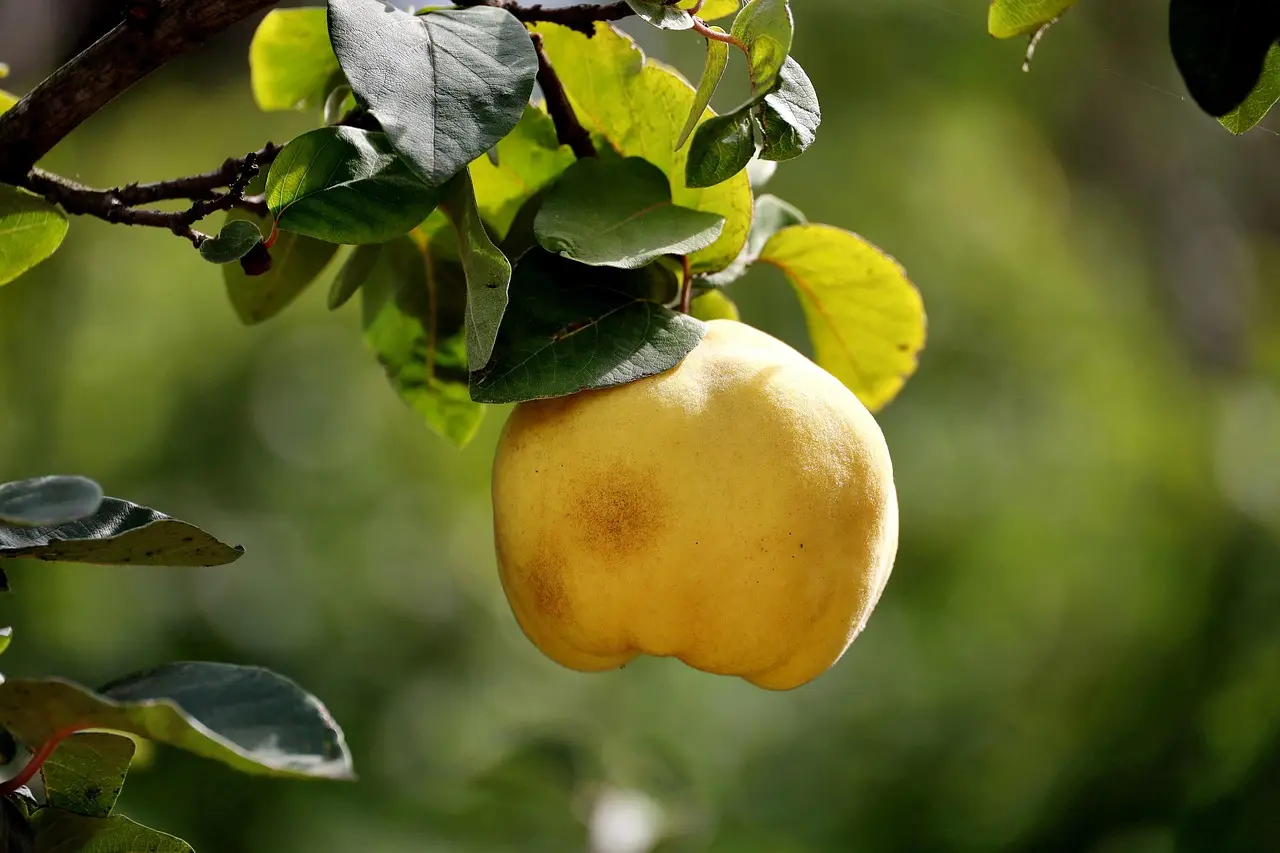
Bite a raw quince and you'll regret it: hard, stringy, sour. Leave one in the fruit bowl, though, and the whole room smells of honey and roses. Then cook it slowly with sugar and something like magic happens. The pale flesh turns pink, then deep ruby red 12. Quince (Cydonia oblonga) is the fruit that asks for patience and pays it back, and people have courted, married and celebrated with it for thousands of years.
Background
Quince is the only member of its genus, Cydonia, in the rose family, which makes it a cousin of apples and pears 1. The tree grows four to six metres tall, flowers white or pink in late spring and bears hard, aromatic, golden-yellow fruit shaped a bit like a pear 1.
It comes from the Hyrcanian forests south of the Caspian Sea, in Iran. Between about 5000 and 3000 BCE, Neolithic farmers carried it into Turkey, Azerbaijan and Central Asia, and from there it reached Europe, Russia, China and North Africa 1. The world grew about 687,000 tonnes in 2023, and Turkey and China together produced 44% of it 1.
That colour change is chemistry, not luck. Long cooking with sugar turns the flesh red because of pigments called anthocyanins 1.
History
The Greeks linked the fruit to Kydonia on Crete and called it the "Cydonian pome", which is where the botanical name comes from 13. Some ancient writers called quinces "golden apples", and they may be the real fruit behind the golden apples of Greek myth, including one of Hercules' labours 1.
The fruit also kept good company. Charlemagne ordered quinces planted in well-stocked orchards, and English records place quince trees at the Tower of London around 1275, under Edward I 1. Settlers took them to North America in the seventeenth century 1.
Quince even gave English a word. Portuguese marmelada, from marmelo (quince), first meant quince paste, then spread into other languages as a name for fruit preserves in general 1. So every jar of orange marmalade owes a small debt to the quince.
Customs, rules and rituals
A Greek wedding law. Plutarch records that Solon, the Athenian lawmaker, required a bride to eat a quince before being shut in a chamber with her new husband 4. Quince was sacred to Aphrodite, goddess of love, too. In one tale preserved by the poet Callimachus, a young man carves a vow onto a quince and rolls it to the girl he loves. She reads it aloud on the goddess's sacred ground and finds herself bound to marry him 1.
A tree for a baby. In parts of the Balkans, families plant a quince tree when a baby is born, as a sign of fertility, love and life 1.
A Spanish pairing. In Spain, dulce de membrillo, a firm quince paste, traditionally goes with Manchego cheese 1.
Place in human experience
Quince sits in a funny spot: loved for millennia, yet rarely eaten as it comes. It may be the most hands-on fruit we grow. Nobody grabs one for the school bag. You have to cook it, and so it has always been fruit for occasions: weddings, births, winter preserves, the cheese board.
It turns up in literature, too. In Edward Lear's 1870 poem The Owl and the Pussycat, the happy couple dine "on mince, and slices of quince" 1. Wedding food again, if you think about it.
In Australia, quince has stayed close to the families who brought it. A growers' fact sheet notes that Italian and Greek communities in southern Australia still cultivate it 5. One orchard, Quince HQ, says it grows all 16 known Australian varieties and sums the fruit up neatly: "Quince + sweetener + heat + time = heaven on a spoon" 3.
How to buy, store and use it
When. Quinces are an autumn fruit. Australian growers pick them from April to June, when the skin turns bright yellow and the fruit gives off a strong, unmistakable aroma 5.
Picking good ones. Look for golden-yellow skin rather than green, and give one a sniff; a ripe quince smells sweet and floral 5. Choose firm fruit without big soft patches. Try greengrocers, farmers' markets and the bigger supermarkets in autumn. Varieties you may see include Smyrna, with very large golden fruit; Champion, greenish-yellow and milder; and Angers, which keeps longer than the others 2.
Storing. Keep quinces in a cool, dark place, and they'll last two to three months 7. Lay them out so they don't touch, which helps prevent bruising 6.
Using. Raw quince is tough, stringy and tart, so cook it: stew, poach or simmer slowly until the flesh turns ruby red 2. Classic uses include quince paste (membrillo), quince poached in spiced syrup, jelly and jam, and quince roasted alongside meat 7. Cooked paste keeps for a year or more 7. Levantine cooks put quince in savoury dishes such as kibbeh safarjaliyeh 1.
Swaps. For a vegan roast, slow-roast quince wedges with root vegetables in place of meat. If you can't find quince, firm pears with a squeeze of lemon make a stand-in for poaching, though you won't get the ruby colour.
Sources
- "Quince", Wikipedia. https://en.wikipedia.org/wiki/Quince
- "Quince", Sustainable Gardening Australia. https://www.sgaonline.org.au/quince/
- Quince HQ, "Quince". https://www.quincehq.com.au/
- Plutarch, Life of Solon 20.3, trans. B. Perrin, LacusCurtius, University of Chicago. https://penelope.uchicago.edu/Thayer/E/Roman/Texts/Plutarch/Lives/Solon*.html
- "Quinces", The Fruit Tree Folk. https://fruittreefolk.com.au/quince/
- "How to grow a quince tree", Ultimate Backyard. https://ultimatebackyard.com.au/how-to-grow-a-quince-tree/
- "How to grow quince", Planting Season. https://www.plantingseason.com.au/grow/guides/how-to-grow-quince/