Radishes
Crisp, peppery and ready in weeks. Radishes fed pyramid builders, star in a Mexican Christmas carving contest and brighten any salad.
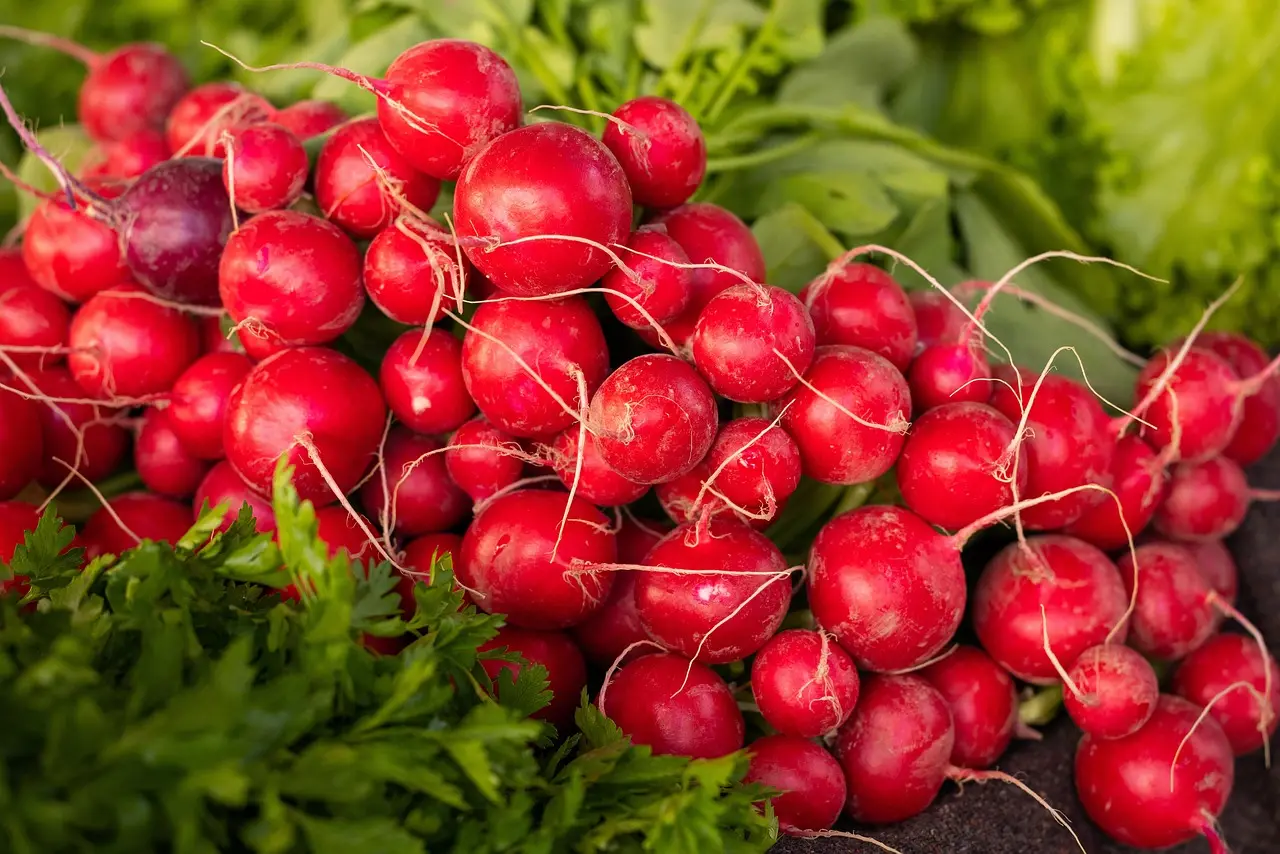
Crunch into a fresh radish and it bites back: cool and watery first, then a peppery kick up the nose. That kick is the same compound you get from mustard, horseradish and wasabi 1. Radishes (Raphanus sativus) are cheap, quick to grow and endlessly cheerful, from the little red globes in a salad to giant white daikon in a Korean kimchi jar. They've fed pyramid builders, they get carved into Christmas sculptures in Mexico, and they'll grow in a pot on your balcony faster than almost anything else.
Background
The radish belongs to the mustard family, Brassicaceae, alongside cabbage and broccoli 1. We mostly eat the swollen taproot, but the whole plant is edible: leaves, seed pods and seeds too 1.
That heat is clever plant defence. Radishes hold compounds called glucosinolates and an enzyme called myrosinase. When you chew, the two meet and make allyl isothiocyanate, the sharp stuff 1.
Radishes come in two broad groups. Small summer radishes, red, pink, purple or white, are best young; let them get too big and they turn tough, woody, hollow and harsh 2. Winter radishes, including white, black and green types, are meant to grow large, and daikon can reach about 45 centimetres long 2. Korean radish, mu, is shorter and stouter than daikon, with a pale green shoulder 1.
Raw radish is about 95% water, 3% carbohydrate and 1% protein, with almost no fat. A 100-gram serve has about 66 kilojoules and a moderate amount of vitamin C 1.
History
Nobody is quite sure where radishes began. Scientists tentatively point to Southeast Asia, where truly wild forms grow, with later centres in South Asia, central China and Central Asia 1. Written records start around the third century BC 1.
Then comes a famous claim. The Greek traveller Herodotus wrote that an inscription on the Great Pyramid recorded "sixteen hundred talents of silver" spent on radishes, onions and garlic for the workers 3. Treat it as a traveller's tale, but it's a lovely picture: a huge building project powered partly by radishes.
By the first century AD, Greek and Roman farm writers described many kinds: small, large, round, long, mild and sharp 1. In 1544 a German botanist reported radishes weighing 100 pounds. Today only Japan's Sakurajima radish gets anywhere near that size 1. The large, mild white radish developed in China, though Japanese farming and exports made "daikon" the name most of us know 1.
Customs, rules and rituals
The Night of the Radishes. Every 23 December, Oaxaca in Mexico holds Noche de los rábanos. Spanish friars brought radishes to Mexico, and carved radishes with religious themes became part of the city's Christmas market. The mayor, Francisco Vasconcelos, made it a formal competition in 1897 4. Carvers receive specially grown radishes on 18 December, some up to 50 centimetres long and three kilos in weight. With knives and toothpicks, they turn them into nativity scenes, buildings and scenes of Oaxacan life 4. More than 100 people compete, and visitors can queue four to five hours to see the entries 4.
Seven herbs in Japan. Daikon is one of the plants in nanakusa no sekku, the Festival of Seven Herbs, held on the seventh day of the new year 1.
A beer companion. In Germany, a spiral-cut radish called Radi is the classic partner to a beer at Oktoberfest 1.
Place in human experience
The radish is a working-person's vegetable, as the Herodotus story suggests. It grows fast, keeps well and costs little. In Mexico, sliced radish garnishes tostadas, sopes, enchiladas and pozole 1. In India, the seed pods, called moongra or mogri, go into their own dishes 1. In Korea, radish is a backbone of fermented foods, and even its greens, mucheong, get cooked as a vegetable 1.
It's also the gardener's first success. Seeds sprout in three or four days in warm, moist soil, and small varieties are ready in three to four weeks 1.
How to buy, store and use it
Picking good ones. Most supermarkets and greengrocers sell red radishes in bunches with the leaves on, and daikon by the piece, often near the Asian greens. Choose small to medium summer radishes; oversized ones can be woody, hollow and strong 2. Look for perky leaves.
Growing your own. In most Australian climates you can grow summer radishes all year. Sow winter types from late summer to early autumn, and sow every three or four weeks for a steady supply 5. Summer radishes take four to six weeks, winter radishes eight to ten 5. Pick them before they over-mature, or they turn woody and bitter 5.
Storing. Cut the leaves off before storing; left on, they draw moisture out of the roots 2. Summer radishes keep five to seven days in a plastic bag in the fridge, winter radishes up to two weeks. Store the greens separately and use them within two or three days 2.
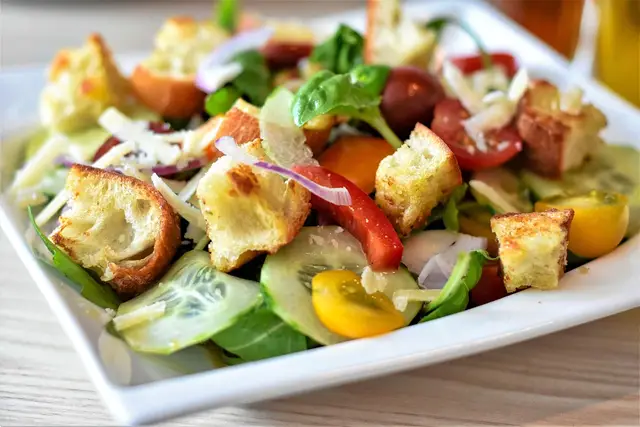
Using. Eat them raw in salads, or with butter and bread 1. Add the leaves to soups or sauté them 1. Roast or braise radishes for a mellow, juicy side. Grate daikon into dipping sauces, or pickle it.
Swaps. Out of radishes? Thinly sliced turnip gives a similar crunch, and a little horseradish or mustard brings back the bite.
Sources
- "Radish", Wikipedia. https://en.wikipedia.org/wiki/Radish
- "Radish", Home Vegetable Gardening, University of Illinois Extension. https://extension.illinois.edu/gardening/radish
- Herodotus, Histories 2.125, trans. A. D. Godley, Perseus Digital Library (Perseids). https://cts.perseids.org/read/greekLit/tlg0016/tlg001/perseus-eng2/2.125.6-2.125.7
- "Night of the Radishes", Wikipedia. https://en.wikipedia.org/wiki/Night_of_the_Radishes
- "How to grow radishes", Bunnings Australia. https://www.bunnings.com.au/diy-advice/garden/planting-and-growing/how-to-grow-radishes