
Rosehip
The bright red fruit a rose leaves behind. Rosehips make tea, syrup, jam and Swedish soup, and they grow wild across much of southern Australia.
After the roses finish, the bush has one more trick. The petals drop, and in their place swell small, glossy fruits in red and orange, sometimes dark purple or almost black 1. These are rosehips, and cooks have turned them into tea, syrup, jam, soup, wine and even a national soft drink 1. They're tangy, a little floral, and one of the few ingredients you might find growing free by a country roadside.
Background
A rosehip is the accessory fruit of the rose plant. It forms after the flowers are pollinated in spring and ripens from late summer into autumn 1. Most roses make hips, but a few species are famous for them: the dog rose (Rosa canina), with its long red hips; the beach rose (Rosa rugosa), with big, fleshy ones; and the sweet briar (Rosa rubiginosa) 12.
Inside each hip sit seeds wrapped in fine hairs. Those hairs irritate, and they've been used as itching powder, so they always come out before you eat 12.
Rosehips are known for vitamin C. Wild hips contain about 426 milligrams per 100 grams, along with carotenoids such as beta-carotene, lutein, zeaxanthin and lycopene 1.
History
The dog rose has a strange name. The Roman writer Pliny put it down to a belief that its root could cure the bite of a mad dog. Another theory says the hooked prickles look like a dog's teeth 3.
Rosehips had their big moment in the Second World War. With citrus imports cut off, British people gathered wild hips to make syrup, and a wartime saying went: "We are getting by on our hips and hops" 34. In the United States, dog roses went into victory gardens 3.
Australia met the sweet briar early. Settlers brought it in the early 1800s, possibly as early as 1803, as an ornamental, a hedge and a source of food 5. Birds, animals and water then spread its seeds far and wide 5.
Customs, rules and rituals
Sweden's rosehip soup. Swedes make nyponsoppa, a sweet soup of rosehips 1.
Hungary's brandy. Hungarians use rosehips in pálinka, the traditional fruit brandy 1.
Slovenia's soft drink. Rosehip is the central ingredient of Cockta, Slovenia's fruity national soft drink 1.
Shakespeare's eglantine. Sweet briar's old name is eglantine 4. Shakespeare named the eglantine among the flowers in A Midsummer Night's Dream, where it has been read as a sign of both pain and pleasure 3.
Place in human experience
Rosehips are a lesson in looking twice. To a gardener they're what's left when the show ends. To a wartime cook they were a vitamin store worth a day's picking. To a land manager in Australia they can be a headache.
Sweet briar now grows in every Australian state and territory except the Northern Territory. It's at its worst in cooler, wetter country: South Australia, Tasmania and the highlands of New South Wales and Victoria 5. It's declared noxious in the ACT, New South Wales, South Australia, Victoria and Western Australia 5. The dog rose is also listed as a weed in Australia, partly because its thickets shelter foxes 3. So the same plant that once fed a hungry Britain now crowds out native bush here. Pick the hips by all means, but never plant the seeds.
How to buy, store and use it
Where to find it. Fresh rosehips rarely turn up in shops. For dried rosehip tea, check the supermarket tea aisle or a health-food store. Or grow your own: rugosa roses and heritage varieties usually give better hips than modern hybrids 2.
Picking good ones. In most of Australia, hips ripen from late autumn into early winter. Wait for a light frost if you can, as the cold softens the fruit and brings out its sweetness 2. Snip firm, plump hips with a rich red or orange colour, and skip shrivelled or mouldy ones. Gloves help if you're collecting a lot 2. Only pick from plants you know haven't been sprayed.
Preparing. Get the hairs out. Either halve the hips and scrape out the seeds and hairs, or simmer them whole and strain the liquid well 2. A jelly bag or muslin catches the fine hairs.
Storing. Dry cleaned hips on trays in a dehydrator or a warm, airy spot out of direct sun. When they're fully dry and leathery, store them in airtight jars away from heat and light 2.
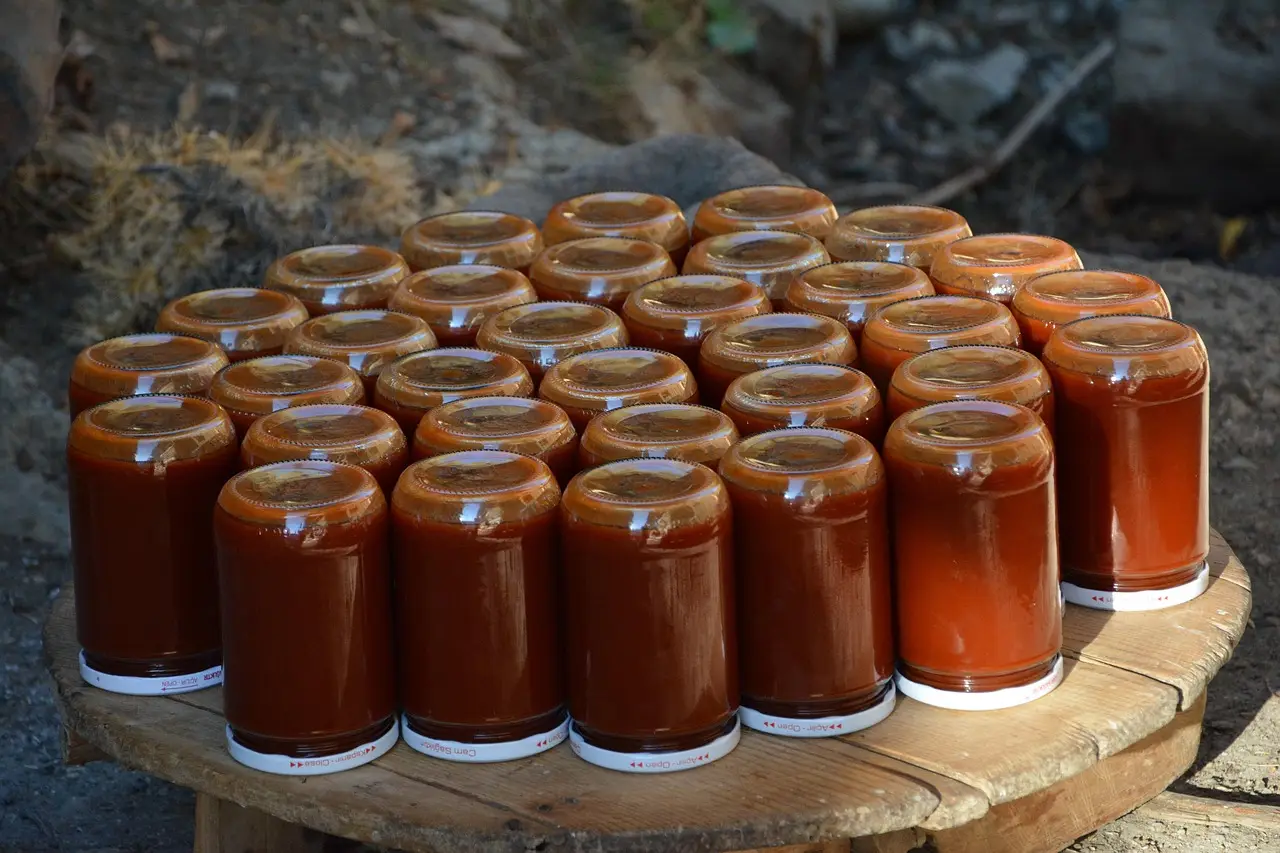
Using. Brew one to two tablespoons of dried hips per cup for tea 2. Simmer them into syrup, jelly or cordial, or steep them in vinegar 2. Rosehips also go into bread, pies, jam and wine 1.
Swaps. No rosehips? Hibiscus tea gives a similar tart, red cup. For jelly, crabapples or cranberries make a fine substitute.
Sources
- "Rose hip", Wikipedia. https://en.wikipedia.org/wiki/Rose_hip
- Kel Buckley, "Rosehips: how to harvest and use this superfood", Pip Magazine. https://pipmagazine.com.au/harvesting-and-using-rosehips/
- "Rosa canina", Wikipedia. https://en.wikipedia.org/wiki/Rosa_canina
- "Rosa rubiginosa", Wikipedia. https://en.wikipedia.org/wiki/Rosa_rubiginosa
- "Sweet briar", Weeds Australia, Centre for Invasive Species Solutions. https://weeds.org.au/profiles/sweet-briar/