Spinach
Spinach: from Persian gardens to Popeye's tin. Its history, customs and myths, plus how to buy, store and cook it in an Australian kitchen.
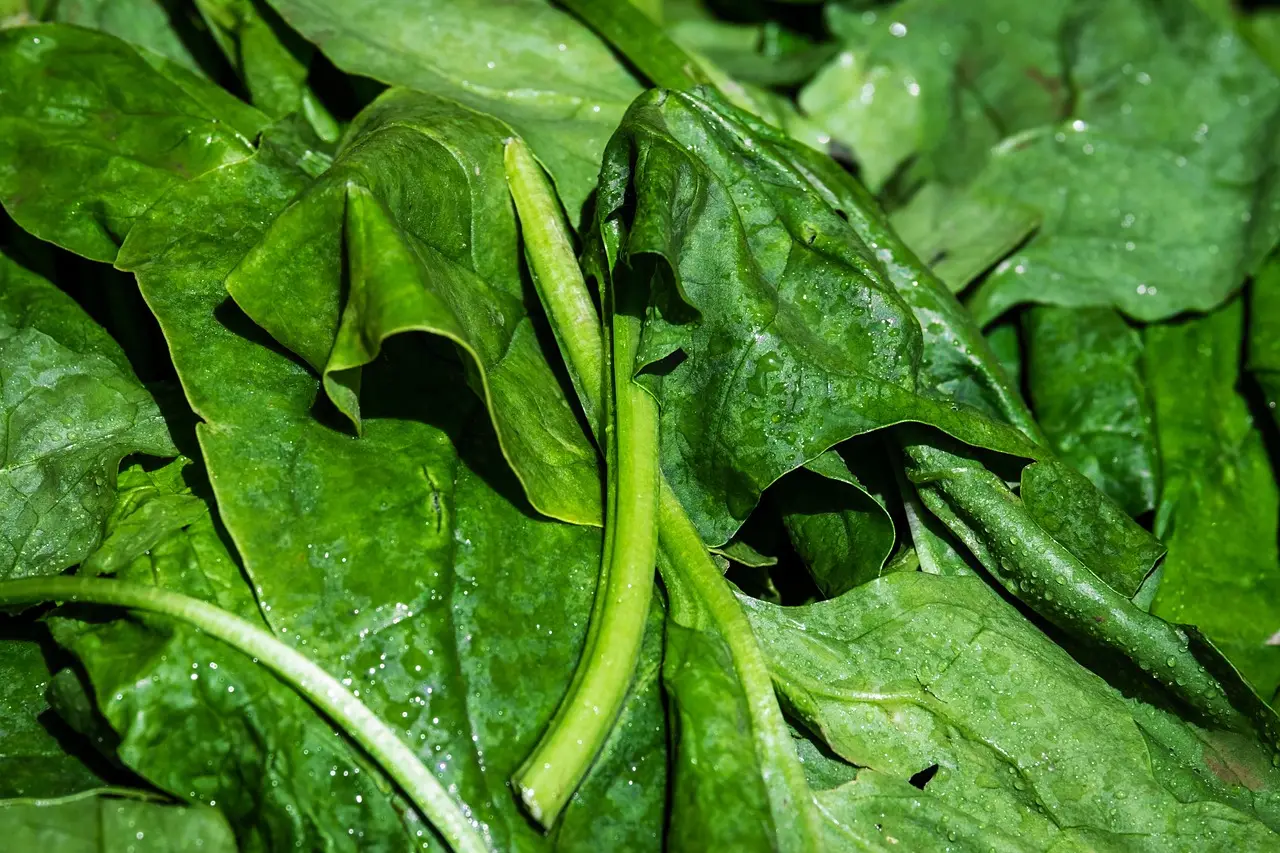
A whole bag of spinach goes into the pan and comes out as a handful. It's one of the great kitchen magic tricks. Spinach (Spinacia oleracea) started out in Iran and the Indian subcontinent around 2,000 years ago, travelled east to China and west to Spain, and ended up in a cartoon sailor's tin 14. Along the way it picked up a famous myth or two. Let's sort the leaf from the legend.
Background
Spinach belongs to the amaranth family 1. Raw, it's 91% water, 4% carbohydrate and 3% protein, with almost no fat and about 23 calories per 100 g 1. It's a rich source of vitamin K and a good source of vitamin A, folate, vitamin C and manganese 1.
China grows about 92% of the world's spinach: 28.3 million of the 31 million tonnes harvested in 2024 1.
Here in Australia, names get muddled. Silverbeet, or chard, often gets called "spinach", but it's actually the same species as beetroot 2. True spinach is the soft, small-leafed one, often sold as English spinach or baby spinach.
History
Spinach probably began in Iran and the Indian subcontinent, then reached China by way of Nepal 1. Arabs brought it to Sicily in 827 CE, and Arabic writers were documenting it around the Mediterranean by the tenth century 1. By the twelfth century it grew in Spain 1.
It reached England and France in the fourteenth century, probably via Spain, and caught on because it gave people something fresh and green in early spring, when little else grew 1. It turns up in The Forme of Cury, an English cookbook from 1390 1.
Now the myths. Ask anyone what "Florentine" means on a menu and they'll say spinach. The popular story says Catherine de' Medici brought her Florentine chefs, and her love of spinach, to Paris when she married Henry II in 1533 3. Food historians have debunked it; Italian influence on French cooking began well before that wedding 3.
Then there's Popeye. His strength first came from spinach in 1931, and the Fleischer Studios cartoons made the can of spinach his trademark 4. People came to believe spinach was unusually rich in iron. It isn't. Wikipedia's spinach entry calls that belief "an academic urban legend", and notes the 1932 comic credited Popeye's strength to vitamin A, not iron 1.
Customs, rules and rituals
- Greek Lent. Orthodox fasting rules out eggs and dairy, so cooks make nistisimi spinach pie: spinach, spring onions, dill, parsley, olive oil and flour, with no cheese or eggs 5.
- A queen's yoghurt. Borani-e esfenaj is a cold Persian salad of spinach and yoghurt. Legend says borani takes its name from the Sasanian queen Pourandokht, whose chef made her yoghurt dishes. Pourani became borani over time 6.
- Spinach and slang. A 1928 New Yorker cartoon gave English "I say it's spinach", meaning "I say it's nonsense" 1.
Place in human experience
Spinach earned its place in Europe as a hungry-season food, the first green thing on the table after winter 1. Centuries later, a cartoon turned it into a promise to children: eat this and you'll be strong. The iron claim fell apart, but the habit stuck.
Australia has its own spinach story. Warrigal greens, also called New Zealand spinach, grow wild here. Captain Cook recorded the plant, Joseph Banks took its seeds to Kew in the eighteenth century, and cooks use it just like spinach 7.
How to buy, store and use it
- Pick it. Look for perky, deep-green leaves with no yellowing or slimy patches. Bunched English spinach sits with the leafy greens; baby spinach comes in bags and tubs in the salad section of Coles, Woolworths and Aldi.
- Store it. Keep it in the crisper and use it within a few days. Fresh spinach loses much of its nutritional value if stored longer than that 1.
- Cook it. Cooking reduces oxalates, but heat breaks down vitamin C and folate leaches into the cooking water 1. A quick wilt keeps the most.
- Swap it. Silverbeet takes longer to cook but works in pies and curries 2. Warrigal greens work too; blanch the leaves for a minute and rinse them in cold water first to reduce their oxalates 7.
Sources
- "Spinach", Wikipedia. https://en.wikipedia.org/wiki/Spinach
- "Chard", Wikipedia. https://en.wikipedia.org/wiki/Chard
- "Florentine (culinary term)", Wikipedia. https://en.wikipedia.org/wiki/Florentine_(culinary_term)
- "Popeye", Wikipedia. https://en.wikipedia.org/wiki/Popeye
- "Spanakopita", Wikipedia. https://en.wikipedia.org/wiki/Spanakopita
- "Borani", Wikipedia. https://en.wikipedia.org/wiki/Borani
- "Tetragonia tetragonioides", Wikipedia. https://en.wikipedia.org/wiki/Tetragonia_tetragonioides