
Adobo
Ask ten Filipino families how to make adobo and you'll get eleven answers, and every one of them will be the right one. At heart it's simple: chicken or…
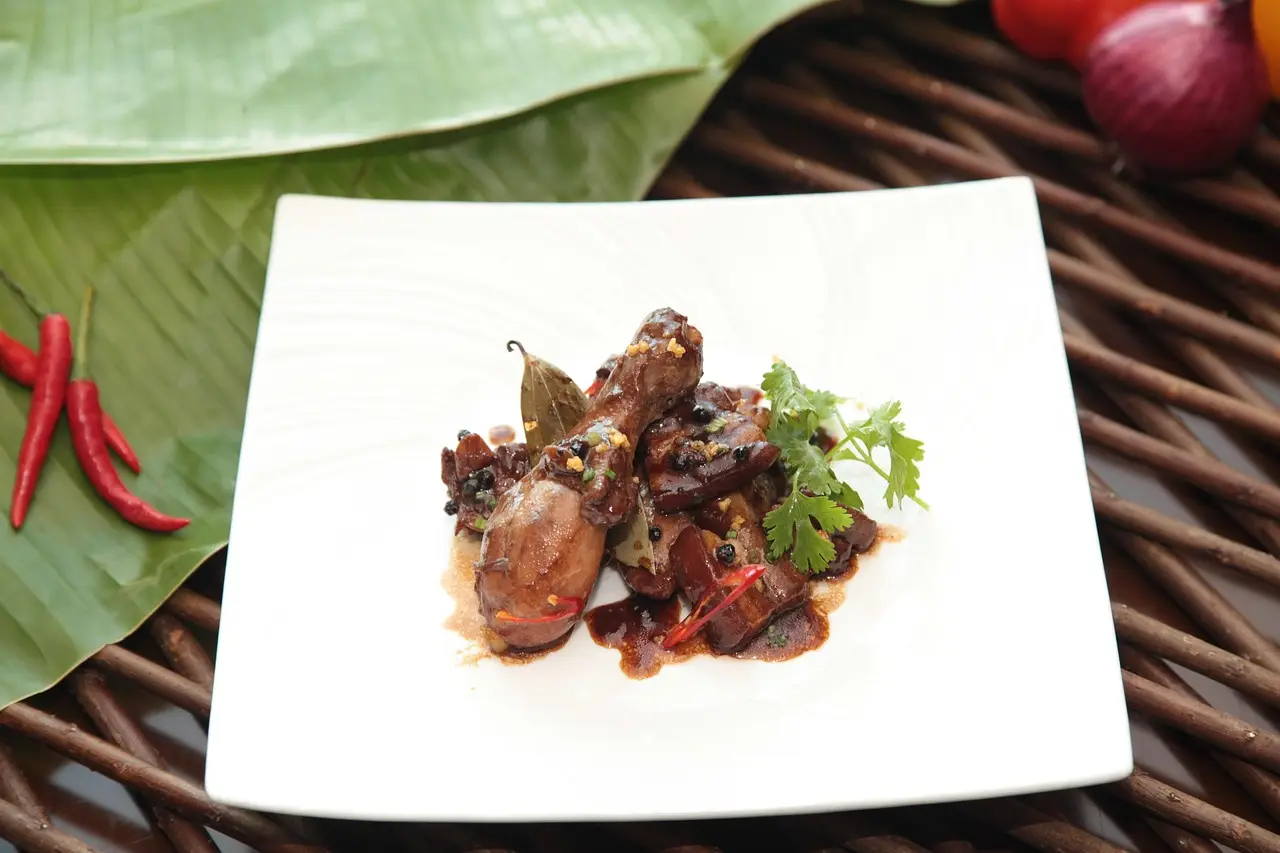
Ask ten Filipino families how to make adobo and you'll get eleven answers, and every one of them will be the right one. At heart it's simple: chicken or pork (or fish, or vegetables) simmered in vinegar with garlic, black pepper, bay leaves and usually soy sauce, until the sauce turns dark, glossy and sticky enough to chase round the plate with rice. Many Filipinos call it their unofficial national dish 1. The name is Spanish. The dish, as it turns out, is not.
Background
Adobo is a braise with a sour backbone. That first whiff of vinegar hitting a hot pan can make your eyes water, then it mellows into something round and savoury as it cooks down 1.
The vinegar isn't only there for flavour. It slows bacteria, so a pot of adobo keeps for days without a fridge. That made it the go-to food for travellers and anyone heading up into the mountains 1.
And the Philippines takes its vinegar seriously. Cooks make it from coconut sap, sugarcane, nipa palm and kaong palm, and every region has a favourite 1. Adobo has a whole family of sour cousins too: kinilaw (raw seafood "cooked" in vinegar), paksiw (meat or fish simmered in it) and sangkutsa (a quick first braise) 1.
History
Long before any Spanish ship turned up, people across the islands were preserving food with vinegar and salt, a smart move in tropical heat 1. The linguist Carl Rubino defines paksiw as fish or meat cooked in vinegar, garlic and salt. Sound familiar? Writer Sterling V. Herrera-Shaw argues paksiw is the original native name for the dish the Spanish later called adobo 2.
"Adobo" comes from the Spanish adobar, to marinate or season 1. Here's the telling detail: the word first shows up in the Philippines in a 1613 Tagalog dictionary by the friar Pedro de San Buenaventura, which mentions "adobo de los naturales", the adobo of the native people 1. In other words, the Spanish met a local dish and gave it a Spanish label. Food historian Raymond Sokolov read it exactly that way 1.
Not everyone tells it quite so neatly. The great Filipino food writer Doreen Fernandez wondered whether some Mexican influence crossed the Pacific on the galleon trade, though Filipino and Mexican adobos taste very different 1. Herrera-Shaw sees adobo as one of several Spanish names pasted over older Tagalog cooking: new words, same pots 2.
Then came soy sauce, a gift from Chinese cooks and traders. It's what makes most adobo dark and salty today, and it's the clearest thing separating Filipino adobo from the Spanish and Latin American dishes that share the name 1.
Customs, rules and rituals
There's no single recipe, and nobody wants one. A few you might meet 1:
- Adobong puti, "white adobo": salt instead of soy sauce. Herrera-Shaw calls it paksiw in its plainest, oldest form 2.
- Adobong itim: the soy sauce version, and the one most people picture.
- Adobo sa gata: finished with coconut milk, from Bicol and Zamboanga.
- Adobong dilaw: golden with turmeric, from Batangas and Laguna.
- Local specials, like Cavite's version enriched with pork liver.
It's a Tuesday dinner and a party dish at once 1. And because the method works just as well with chicken, fish or vegetables as with pork, families who don't eat pork keep the dish and simply change what goes in the pot 1. Chef Claude Tayag's 2024 book even includes a jackfruit adobo for vegetarians 4.
Now for the funniest chapter. In 2021 the Department of Trade and Industry set up a technical committee to write an official national standard for adobo, working from the guidebook Kulinarya 3. The internet did not take it well. The department quickly explained it was voluntary and only for promoting Filipino food abroad, because there are "thousands or millions" of ways to cook adobo, and "to many Filipinos, the best adobo is the one 'cooked at home'" by a parent or lola 3.
Place in human experience
That 2021 uproar says it all. A government office tried to write down the correct adobo, and a whole country pointed to their mum's kitchen. Tayag puts it best: "the only correct way to cook adobo… is the one you grew up with" 4.
So adobo is less a recipe than a memory: one particular kitchen, one particular vinegar, one particular person stirring the pot.
It also carries a quiet argument about history. Calling it "adobo" uses the coloniser's word; calling it "paksiw" claims it back 2. Herrera-Shaw uses dishes like this to argue that Filipino food stayed Asian at its core through three centuries of Spanish rule, and that Spain mostly contributed the names 2. Tayag frames adobo as a proudly Filipino gift to the world's table, built on vinegar-and-salt know-how the islands had all along 4.
It travels, too. The ingredients are cheap and the method forgiving, so adobo goes wherever Filipinos go. Tayag's longest chapter tours Filipino restaurants abroad and their own spins on the dish, still unmistakably adobo, still changing 4.
Sources
- "Philippine adobo", Wikipedia (citing San Buenaventura's 1613 Vocabulario de la lengua tagala, Raymond Sokolov, Doreen G. Fernandez's Tikim, and Pia Lim-Castillo in the Oxford Symposium on Food and Cookery 2005 proceedings). https://en.wikipedia.org/wiki/Philippine_adobo
- Sterling V. Herrera-Shaw, "Adobo is 'paksiw,' and other terms in Filipino food history", Philippine Daily Inquirer via Asia News Network, 30 August 2024. https://asianews.network/adobo-is-paksiw-and-other-terms-in-filipino-food-history/
- "Proposed 'adobo standard' only for int'l marketing, DTI clarifies", Edge Davao (Philippine News Agency report), July 2021. https://edgedavao.net/the-economy/2021/07/proposes-adobo-standard-only-for-intl-marketing-dti-clarifies
- R.C. Ladrido, "Being Filipino: What's your adobo story?" (review of Claude Tayag, The Ultimate Filipino Adobo, Anvil, 2024), Vera Files, 14 June 2024. https://verafiles.org/articles/being-filipino-whats-your-adobo-story