Baklava
Listen to a fresh tray of baklava when the cold syrup hits the hot pastry: it crackles and hisses like rain on a tin roof. Then comes the bite, dozens of…
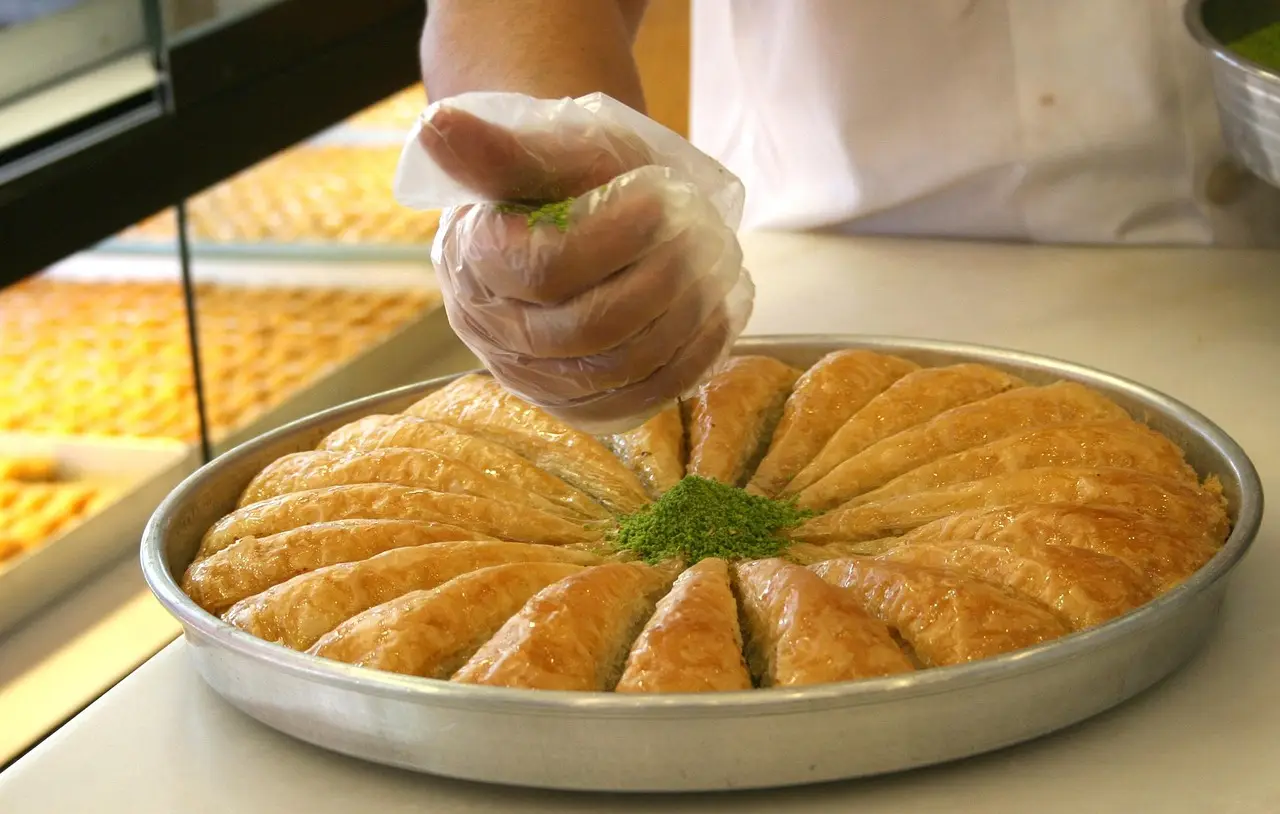
Listen to a fresh tray of baklava when the cold syrup hits the hot pastry: it crackles and hisses like rain on a tin roof. Then comes the bite, dozens of buttery, paper-thin sheets shattering over a layer of pistachio or walnut, all of it sticky with honey or syrup. Turkey, Greece, the Levant, the Balkans, Armenia and North Africa all make it, and more than one of them insists it's theirs 12. What we know for sure: the version we love took shape in the kitchens of the Ottoman sultans, and it still turns up wherever there's a feast to mark, from the end of Ramadan to Greek Easter 234.
Background
You only need four things: thin dough (yufka in Turkish, filo in Greek), butter, nuts and something sweet to soak it. The nut tells you where you are. Chef and researcher Bethany Kehdy says pistachio rules in Anatolia and the Levant, walnut in the Caucasus, and almond in North Africa 5. At Turkish holiday time, trays come with hazelnut, walnut or pistachio 6.
One town has its baklava protected by law. In December 2013 the European Commission registered "Antep Baklavası", or "Gaziantep Baklavası", as a Protected Geographical Indication, the first Turkish product to get EU protection 7. The rules tie it to the local Antep pistachio, which gives the bottom of each piece its deep green colour 7.
History
Here's the fun part: nobody can prove where baklava started, so everyone has a theory.
The nomad theory. Food historian Charles Perry places its birth somewhere between the Turkic nomads of Central Asia and the Iranian world. The nomads already made layered breads. When they met Persian sweet nut fillings, they adapted their layering to settled people's ovens 51.
The Greek theory. Ancient Greeks baked plakous, a flat, layered honey dessert, and Byzantine historian Speros Vryonis called the Byzantine pastry koptoplakous "the same as" Turkish baklava 1. A recipe from ancient Crete for gastris, made with sesame, poppy seed, pepper and a grape-must syrup, sometimes gets nominated too 4.
The wild cards. A tenth-century Baghdad cookbook describes lauzinaj, almond paste wrapped in very thin pastry and soaked in syrup, though Perry judged it "not much like baklava" 1. And a Chinese court cookbook from 1330 records a layered pastry called güllach 4.
The Ottoman evidence. This is where the paper trail firms up. The first written mention of baklava by name is a fifteenth-century poem by the Sufi dervish Kaygusuz Abdal, who enjoyed his filled with almonds, or lentils 3. A kitchen register from Istanbul's Topkapı Palace, dated 1474 under Sultan Mehmed II, shows 41-layer baklava made every day of Ramadan. The palace baklava team couldn't keep up, so extra trays were farmed out to home bakers 3. Kehdy sums it up as "a product of Ottoman culinary synthesis" 5, and Perry thinks the paper-thin version was perfected in Istanbul to please the sultans 5.
From there it spread. Probate records from the late 1400s onward list copper baklava trays in ordinary middle-class homes 3. By 1650 it had reached English print, when Robert Withers reported that the sultan finished his meal with "bocklava" 3. In Gaziantep, local lore says pistachio baklava arrived in 1871 with Çelebi Güllü, who learned it from a cook in Damascus 1.
Customs, rules and rituals
The Baklava Procession. Picture this. On the fifteenth of Ramadan every year, the sultan's Janissary soldiers in Istanbul marched to the palace and carried away trays of baklava, a gift from the sultan himself. The Baklava Alayı ran until 1826 23.
The Sugar Feast. Baklava is still one of the most eaten sweets of Ramazan Bayramı, the festival that ends the month of fasting. Turks also call it Şeker Bayramı, the Sugar Feast 6. Families dress in new clothes, go to early prayers, then visit relatives, who greet them with cologne, sweets and food. One folk story says the holiday's name slid from şükür, "thanks", to şeker, "sugar" 6.
Easter, Christmas and the Jewish new year. Baklava also shows up at Greek Orthodox Easter and Christmas, and at Purim and Rosh Hashanah 24. For Rosh Hashanah, Sephardic cooks use blanched almonds to keep it pale, so the year ahead will be "sweet and bright", and steer clear of dark desserts 24.
Counting layers. Greek cooks often use 33 sheets of filo, one for each year of Christ's life. Some Armenian cooks use 40, for the days of Lent 1. And not everyone brushes butter on each sheet: some pour hot olive oil over the lot 4.
Place in human experience
Baklava has always sat close to power. A sultan handing his soldiers trays of pastry is generosity and politics in one parade 23. Poets got carried away too. The sixteenth-century poet Nazmi of Edirne called it a jewel and the "sultan" of Ramadan meals 3. Traveller Evliya Çelebi swore in 1659 that wedding baklava in Belgrade came the size of cartwheels, with a thousand layers each. Nobody believes him, but you get the point: baklava meant celebration 3.
Those copper trays in ordinary homes tell another story, of a palace luxury moving down the social ladder 3. At bayram, a tray still sits ready for every visitor 6.
And then there's the argument. Because baklava crossed so many borders, Greeks, Turks, Armenians, Arabs and Balkan peoples each claim it, and the debate never quite ends 12. Kehdy's take is generous: baklava grew out of exchange between empires, not one nation 5. Even the EU ruling doesn't settle it. It protects how one town makes baklava, not who made it first 7.
So bake it however your family does. Thin dough, good nuts, cold syrup on hot pastry, and a bit of patience. You're in excellent company.
Sources
- "Baklava", Wikipedia, https://en.wikipedia.org/wiki/Baklava
- "Biting into baklava's sweet, yet controversial history", SBS Food, https://www.sbs.com.au/food/article/biting-into-baklavas-sweet-yet-controversial-history/6bb5ifm2d
- "Deconstructing baklava, a Turkish classic", National Geographic, https://www.nationalgeographic.com/travel/article/deconstructing-baklava-turkish-classic
- "Baklava", New World Encyclopedia, https://www.newworldencyclopedia.org/entry/Baklava
- "Where Exactly Does Baklava Come From?", Tasting Table, https://www.tastingtable.com/1877517/baklava-dessert-origin/
- "Ramadan Bayram: An Eid of traditions, festivities, sweets in Türkiye", Daily Sabah, https://www.dailysabah.com/life/religion/ramadan-bayram-an-eid-of-traditions-festivities-sweets-in-turkiye/amp
- "Turkish baklava, Wensleydale cheese and Santorini tomatoes gain EU protected status", FoodNavigator, https://www.foodnavigator.com/Article/2013/12/20/Turkish-baklava-Wensleydale-cheese-and-Santorini-tomatoes-gain-EU-protected-status