
Bánh mì
Snap the crust of a good bánh mì and it shatters, showering crumbs down your shirt, while the inside stays soft as a cloud. Then come the layers: a swipe…
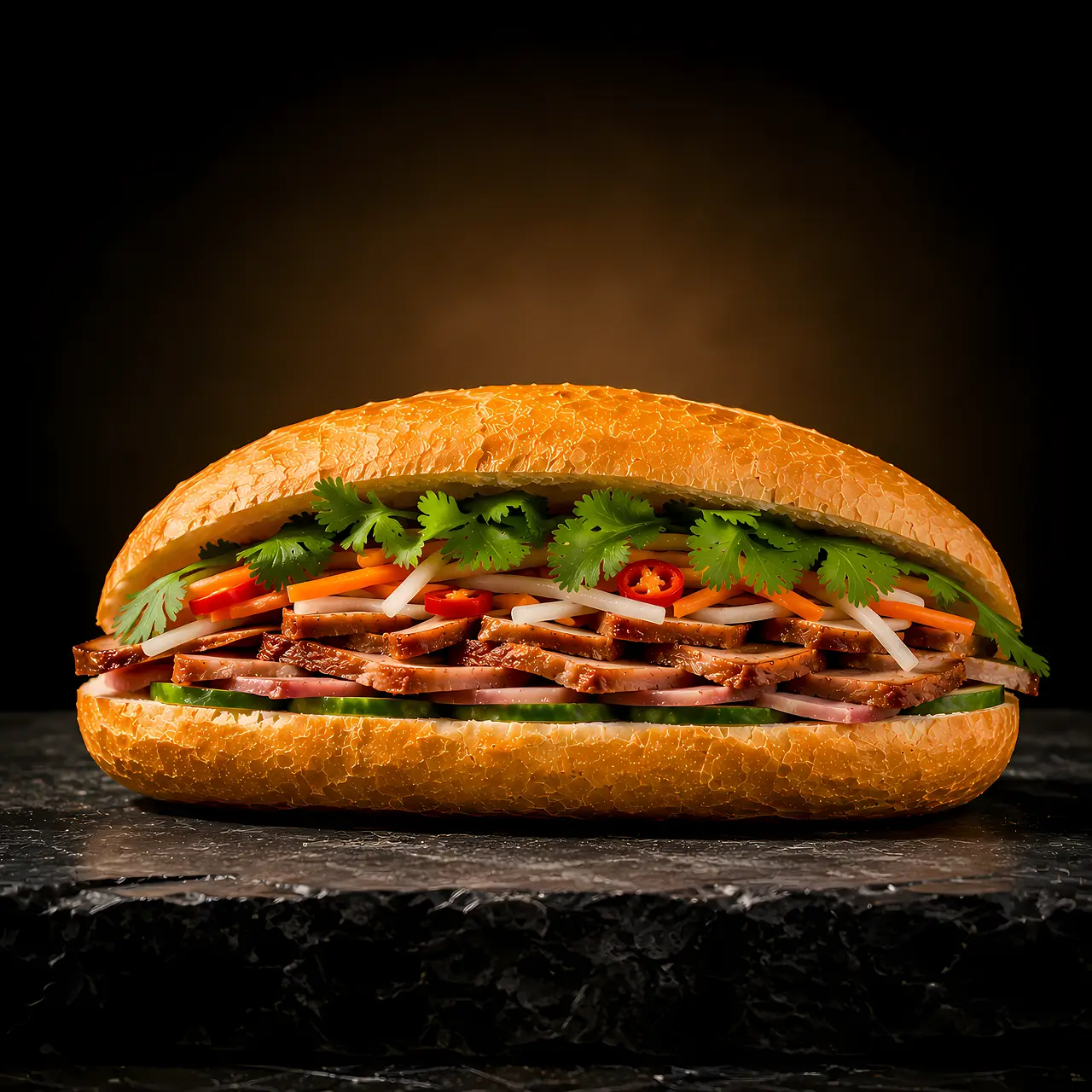
Snap the crust of a good bánh mì and it shatters, showering crumbs down your shirt, while the inside stays soft as a cloud. Then come the layers: a swipe of mayonnaise, a few drops of Maggi, pork or pâté or tofu, tangy pickled carrot and daikon, cool cucumber, a fistful of coriander and a slice of chilli if you're brave. It's Vietnam's street sandwich, built on a French loaf and filled with Vietnamese flavour, and somehow it tells the whole story of the country's last 150 years in one lunch 123.
Background
The name is simple. Bánh covers breads and cakes, and mì means wheat, so bánh mì just means wheat bread. You may hear that it comes from the French pain de mie. It doesn't: Vietnamese cooks used the word bánh for rice cakes centuries before any French baker arrived 1. The word shows up in print as early as Jean-Louis Taberd's 1838 dictionary 1.
In Vietnam, "bánh mì" means the bread itself as much as the sandwich. The loaf has a thin, crackly crust and an airy white crumb, and some bakers mix rice flour into the wheat 1. People mostly eat it for breakfast or as a snack, bought from a street stall or a cart 1.
History
The French bring bread. France began its conquest of the region in the mid-1800s, and colonial life needed baguettes. Wheat flour came in, bakeries opened, and Vietnamese bakers learned to turn out crusty loaves in tropical heat 13. Northerners called the new bread bánh tây, "Western bread"; southerners said bánh mì 1.
A war in Europe changes the menu. For years, French food and Vietnamese food stayed in separate worlds. The First World War broke that wall. Colonists left for the front, French goods got cheaper, and local cooks started making their own take on the casse-croûte, a baguette eaten with cold cuts, cheese and butter 2. Wheat shipments faltered too, and bakers began stretching flour with rice flour, which made the bread lighter and more affordable 15.
1954: the sandwich we know is born. After the war against France ended in 1954, the country split in two, and over a million northerners moved south to Saigon 1. Private business was banned in the north, so the sandwich's next chapter played out in the south 2. Two of those migrants, Lê Minh Ngọc and Nguyễn Thị Tịnh, opened a small bakery called Hòa Mã, one of the first shops to sell bánh mì thịt, in 1958 1. The Hòa Mã cooks made it cheaper by shortening the loaf and swapping some of the pricey cold cuts for vegetables, which put it in reach of working people 2.
So did the rice flour go in during World War One, or in the lean 1950s? Sources tell it both ways 15. Either way, by the late 1950s Saigon had a sandwich of its own 2.
1975: the sandwich leaves home. After the war with the United States ended, Vietnamese refugees carried bánh mì to Europe, North America and Australia 12. In California, brothers Chieu and Henry Le ran a catering business from 1982, and their parents soon started selling bánh mì near San Jose State University. That became Lee's Sandwiches, now more than 60 shops across the United States 4.
Fame. The Oxford English Dictionary added "bánh mì" on 24 March 2011, and Google marked the same date with a Doodle in 2020 1.
Customs, rules and rituals
There's a proper way to build one. Cookbook author Andrea Nguyen lays it out: warm the roll so the crust crisps and the inside stays soft, let it cool a moment, spread mayonnaise right to the edges, splash on Maggi seasoning, add the protein, then pickles, cucumber, chilli and herbs 3.
The north and south do it differently. Nguyen says northern bánh mì tended to be plain, perhaps meat with salt and pepper. In the south, "they lived large", piling on herbs, pickles and anything from chicken to seafood to pâté 3.
A few classics to look for 1:
- Bánh mì thịt: cold cuts, pâté and pickles, the everyday hero.
- Bánh mì xíu mại: soft pork meatballs in tomato sauce.
- Bánh mì ốp la: fried eggs, a breakfast favourite.
- Bánh mì chay: vegetarian, built on tofu.
Nguyen encourages riffing: soy sauce for Maggi, no coriander if you hate it, last night's roast or a slab of tofu in place of pork 3. That flexibility lets vegetarians, and anyone avoiding pork, join in.
Make it at home
A great bánh mì comes down to a few fresh parts. A crusty baguette from your local bakery works fine. The Vietnamese loaf is shorter, with a thin, crackly crust and an airy middle; some bakers mix rice flour into the wheat to get it.
- Protein: thinly sliced lemongrass pork, crispy roast pork belly, seasoned chicken, or mushrooms or tofu (sorry, Asher).
- Spreads: chicken liver pâté on one side, egg-yolk mayonnaise on the other. Kewpie is perfect. Or stir a little sriracha into the mayo.
- Quick pickles (đồ chua): matchsticks of carrot and daikon, soaked for at least 30 minutes in vinegar, water, sugar and a pinch of salt, boiled together and cooled.
- Fresh finish: long cucumber spears, coriander sprigs, sliced chilli, and a few dashes of Maggi seasoning or soy sauce.
Skip the filling altogether and bánh mì is still a daily staple in Vietnam: dunked in beef stew (bánh mì bò kho) or eaten plain.
Place in human experience
Bánh mì is a colonial story with a happy ending for the eater. Food writer Mina Holland calls it a reminder of Vietnam's imperial past, joining the coloniser's bread to the fillings of the colonised 5. NPR puts it more cheerfully: whatever Vietnamese think of French rule, most agree the baguette was a good thing to inherit 3.
It's also a story of ordinary people. The 1950s bakers who trimmed the loaf and stuffed it with vegetables turned a French snack for the comfortable into a working person's breakfast 2.
And it's a refugee story. Andrea Nguyen's family fled Saigon in 1975 and settled in Southern California. At first they bought cheap commercial bánh mì from immigrant-run shops, until her mother, Tuet Ti, called it: "Tien nao cua nay", you get what you pay for. From then on they made their own 3. Plenty of families will know that feeling: the taste of home is close, but not quite right, so you roll up your sleeves.
Today chains bet on it and food magazines put it on covers 34. Yet the best bánh mì still comes from someone who cares about the crunch.
Sources
- "Bánh mì", Wikipedia, https://en.wikipedia.org/wiki/B%C3%A1nh_m%C3%AC
- "The Saga of the Bánh Mì", Saigoneer, https://www.saigoneer.com/saigon-food-culture/7336-how-the-bánh-mì-became-world-famous
- "'The Banh Mi Handbook': A Guide To A Viet-French Sandwich", NPR Code Switch, https://www.npr.org/sections/codeswitch/2014/11/29/366611344/the-banh-mi-handbook-a-guide-to-a-viet-french-sandwich
- "The California Sandwich Chain With A Vietnamese Twist", Chowhound, https://chowhound.com/1772233/lees-sandwich-chain-vietnamese-california
- "How French colonisation of Vietnam led to the birth of banh mi", Kajo Magazine, https://kajomag.com/how-french-colonisation-of-vietnam-led-to-the-birth-of-banh-mi/