
Bibimbap
A bowl of warm rice, a ring of bright vegetables, maybe some beef, an egg on top and a dollop of red chilli paste. It looks too pretty to wreck, and then…
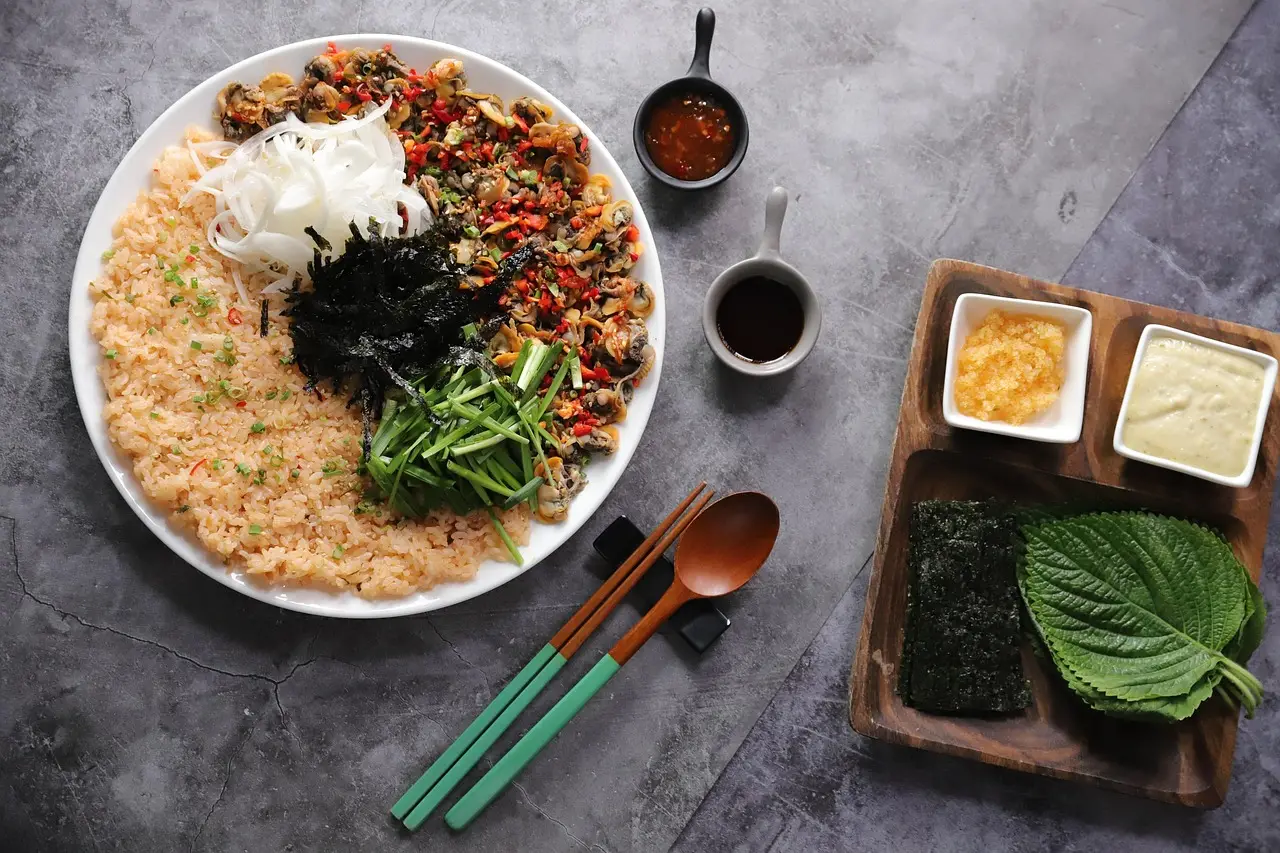
A bowl of warm rice, a ring of bright vegetables, maybe some beef, an egg on top and a dollop of red chilli paste. It looks too pretty to wreck, and then you wreck it: you stir everything together and eat. That's bibimbap, Korean mixed rice. The name says exactly what it is, bibim for "mixing" and bap for cooked rice 1. It started as a smart way to use up what was in the kitchen, and in a 2007 Korean government survey it beat a dozen rivals as the country's finest dish 3.
Background
Bibimbap runs on loose principles, not a strict recipe. Cooks aim for five tastes, salty, sweet, hot, sour and bitter, and often for obangsaek, the five traditional colours: red, green or blue, yellow, white and black. In Korean tradition those colours line up with the five elements, the compass points and even the organs of the body 2. So that carrot, spinach, egg yolk, bean sprout and dark mushroom aren't just pretty. They're a small map of the world.
Every region has its own spin 2:
- Jeonju cooks the rice in beef bone broth and can pile on around 30 ingredients, served in a hot brass bowl.
- Jinju adds yukhoe, raw seasoned beef 1.
- Tongyeong brings seaweed, shrimp and clams.
- Mountain villages use foraged greens and barley, no meat.
- Coastal towns top the rice with raw fish and a sweet-sour chilli dressing.
And the sizzling stone-bowl version, dolsot bibimbap, with its crunchy rice crust? Stone pots for cooking rice go back centuries 2, but as a restaurant dish it's younger than you'd think. Wikipedia credits Namgung Seong of Jeonju's Jungang Hoegwan restaurant with creating it in 1969 1.
History
Nobody knows who mixed the first bowl, and Korea has several good stories.
The ancestors' leftovers. After jesa, the Confucian rites honouring ancestors, families shared the offerings, and mixing them into rice made one easy meal. A related idea: after outdoor rites to mountain or village spirits, people had few pots and bowls with them, so everything went into one 12.
The new year clear-out. A dish called goldongban mixed rice with pantry leftovers so a household could empty its stores before the lunar new year 25. A fresh start, and nothing wasted.
The harvest field. One big mixed bowl fed a crowd of farm workers fast. National Geographic says this may go back to the late Goryeo dynasty (918–1392) 2.
The king's snack. Other accounts say it was served to the king as a light lunch 1.
The paper trail is clearer. A dish called hondon-ban shows up in 1590 in notes by the scholar Bak Dongnyang. Goldong-ban appears in 17th- and 18th-century writing, and an early Korean-script name close to today's appears in an 1810 encyclopedia. The first known recipe, for bubimbap, sits in an anonymous late Joseon cookbook called Siuijeonseo 12.
Jinju has a dramatic legend of its own, linking its bibimbap to the Japanese invasions of the 1590s and the battles for Jinju castle 1. It's a great story. It's also a legend, so enjoy it with a pinch of salt.
Then bibimbap took to the skies. Korean Air started serving it on flights in the late 1990s and won the Mercury Award from the International Flight Catering Association for it; sources disagree on whether that was 1997 or 1998 35. Jeonju began promoting its version abroad in 2000, and instant bibimbap hit the shelves in 2002 3.
Customs, rules and rituals
There's one rule: mix before you eat. Koreans traditionally stir and eat bibimbap with a spoon, so every mouthful gets a bit of everything 2. Picking out just the egg is missing the point.
Ritual still lives in some bowls. In Andong, a centre of Korean Confucian learning, there's heotjesatbap, "mock ancestral-rite rice". It looks like rite food, with vegetables, fish and pancakes over rice, but it's seasoned with soy sauce rather than chilli paste. The story goes that Joseon-era scholars made rite-style food to eat themselves, because real offerings got dusted with incense ash and couldn't be eaten. Students reportedly enjoyed it as a late-night study snack 4. Cramming food, Joseon style.
Across all these versions, the job is the same: turn lots of little dishes into one meal everybody can share 125.
Place in human experience
Bibimbap is a bowl full of ideas about balance. Its colours and tastes follow a way of seeing the world that's older than the dish, and stirring them together puts every ingredient on equal footing 2. Jeonju leans into that: mayor Song Ha-jin once said the city wanted bibimbap to be "a truly global dish that transcends borders and races", and the city planned to fund cultural work on themes of unity 3.
It's also a lovely example of thrift turning into pride. A dish born from leftovers, small kitchens and not enough bowls is now a patented regional product, the star of Jeonju's food festival and an airline's signature meal 235. For plenty of people, it's their very first taste of Korea.
Korean home cooks tend to treat recipes as suggestions. One saying, shared in a university cookbook project, holds that Korean food "is made by the eyes, hands, tongue, and nose" 5. Bibimbap fits that perfectly. No two family bowls look alike, and that's the whole charm.
Sources
- "Bibimbap", Wikipedia, https://en.wikipedia.org/wiki/Bibimbap
- "Bibimbap: Korea's famous dish", National Geographic Traveller, https://www.nationalgeographic.com/travel/article/bibimbap-koreas-famous-dish
- "The secret is in the mix", Korea JoongAng Daily, https://www.koreajoongangdaily.com/korea/the-secret-is-in-the-mix/11064215
- "Heotjesatbap", Wikipedia, https://en.wikipedia.org/wiki/Heotjesatbap
- Rick McBride, "Bibimbap story", Humanities Cookbook, Brigham Young University, https://humcookbook.byu.edu/bibimbap-story