Enchiladas
Take a corn tortilla, give it a bath in chilli sauce, wrap it round something good and you have an enchilada. The name says exactly that: it comes from…
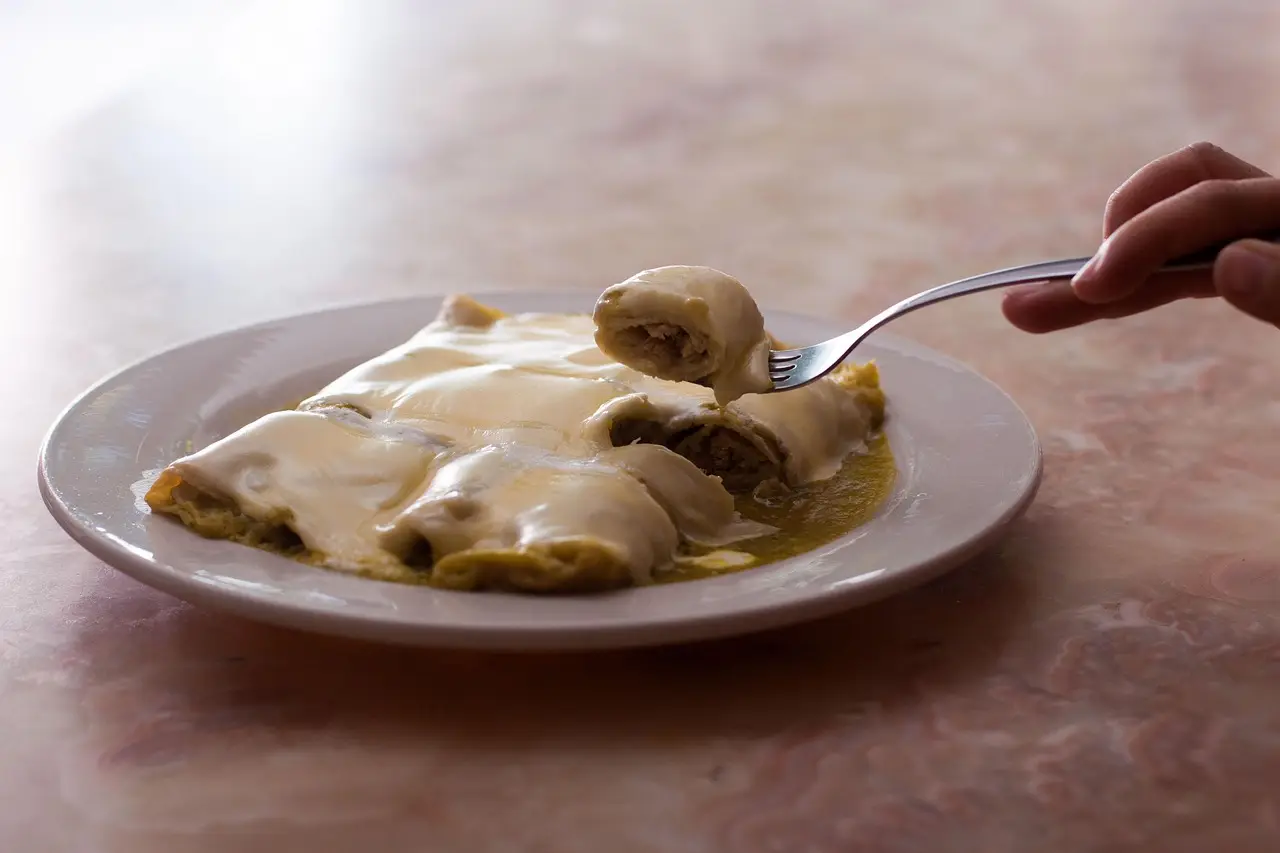
Take a corn tortilla, give it a bath in chilli sauce, wrap it round something good and you have an enchilada. The name says exactly that: it comes from the Mexican Spanish verb enchilar, "to add chilli to" 1. Behind that simple idea sits one of the oldest habits in the Americas, rolling food in maize flatbread, plus a few centuries of Spanish cheese, Swiss cream and Texan gravy layered on top.
Background
Spain's Royal Academy defines an enchilada as a rolled maize tortilla stuffed with meat and covered with tomato and chilli sauce 1. In practice, Mexico treats that definition as a starting point. Michoacán piles on chicken, fried potatoes and crumbly Cotija cheese; San Luis Potosí works chilli straight into the masa so the tortillas blush red; Querétaro tops them with diced fried potato and carrot; Oaxaca reaches for an orange mole; Sinaloa makes a version "del suelo"; and Colima even has a sweet enchilada with piloncillo sugar and raisins 2.
Then there are the sauce families: verdes in green salsa with poached chicken and fresh cheese, enmoladas drowned in mole, and suizas in a creamy white sauce 1.
Underneath every one of them is the tortilla. UNESCO, which listed traditional Mexican cuisine as world heritage in 2010, describes maize, beans and chilli as its foundation and singles out nixtamalisation, cooking corn with lime, as an ancestral technique that lifts its nutritional value 4.
History
Rolling things in tortillas is ancient. People around the lakes of the Valley of Mexico wrapped corn tortillas round small fish 1. Spanish Wikipedia's account adds that Maya cooks in Yucatán dipped tortillas in a pumpkin-seed sauce, rolled them round hard-boiled egg and covered them in tomato sauce, a dish it traces to the Preclassic period 2. The Nahuatl word recorded in the Florentine Codex, chīllapītzalli, joins the words for chilli and flute, a fair description of a rolled tortilla 12.
When Bernal Díaz del Castillo, one of Hernán Cortés's soldiers, described a feast Cortés held at Coyoacán, he mentioned foods served in corn tortillas 1. Spanish accounts also record rolled tortillas from Díaz's arrival in Tenochtitlán in 1519 2.
The word "enchilada" itself shows up in print in Mexico's first published cookbook, El cocinero mexicano, in 1831, and again in Mariano Galván Rivera's Diccionario de cocina in 1845 12. Those books belong to the nineteenth century's push to write Mexican cooking down 1.
North of the border the dish kept changing. Folklorist Joe S. Graham, writing for the Texas State Historical Association, explains that Tex-Mex grew from Native American and Spanish cooking meeting, with Spain bringing wheat, cattle, pigs, goats and sheep 3. Even within Texas, enchiladas split: West Texas cooks lay them flat, closer to New Mexico, while South Texas rolls them 3. In New Mexico, enchiladas montadas stack the tortillas and crown them with a fried egg 1.
Customs, rules and rituals
There is no single right enchilada, and arguing about which is best is half the fun. The regional list above is really a map of Mexico's markets and kitchens: Michoacán's plaza-style placeras use vegetables and chicken 1, while each state builds its version from what grows nearby 2.
Enchiladas suizas carry their own little story. "Suiza" means Swiss, and the cream-heavy sauce nods to Swiss immigrant dairies in Mexico 1. The dish is a signature at Sanborns, the restaurant chain founded in Mexico City in 1903 by California brothers Walter and Frank Sanborn, whose most famous branch occupies the sixteenth-century House of Tiles; the menu lists enchiladas suizas with chicken, cheese and green sauce among its iconic items 5.
Place in human experience
The enchilada is a neat edible history lesson. Its base, maize tortilla and chilli, is Mesoamerican 14. Its cheese, cream and beef rely on the cattle and other livestock the Spanish brought 3. Its Swiss-style cousin reflects later European arrivals 1, and its Tex-Mex branch reflects the borderlands 3. Every bite holds a few centuries of people meeting, sometimes violently, and cooking together anyway.
UNESCO stresses that Mexican cuisine is more than recipes. It is a whole chain from field to table, kept alive by communities and especially by collectives of women cooks, the cocineras, whose work expresses community identity and strengthens bonds at local, regional and national level 4. Everyday tortillas are woven into ritual life too, including offerings for the Day of the Dead 4.
That is a good way to think about your own enchiladas. When you dip a tortilla in sauce and roll it, you are repeating a gesture made for thousands of years in the Valley of Mexico, then adding your own filling, the way every region and family has done since.
Sources
- "Enchilada", Wikipedia, https://en.wikipedia.org/wiki/Enchilada
- "Enchilada", Wikipedia en español, https://es.wikipedia.org/wiki/Enchilada
- Joe S. Graham, "Tex-Mex Foods", Handbook of Texas, Texas State Historical Association (1996), https://www.tshaonline.org/handbook/entries/tex-mex-foods
- "Traditional Mexican cuisine – ancestral, ongoing community culture, the Michoacán paradigm", UNESCO Intangible Cultural Heritage, https://ich.unesco.org/en/RL/traditional-mexican-cuisine-ancestral-continuing-community-culture-the-michoacan-paradigm-00400
- "Sanborns", Wikipedia, https://en.wikipedia.org/wiki/Sanborns