
Falafel
Crunchy outside, bright green and fluffy inside, falafel is a ball of soaked, ground beans or chickpeas, packed with herbs and fried until it crackles. It…
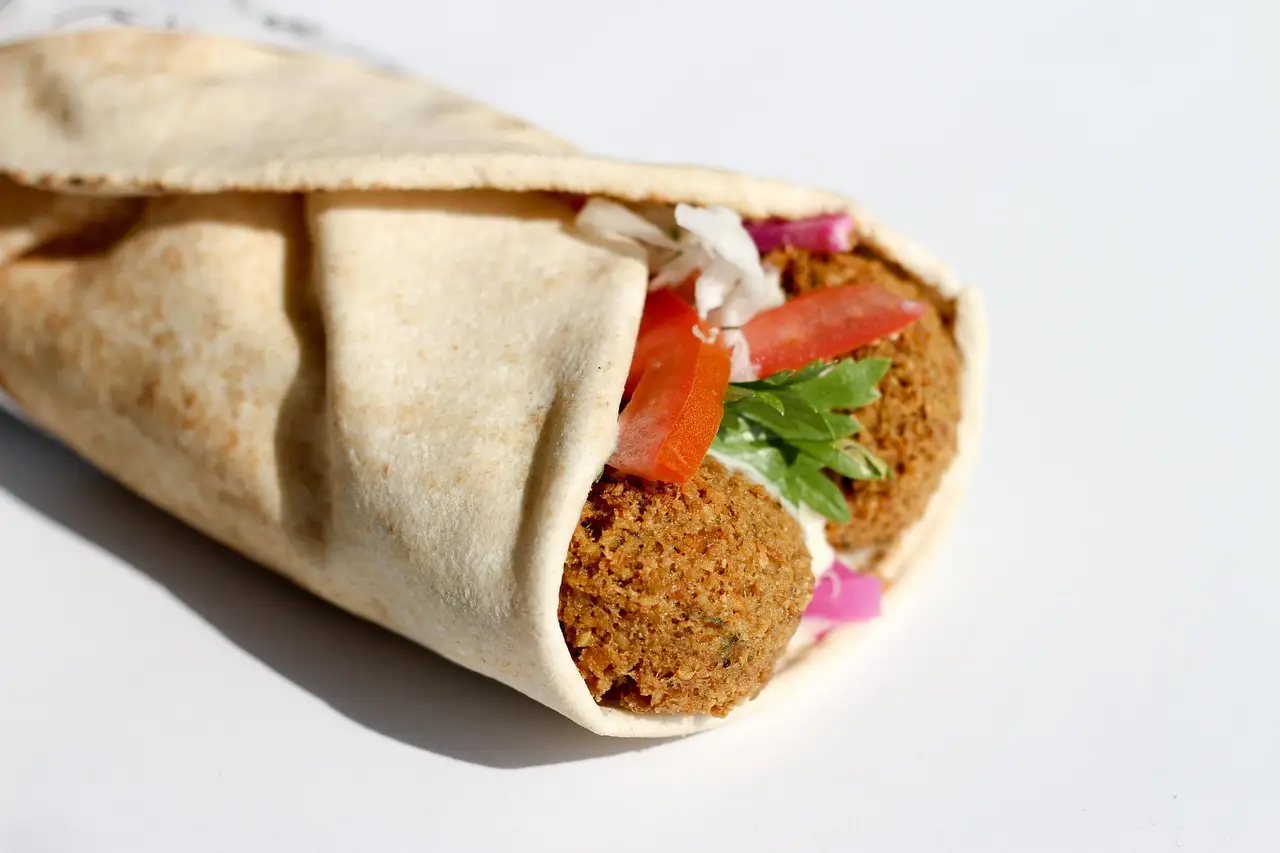
Crunchy outside, bright green and fluffy inside, falafel is a ball of soaked, ground beans or chickpeas, packed with herbs and fried until it crackles. It is cheap, filling, meat-free and fits in your hand, which explains why it conquered street corners around the world. It also explains why half the eastern Mediterranean would like a word about who invented it.
Background
The name probably comes from the Arabic plural of filfil, pepper, a word borrowed from Persian and ultimately from Sanskrit pippalī, long pepper; another theory points to an Aramaic word for a small round thing or peppercorn 1. English first printed "falafel" in 1936 1.
In Egypt, ask for ta'amiya instead. The name is a diminutive of ta'am, food, so it means something like "a little bite of food" 2. Egyptian cooks use dried fava beans, which makes ta'amiya lighter and moister than the chickpea kind 2. In Alexandria, with its Levantine ties, people say falafel too 2.
The method surprises first-timers: the chickpeas are soaked overnight but never cooked, because cooked chickpeas fall apart in the oil 1. They are ground raw with parsley, spring onions and garlic, seasoned with cumin and coriander, shaped by hand or with a mould called an aleb falafel, then fried 1.
History
Nobody knows exactly where falafel began, and anyone who tells you otherwise is selling something. Most accounts point to Egypt 1.
The romantic story says Egypt's Coptic Christians created fava-bean ta'amiya about a thousand years ago as a meat substitute for Lent 2. Some writers reach back further, to the pharaohs, but that is speculation: the earliest Egyptian written references date only from the nineteenth century 1. A third theory says British soldiers in Egypt, missing the fried snacks of India, asked local cooks for something similar. The circumstantial case exists, but nobody has proved it 1.
What the record does show is a fast spread in the twentieth century. From Alexandria falafel moved across Egypt and, after the First World War, around the region. A falafel shop was open in Beirut by 1933, and the dish travelled down the Red Sea coast to Yemen, west into Libya and north to Turkey 1. In the Levant, cooks swapped fava beans for chickpeas 1.
In Mandatory Palestine, some Jewish and Arab residents adopted it, though newly arrived Ashkenazi Jews were slow to warm to it 1. Rationing in 1949 helped: falafel was protein-rich and made from easy-to-get ingredients 1. Food historian Gil Marks credited Yemenite Jewish immigrants with popularising falafel in pita in the 1950s, although The Palestine Post described the idea as early as 19 October 1939 1.
There is also a medical twist. Cookbook author Joan Nathan explains that favism, an inherited enzyme deficiency found among some Jews of Kurdish and Iraqi descent, pushed Israeli falafel makers away from fava beans altogether, which is how Israeli falafel became firmly chickpea 3.
Customs, rules and rituals
Falafel is a gift to anyone keeping a fast that rules out meat. Copts cook it in huge batches for religious holidays, and Arab Christians eat it during Lent 1. During Ramadan, falafel turns up at iftar, the meal that breaks each day's fast 1.
The classic way to eat it barely changes from city to city: stuffed into pita or another flatbread with salad, pickles, hot sauce and a drizzle of tahini 12. Even McDonald's in Egypt once put a "McFalafel" on its breakfast menu 1. Since 2012 there has also been an International Falafel Day, and in 2016 an Egyptian chef from the restaurant Zooba won the London Falafel Festival with a fava-bean version 2.
Place in human experience
Falafel shows how a snack can become a flag. Scholar Yael Raviv traced how, in the early twentieth century, falafel was "gradually disassociated from its Arab origins" and deliberately turned into a symbol of Israeli national cuisine 4. Her 2015 book Falafel Nation argues that European Jewish immigrants used local foods like falafel and hummus to make themselves part of the Middle East, and that national cuisines keep shifting as new people arrive 5.
For early settlers, falafel suited the mood: quick, no-frills, affordable and satisfying, part of a "holy trinity" with hummus and schnitzel 4. By the 1980s, travel and fine dining had Israeli chefs playing with it, from shrimp falafel to chocolate truffles 4.
That same story looks very different from the other side. The chickpea version became known as Israel's national dish, which Palestinians and other Arabs criticise as cultural appropriation 1. The fight over Middle Eastern food runs hot: in October 2009 about 300 Lebanese cooks made more than two tonnes of hummus to win a Guinness record they said Israel held, with organiser Fadi Abboud vowing to "remind the world that it's not true that hummus is an Israeli traditional dish" 6.
Strip away the politics and falafel is still what it always was: food for people without much money, food for fasting days, food you share standing up. Egyptians, Palestinians, Lebanese, Israelis and Yemenis all have real memories wrapped up in it. Perhaps that is why everyone wants to claim it.
Sources
- "Falafel", Wikipedia, https://en.wikipedia.org/wiki/Falafel
- "Falafel or Taameya? Celebrating the Popular Dish's Many Disguises on International Falafel Day", Egyptian Streets (12 June 2019), https://egyptianstreets.com/2019/06/12/falafel-or-taameya-celebrating-the-popular-dishs-many-disguises-on-international-falafel-day/
- Joan Nathan, "Classic Falafel Recipe", My Jewish Learning, https://www.myjewishlearning.com/?p=231297
- "The ever-changing chickpea fritter reflects Israel's shifting mores", J. The Jewish News of Northern California (27 May 2005), https://jweekly.com/?p=50337
- Review of Yael Raviv, Falafel Nation: Cuisine and the Making of National Identity in Israel (University of Nebraska Press, 2015), Kirkus Reviews, https://www.kirkusreviews.com/book-reviews/yael-raviv/falafel-nation/
- "Lebanese to Israel: Hands off our hummus!", Associated Press (24 October 2009), archived at MIT Lebanon Articles list, https://mailman.mit.edu/pipermail/lebanon-articles/2009-October/001076.html