
Fried Rice
Fried rice is yesterday's rice given a second, better life: a hot pan, a splash of oil, an egg, whatever the fridge offers, and a few minutes of noisy…
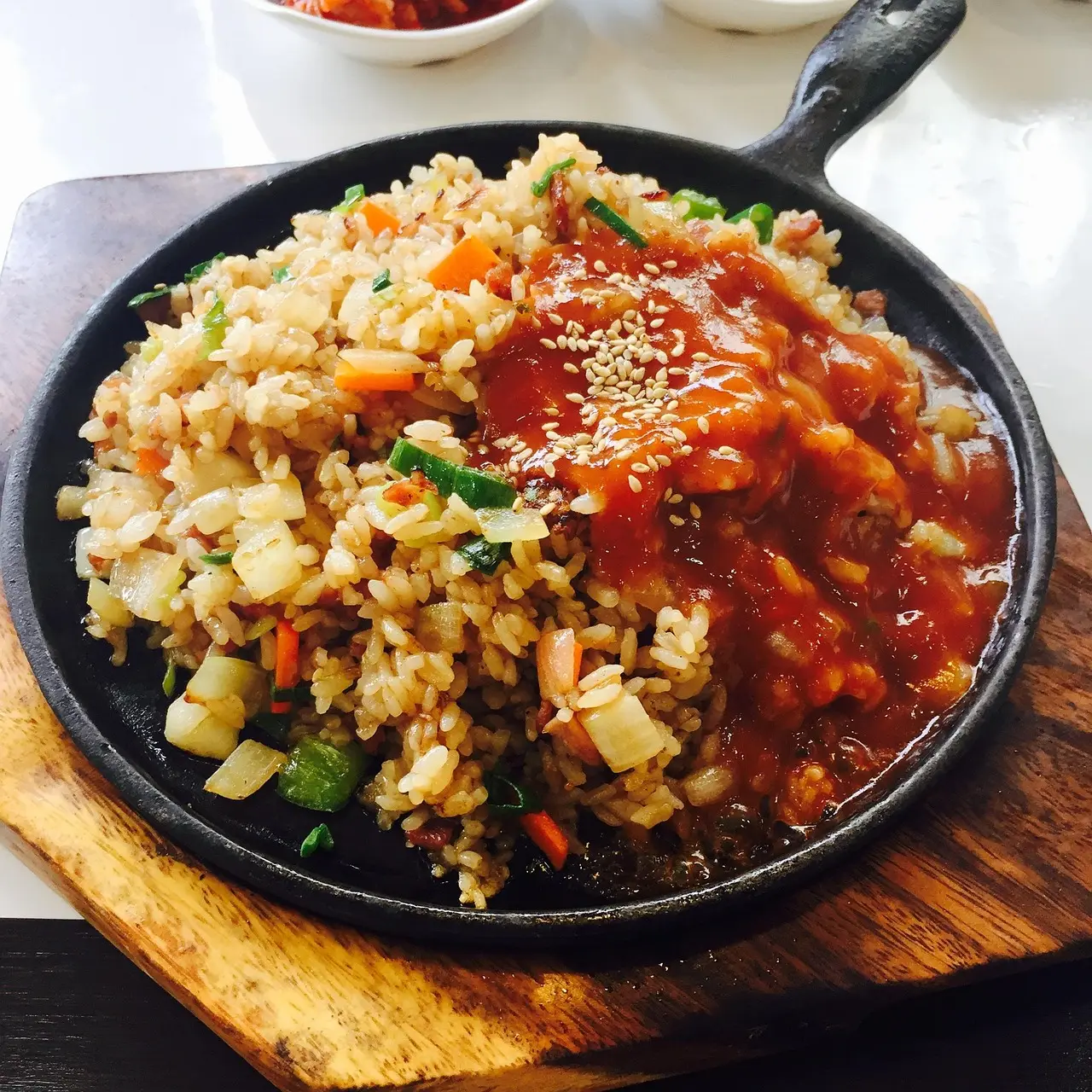
Fried rice is yesterday's rice given a second, better life: a hot pan, a splash of oil, an egg, whatever the fridge offers, and a few minutes of noisy tossing. It started in China and now has a local accent almost everywhere rice is eaten, from Jakarta breakfast stalls to Lima's Chinese-Peruvian restaurants 156. For a home cook it may be the friendliest dish in the world. It forgives everything except fresh, soggy rice.
Background
The whole trick is leftovers. Cooked rice that sits overnight dries and firms up, so the grains stay separate in the pan instead of turning to paste. Chinese households stir-fried it with egg, vegetables and scraps of meat as a thrifty way to use what was left from the day before 12.
Because it starts with leftovers, no two plates match. China alone has the shrimp, egg and barbecued pork of Yangzhou fried rice, the saucy Hokkien style and a chilli-bean Sichuan version 1. Thailand's khao phat uses jasmine rice and fish sauce; Indonesia's nasi goreng leans on sweet soy and shrimp paste; Japan's chāhan picks up a hint of bonito flakes 1.
History
The usual story places the earliest record of fried rice in the Sui dynasty (589–618), around the city of Yangzhou 12. Take that date with a grain of rice. The historian Endymion Wilkinson, summarised by the writer T. Greer, finds the word chao (stir-fry) first used in the Tang dynasty for roasting tea leaves, not food. It turns up in about a dozen Song-dynasty recipes, and stir-frying spreads mainly in the late Ming and Qing, when fuel in crowded cities grew scarce and dear and a quick blast of heat saved money 4. The Chinese fried rice entry in Wikipedia agrees the technique only caught on widely in the late Ming 2. So a Sui-era dish may have existed, but the everyday wok habit came much later.
Yangzhou fried rice carries the city's name, yet the credit for popularising it goes to a Qing official, Yi Bingshou (1754–1815), a former prefect of Yangzhou 3. The city still treats it as a point of pride. In 2015, for Yangzhou's 2,500th anniversary, 300 cooks fried 4,192 kilograms of it to set a world record. The record was refused: about 150 kilograms had sat too long to be safe and went to pigs 3.
The dish travelled with people. Hokkien, Cantonese, Hakka and Teochew settlers carried fried rice into the ports of Southeast Asia, including Batavia, Semarang and Singapore, between the 10th and 19th centuries 5. There it became nasi goreng, darkened with local sweet soy. Dutch colonists met it in Java; it appears in a 1925 Dutch cookbook of East Indies recipes, and later Indo-Dutch migrants took it to the Netherlands and Suriname 5.
In Peru the route was harsher. From 1849 more than 100,000 men from southern China arrived as indentured labourers, put to work in cotton and sugarcane fields after the emancipation of enslaved Africans, under conditions that included beatings and withheld pay 6. Freed from their contracts, many opened restaurants. Their food became chifa, and chifa's fried rice, chaufa, became Peruvian comfort food 6.
Customs, rules and rituals
Fried rice has a time of day in many places. Filipino cooks make sinangag, garlic fried rice, from last night's rice for breakfast, part of the classic tapsilog plate 1. Nasi goreng is a classic Indonesian breakfast too, made at home or bought hot from a street hawker 5.
At a Chinese banquet it arrives near the end, often as the penultimate dish before dessert, a filling full stop for anyone still hungry 2. Korean restaurants run the clock the other way round: when the barbecue is finished, staff tip rice, seaweed flakes and sesame oil straight into the pan's leftovers and fry it at the table 1.
Every region adds its own signature. Hawaii adds Spam or Portuguese sausage 1. Puerto Rico's arroz mamposteao folds in red beans and sweet plantain; Dominican chofán gets its character from Jamaican oregano and a stock cube 1. Japan wraps ketchup-red chicken rice in an omelette and calls it omurice 1. In 2024 restaurants in Baguio in the Philippines fed some 16,000 people at a single giant fried rice feast 1.
Place in human experience
Fried rice is a dish about not wasting things. It began with cooks who could not afford to throw out cooked rice 12, and it still says something about a household: here, nothing is thrown away.
It also says something about who travelled. The labourers, traders and settlers who carried it rarely chose easy journeys, yet their dish became local. In 2018 Indonesia named nasi goreng one of five national dishes 5. In Peru, about 2.5 million people identify as tusán, of Chinese descent, and Cantonese words for some ingredients have replaced the Spanish ones in everyday speech 6.
And it is a memory food. When Barack Obama, who spent four years of his childhood in Jakarta, returned to Indonesia in 2017, the hotel reported him ordering noodles, satay and fried rice 7. A plate of fried rice is often how people taste home.
Sources
- "Fried rice", Wikipedia, https://en.wikipedia.org/wiki/Fried_rice
- "Chinese fried rice", Wikipedia, https://en.wikipedia.org/wiki/Chinese_fried_rice
- "Yangzhou fried rice", Wikipedia, https://en.wikipedia.org/wiki/Yangzhou_fried_rice
- T. Greer, "Chinese Cookery: Notes on the History of Chinese Stir Fry" (drawing on Endymion Wilkinson, Chinese History: A New Manual, Harvard University Press), The Scholar's Stage, https://scholars-stage.org/chinese-cookery-notes-on-the-history-of-chinese-stir-fry/
- "Nasi goreng", Wikipedia, https://en.wikipedia.org/wiki/Nasi_goreng
- Siyi Chu, "Introducing Chifa: Peru's Chinese Culinary Tradition", The World of Chinese, https://www.theworldofchinese.com/2022/03/introducing-chifa-perus-chinese-culinary-tradition/
- "Fried rice, sate ayam bring back nostalgia for Obama", The Jakarta Post, https://www.thejakartapost.com/travel/2017/06/30/fried-rice-sate-ayam-brings-back-nostalgia-for-obama