
Greek Salad
Picture a bowl of fat summer tomatoes, crunchy cucumber, sharp onion, a few olives, and a slab of feta sitting on top like a crown, all glossy with olive…
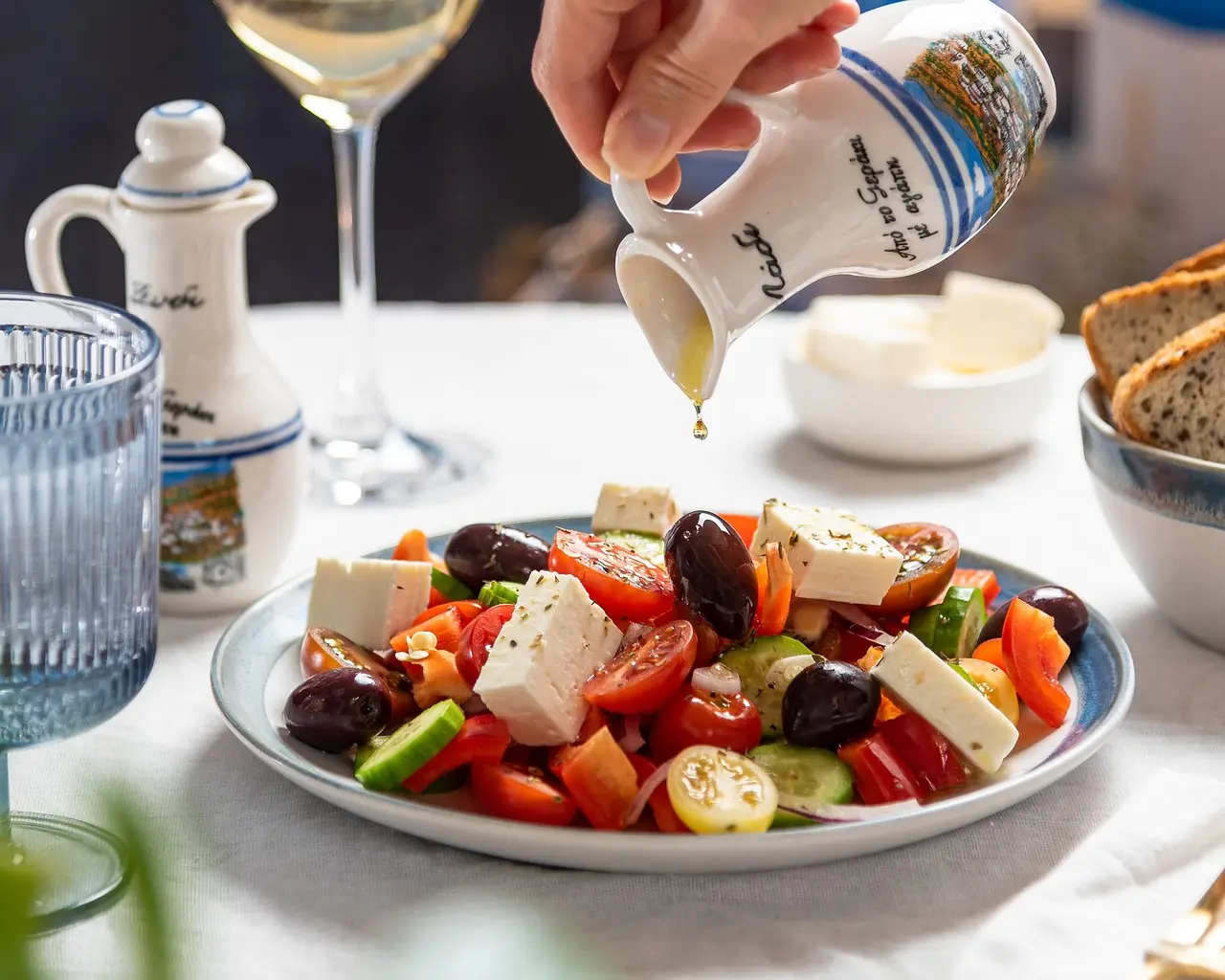
Picture a bowl of fat summer tomatoes, crunchy cucumber, sharp onion, a few olives, and a slab of feta sitting on top like a crown, all glossy with olive oil and dusted with dried oregano. In Greece it goes by horiatiki, which means "from the village" or simply "peasant" 1. It looks as old as the Parthenon. It isn't. The salad you order at a taverna is younger than plenty of the people eating it, and the tale of how it got there is half farm, half tourist trap, and wholly delicious.
Background
Greek food writer Aglaia Kremezi says the restaurant salad borrows from the summer salad-meals farming families ate 1. Those were never fixed recipes. Whatever the garden gave went in: ripe tomato, onion, cucumber, purslane, sweet or slightly hot peppers, maybe a pickled green such as kritama (rock samphire), then olives, perhaps capers or caper leaves, and always feta 1. Wild oregano or savory and a generous glug of fruity olive oil finished the job 1.
Winter got its own salad: crisp cos lettuce, peppery wild rocket, fennel, dill, mint, borage and heaps of spring onion, and hardly ever a tomato 1. That's why a proper summer horiatiki has no lettuce at all. In Greece lettuce is a winter crop, and tomato salads belong to summer 4. So if someone hands you a "Greek salad" on a bed of iceberg, you have permission to raise an eyebrow.
And the feta? It has lawyers. Since 2002 EU law says "feta" must come from mainland Greece or Lesbos and be made from sheep's milk, or sheep's milk with up to 30 per cent goat's milk 7. Denmark and Germany fought it all the way to the EU's top court and lost in 2005; a Danish dairy giant renamed its cheese "Apetina" 7.
History
Here's the twist: the star ingredient is a newcomer. Kremezi records that tomato seeds reached mainland Greece in 1815, brought by Paul d'Yvrai, the French head of the Capuchin monastery in Athens's Plaka, who apparently wanted pretty, rare plants for the garden 2. Greeks called the fruit chryssomila, "golden apples", a translation of the Italian pomodoro 2. The first Greek-language cookbook, printed on Syros in 1827, already had two tomato recipes 2, but village cooks took their time. Tomatoes only became everyday food around the end of the nineteenth century, or really the start of the twentieth 2.
The salad as a menu item came later still. Kremezi dates it to the 1960s or early 1970s 1. The story you'll hear in food magazines: during the tourist boom, taverna owners in Plaka tossed feta onto vegetables and oil to create a "new" dish they could price freely, dodging caps on the price of staple foods 34. Nobody has named the inventor, and Tasting Table calls the motive "alleged" 34, so enjoy it as a good yarn rather than gospel.
What is on record is the grumbling. Kremezi's parents called horiatiki an overpriced gimmick for tourists, and taverna owners moaned about the "horiatiki tourists" who packed their tables in high season and ordered little else 1. A salad and not much else, per table, in the busiest weeks of the year. You can see the problem.
Customs, rules and rituals
Horiatiki is a summer thing, made when tomatoes taste of sunshine 14. In the village it was a meal, not a side dish 1. The feta goes on in a big piece or chunky bits, and people noticed when it shrank: Kremezi mentions a suspicion that taverns used the standard salad to slip in cheaper, smaller pieces 1.
The church calendar has a say too. Greek Orthodox Christians fast on most Wednesdays and Fridays and through Great Lent, Holy Week, the Dormition fast from 1 to 14 August, and the Nativity fast, and the standard fast cuts out meat, fish, dairy, eggs, alcohol and olive oil 6. On a strict day, your horiatiki loses its feta and its oil and becomes, well, chopped vegetables. Spare a thought for anyone keeping the August fast in peak tomato season. The Greek Orthodox Cathedral in Portland describes fasting as a way to simplify life and share with others, not a list of legal food rules 6.
Every region tweaks it: capers here, purslane or samphire there, herbs everywhere 1, and modern cooks add whatever looks good that week 4.
Place in human experience
The funny thing is that Greeks didn't all love it at first. When the salad appeared, the country was busy trying to look urban and European, and "horiatiko" was a put-down for anything too old-fashioned for the new city middle class 1. A dish proudly named "peasant", sold to foreigners in the capital, made some people cringe 1. Give it a generation and the same word turned into a compliment: honest, seasonal, from the land.
UNESCO agreed, in its way. In 2013 it added the Mediterranean diet, shared by Greece and six other countries, to its list of intangible cultural heritage, with the town of Koroni as Greece's showcase 5. The listing says eating together is the foundation of identity across the region, and credits women with passing on the seasons, techniques and festive dishes to the next generation 5. A bowl of vegetables, oil and cheese in the middle of the table, everyone helping themselves, fits that picture nicely.
So the next time you make one, remember: a monk's flowerbed, a cheese court case and a few cheeky taverna owners all helped put it on your plate.
Sources
- "HORIATIKI, the peasant roots of Greek Salad", Aglaia Kremezi, https://www.aglaiakremezi.com/horiatiki-peasant-roots-greek-salad/
- "TOMATO: A Latecomer That Changed Greek Flavor", Aglaia Kremezi, https://aglaiakremezi.com/?p=91
- "Greek Salad Is A More Recent Invention Than You Might Think", Melanie McCrary, The Daily Meal, https://www.thedailymeal.com/1328326/invention-greek-salad/
- "The Reason Traditional Greek Salad Is Served Without Lettuce", Michelle Welsch, Tasting Table, https://tastingtable.com/1822385/why-no-lettuce-greek-salad
- "Mediterranean diet", UNESCO Intangible Cultural Heritage, https://ich.unesco.org/en/RL/mediterranean-diet-00884
- "Fasting", Holy Trinity Greek Orthodox Cathedral, Portland, https://www.goholytrinity.org/our-faith/fasting
- "Feta", Wikipedia, https://en.wikipedia.org/wiki/Feta