
Guacamole
Guacamole is mashed avocado, salt and a squeeze of lime, usually with onion, chilli and coriander folded through . That's close to the whole recipe. It…
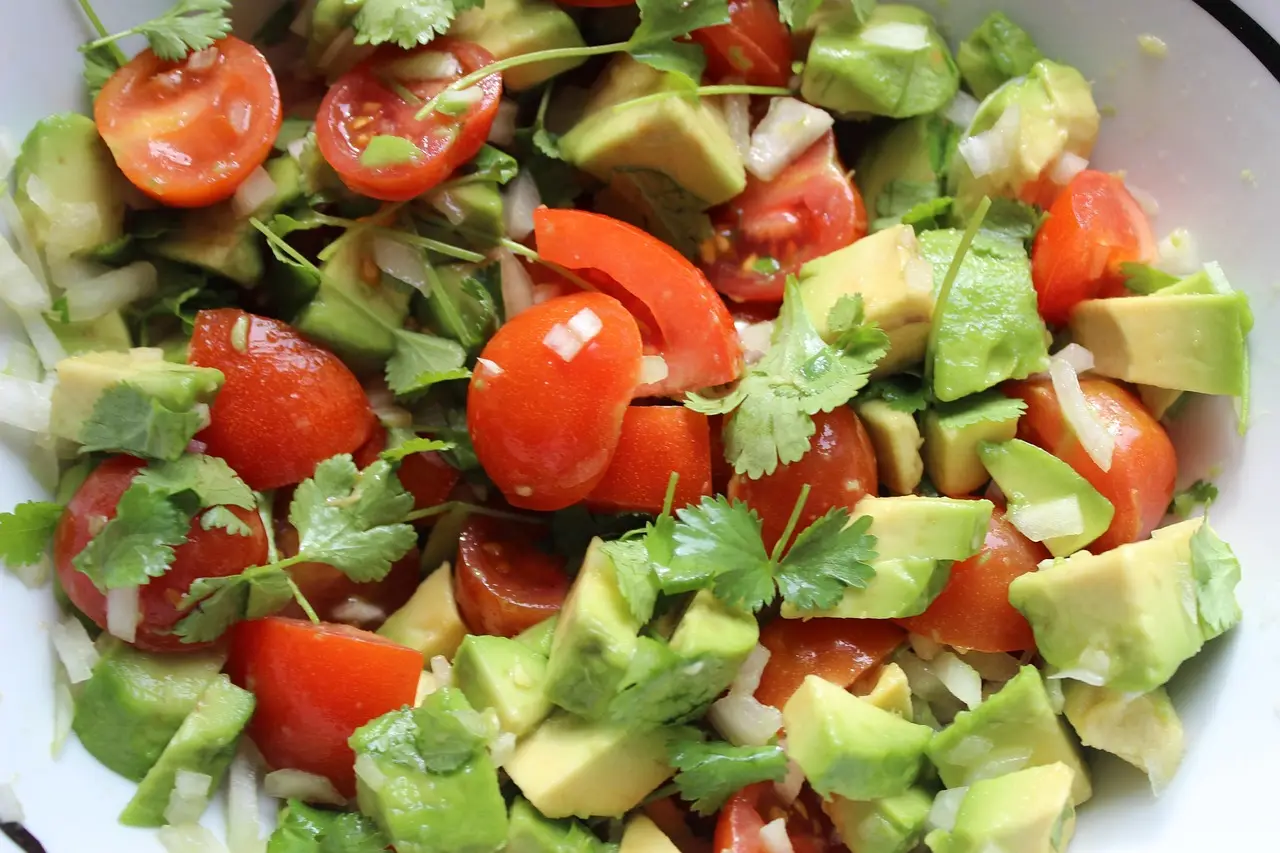
Guacamole is mashed avocado, salt and a squeeze of lime, usually with onion, chilli and coriander folded through 1. That's close to the whole recipe. It comes from Mexico, its name comes from the Aztec language, and it now turns up at Super Bowl parties by the truckload. Not bad for a bowl of green mush.
Background
The name gives the game away. In Classical Nahuatl, the Aztec language, āhuacatl means avocado and mōlli means sauce; put them together and you get āhuacamōlli, avocado sauce 1. Yes, mōlli is the same root as mole.
The traditional tool is the molcajete y tejolote, a three-legged bowl and pestle carved from volcanic basalt 12. The stone is porous, so it seasons like a cast-iron pan and carries flavour from one batch to the next 2. A new one gets broken in by grinding white rice until no grit shows 2. Today cooks stir in all sorts, from tomato and sour cream to basil and even peas 1.
History
The avocado had a long head start. Seeds turn up in the Tehuacán Valley of Mexico around 9,000 to 10,000 years ago, and Mesoamerican peoples had domesticated the tree by about 5000 BCE 1. Avocados were growing in Peru's Supe Valley by 3100 BCE 1.
Spanish dictionaries let us glimpse the sauce itself. Alonso de Molina's 1571 Nahuatl-Spanish vocabulary records ahuacamolli as a sauce of avocado and dried ground chilli, according to historian Kristen Jancuk 3. By 1554 Spanish speakers already said aguacate, their best shot at the Nahuatl sound 3. The friar Bernardino de Sahagún described three kinds of avocado and listed medicinal uses for the leaves, seeds and oil, including remedies for coughs, dandruff and period pain 3.
Here the stories split. Avocados From Mexico, the industry marketing body, says the Aztecs mashed avocado with tomato, green chilli and salt, and that the Spanish who arrived in 1519 added onion, lime and coriander from Europe and renamed it guacamole 4. Treat that as the industry's version; the tidy before-and-after is hard to pin down in older sources. What we can say: in 1697 the English privateer William Dampier described locals in Central America beating avocado with sugar and lime juice on a plate, the first known recipe in English 13. Sugar. In guacamole. The past really is another country.
You may have heard āhuacatl also meant "testicle". Jancuk calls that a myth: the word was more likely a food-inspired euphemism, and Nahuatl had its own anatomical term, atetl 3.
The modern boom is a trade story. The United States banned Mexican avocado imports in 1914 over fears of seed weevils, and only began lifting the ban in 1997 once inspectors found the fruit posed no pest risk 56. US avocado eating then climbed more than 600 per cent between 1989 and 2020 6. Most of it comes from a single Mexican state, Michoacán, the only one fully cleared to export to the US 5.
Customs, rules and rituals
In the US guacamole became a party food, and the party is the Super Bowl. Americans ate about 54 million avocados during the 2024 game 6, and the Mexican avocado industry helped make that happen by promoting guacamole as game-day food 6. The fruit's journey can get tense: in February 2022, on the eve of the Super Bowl, the US briefly suspended Mexican avocado imports after a US plant inspector in Uruapan, Michoacán received a threatening message, amid cartel turf wars in the region 5.
Calendars help too. National Guacamole Day falls on 16 September, Mexican Independence Day 14, and in the US the dip is tied to Cinco de Mayo as well 1. Mexico holds the bragging rights: in 2022 the town of Peribán set a Guinness World Record with a 4,972-kilogram serving made by 500 people 1.
Place in human experience
Guacamole is a quiet survivor. Its name, its stone bowl and its basic method all come from pre-Hispanic Mexico 12, and they outlived the conquest that toppled the people who made them. The molcajete itself carries weight: the Aztec and Maya ground food in them, and large lidded molcajetes from that era may have held burials of high-status people 2. Today many carry a carved pig's head, a nod to animals the Spanish brought 2, so even the bowl tells the colonial story.
In the US, guacamole tracks the growth of the Latino population as much as the trade deals 1. A sauce named in Aztec Nahuatl now anchors the biggest television event of the American year. Every bowl still starts the same way: someone with a fork or a pestle, squashing a ripe avocado and tasting for salt.
Sources
- "Guacamole", Wikipedia. https://en.wikipedia.org/wiki/Guacamole
- "Molcajete", Wikipedia. https://en.wikipedia.org/wiki/Molcajete
- Kristen Jancuk, "A Brief History of Guacamole (And It's Not What You'd Expect!)", TheCollector, 16 February 2024. https://www.thecollector.com/history-guacamole
- "The History and Origins of Guacamole", Avocados From Mexico. https://avocadosfrommexico.com/blog/guacamole/guacamole-origin-and-history/
- "US suspends Mexican avocado imports on eve of Super Bowl", PBS NewsHour (Associated Press), 13 February 2022. https://www.pbs.org/newshour/economy/us-suspends-mexican-avocado-imports-on-eve-of-super-bowl
- "Holy Guacamole: U.S. Avocado Imports Soar Ahead of Super Bowl", The Food Institute, 20 January 2025. https://foodinstitute.com/focus/holy-guacamole-u-s-avocado-imports-soar-ahead-of-super-bowl/