
Kebab
Kebab is meat cooked over or beside fire: on a skewer, minced round a sword-like blade, or stacked high and turning slowly in front of a wall of heat. The…
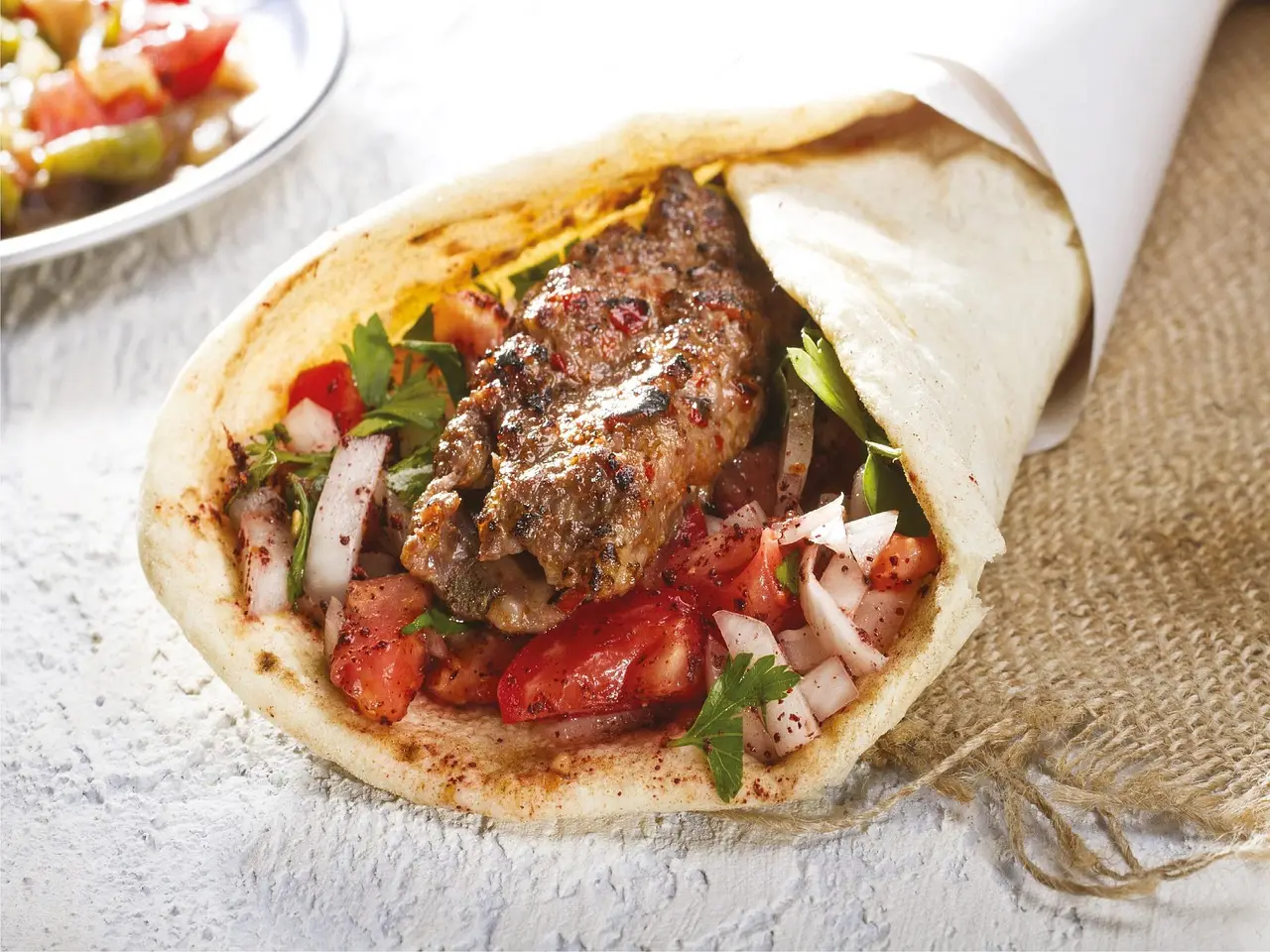
Kebab is meat cooked over or beside fire: on a skewer, minced round a sword-like blade, or stacked high and turning slowly in front of a wall of heat. The word comes from Arabic and travelled through Persian and Turkish, and the food travelled even further 1. Today it covers everything from a grilled skewer to the 2am doner that has saved more than one night out. Few dishes have crossed so many borders with so little fuss.
Background
Strip away the regional names and a kebab is simple: cut meat, a fire, and something to hold one over the other. That simplicity explains why it turns up almost everywhere people keep sheep, goats or cattle.
The modern family splits roughly two ways. Skewer kebabs grill small pieces over coals. Rotisserie kebabs, the doner family, stack thin slices of seasoned meat on a vertical spit and shave off the cooked outside as it turns 3. That second idea, the turning stack, went on to become the Greek gyros, Lebanese shawarma and, by way of Lebanese migrants, Mexico's tacos al pastor 3.
History
Skewered meat is older than the word. Archaeologists trace kebab-style cooking in the Aegean back to the Minoan civilisation in the seventeenth century BCE, and Homer's Odyssey describes strips of meat threaded for grilling, which food historian Clifford A. Wright reads as an early shish kebab 1. Taverns in classical Athens grilled them over an eschara, a kind of brazier, and Byzantine images show Greeks still at it centuries later 1.
The first cookbook entry belongs to tenth-century Baghdad. Ibn Sayyar al-Warraq's Kitab al-Tabikh describes kabab as cut-up meat, fried in a pan or grilled over fire 1. The Moroccan traveller Ibn Battuta found kebab served in royal houses of the Delhi Sultanate (1206–1526), and noted ordinary people ate it for breakfast with naan 1. From there it spread wherever Muslim trade and rule went, from Southeast Asia to Africa 1.
The rotating stack is an Ottoman story, and its inventor depends on who you ask. Food historian Mary Işın points to Istanbul miniature paintings from 1616–1620 as the first pictures of the dish, then cooked on a horizontal spit 2. A photograph by James Robertson, taken around 1853–55, is the first known image of a doner 2. The town of Bursa claims the vertical spit through İskender Efendi, who, family legend says, stood the lamb upright in his father's restaurant in the 1850s 23. Kastamonu has a rival, Hamdi Usta, who may have done it about 1830 3. Neither claim can be proved 3.
The sandwich is a Berlin story. Between 1960 and 1973 nearly a million Turkish guest workers moved to West Germany 2. In 1972 Kadir Nurman, who had arrived in 1960, opened a stall in West Berlin selling grilled meat and salad in flatbread, figuring busy Berliners wanted a meal they could carry 4. Others also claim the idea, but the Association of Turkish Doner Manufacturers recognised Nurman in 2011 4. He never patented it and never got rich from it. He told a German newspaper he was simply glad so many Turkish people made a living from doner and so many millions ate it 4.
Customs, rules and rituals
In Bursa, the İskender kebab is a small ceremony on a plate: thin slices of doner laid over pide bread, covered in tomato sauce, then finished at the table with sizzling sheep's-milk butter 2. The family still runs the restaurant and holds the trademark 3.
Halal, meaning permitted under Islamic law, sits right in the name of one Australian takeaway classic, and there it became a joke and a badge at once. The halal snack pack, a styrofoam box of doner meat over chips with cheese and sauce, grew a Facebook fan club of nearly 90,000 members by 2016, Muslim and non-Muslim alike, who call one another "brothers and sisters" 6. Members police the rules with real enthusiasm: no salad, and never, ever tomato sauce 6.
Every country tweaks its kebab. German doner shops in the United States pre-cook the beef to suit American food-safety habits and swap pita for fluffier Persian bread 5. A Florida trader adds extra spice because "Americans like spicier meat" 5.
Place in human experience
Kebab is migrant food in the best sense. It travelled with Muslim merchants and rulers to India and beyond 1, with Lebanese families to Mexico 3, and with Turkish guest workers to Germany 2. Each time it settled in and became local.
Germany shows how far that goes. By 2013 the country had about 16,000 doner outlets, and German firms made 80 per cent of the meat and grilling machines sold in the EU 4. National Geographic Traveller counts around 40,000 kebab shops in Germany and 20,000 in the UK 2. The owner of a doner shop in Seattle explains it to Americans this way: "Tacos to Americans are like döners to Germans" 5. A dish that arrived with workers nobody expected to stay became the country's favourite fast food 5.
The snack pack tells a similar story. At a time when halal certification drew suspicion in Australian politics, a takeaway box labelled halal became a shared joke among strangers of every faith 6. Food can do what speeches can't: get people queuing at the same counter at midnight, arguing cheerfully about sauce.
Sources
- "Kebab", Wikipedia (citing Clifford A. Wright and Ibn Sayyar al-Warraq). https://en.wikipedia.org/wiki/Kebab
- Al-Mousawi E., "What is Turkish doner kebab?", National Geographic Traveller (UK), 13 August 2024. https://www.nationalgeographic.com/travel/article/what-is-turkish-doner-kebab
- "Doner kebab", Wikipedia. https://en.wikipedia.org/wiki/Doner_kebab
- "Doner kebab 'inventor' Kadir Nurman dies in Berlin", BBC News, 26 October 2013. https://www.bbc.com/news/world-europe-24685617
- Scaturro M., "The American döner", Deutsche Welle, 28 December 2012. https://www.dw.com/en/germanys-fast-food-favorite-takes-on-the-us/a-16480726
- "The halal snack pack: a fast track to a heart attack? Or worse?", The Guardian, 19 April 2016. https://www.theguardian.com/lifeandstyle/2016/apr/19/the-halal-snack-pack-a-fast-track-to-a-heart-attack-or-worse