
Kimchi
Kimchi is Korea's fermented vegetable dish: cabbage, radish or almost any green, salted, seasoned and left to sour into something crunchy, fizzy and…
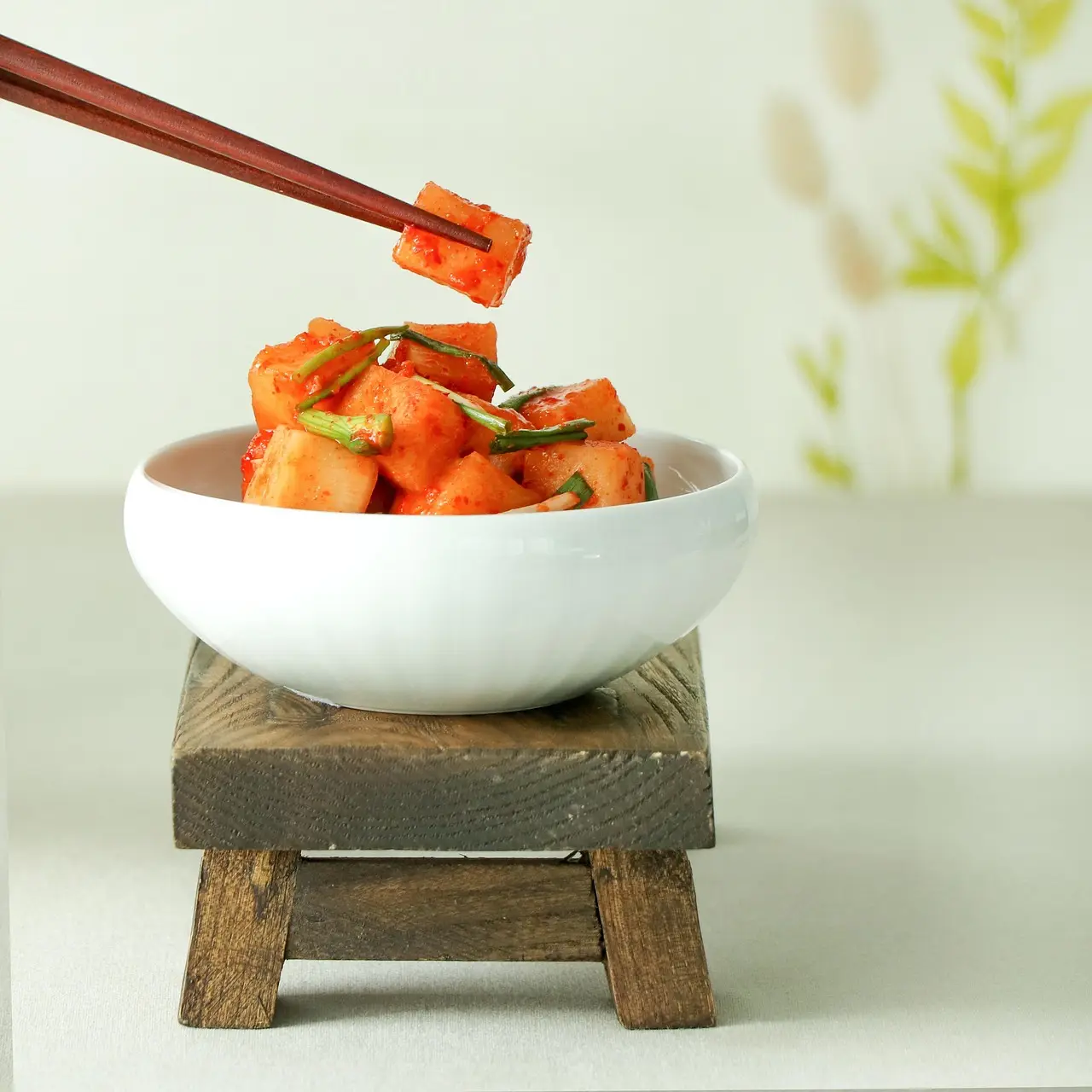
Kimchi is Korea's fermented vegetable dish: cabbage, radish or almost any green, salted, seasoned and left to sour into something crunchy, fizzy and fiery. North Korea's own UNESCO listing describes it as vegetables or wild greens seasoned with spices, fruit, meat, fish or fermented seafood, then left to ferment 1. South Koreans get through about 1.5 million tonnes of it a year, and as one NPR report put it, "Kimchi is like air in Korea" 2. Eat it once and you start finding reasons to put it on everything.
Background
Here's the first surprise: the bright red kimchi on your plate is the new version. For most of its life kimchi was pale, salty and not hot at all.
Pickled vegetables in Korea go back to the Three Kingdoms era (37 BCE–668 CE), when cooks preserved them with salt or vinegar 3. By the Goryeo period (918–1392) there were three kinds: plain pickles, dongchimi (a cool radish water kimchi) and nabak kimchi, a sliced kimchi floating in its own brine 3. Today both Koreas count their varieties in the hundreds 12.
What makes kimchi kimchi is lactic fermentation 1. Friendly bacteria eat the sugars in the vegetables and turn them sour, which is also what keeps them good through a long winter.
History
The oldest Korean written mention sits in the History of Goryeo, which lists radish, minari (water dropwort), chives and bamboo shoots served at Confucian rites 3. Fermented vegetables of the same family appear 3,000 years ago in China's Classic of Poetry 3, a reminder that East Asia shared the habit of salting greens long before any border was drawn.
Then came the chilli. Chillies are an American plant, and they reached Korea around the Imjin War, when Japan invaded in 1592 3. Koreans took their time: chilli became a common kimchi ingredient only about 200 years later 3. One cookbook from around 1670, Eumsik dimibang, often called the oldest cookbook by a woman in East Asia, seasons its kimchi with salt, soybean paste and wheat bran, and no chilli at all 3. One theory for the switch: cooks used chilli to hide the fishy smell of jeotgal, the salted seafood that was standing in for plain salt 3.
The fat napa cabbage most of us picture arrived later still. Koreans began growing it widely in the early twentieth century, and radish and cucumber shifted from main event to part of the seasoning paste 3.
Kimchi went global at the 1988 Seoul Olympics, where it was served in the athletes' village 3. In 2001 the Codex Alimentarius, the United Nations food-standards body, set an international standard for it 34.
That standard mattered in 2020. Sichuan province in China won an ISO listing, ISO 24220, for pao cai, its own pickled vegetables. Some Chinese media called it a world standard for kimchi led by China 4. Korea's agriculture ministry pointed out that the ISO document itself says it "does not apply to kimchi" 4. The BBC added a wrinkle: Korean kimchi is often sold in China under the name pao cai, even though China has its own, different pao cai 4. Kimchi ferments twice; pao cai, once 4.
Customs, rules and rituals
The big event is kimjang, the late-autumn kimchi-making that fills a family's jars for winter. UNESCO added it to its heritage list in 2013 5, and North Korea's kimchi-making tradition followed in 2015 1.
Kimjang runs on a calendar the whole year round. In spring families buy seafood to salt and ferment. In summer they buy sea salt for brine. In late summer they dry and grind red chillies. Then, as the cold arrives, everyone gathers and the cabbage mountain begins 5. Cooks watch the weather forecast to pick the best day and temperature 5. Neighbours and relatives share the work and swap the results, so no household goes into winter without enough 15.
Recipes travel down the generations, classically from a mother-in-law to her new daughter-in-law 5. Each household's version differs, and swapping kimchi with neighbours is how new tricks spread 5.
In the North, kimchi turns up at weddings, holidays and state banquets as well as every ordinary meal 1. South Korea now marks Kimchi Day on 22 November 3.
Today many families skip the buried earthenware jar for a dedicated kimchi fridge, built to hold the right temperature all year. Plenty of Koreans pack one when they move abroad 3.
Place in human experience
Kimchi has always been about more than food. Village kimjang days were social events: matches got made, quarrels got settled over the cabbages, and women's networks grew stronger 2. UNESCO's citation says the practice "reaffirms Korean identity" and reminds people to live in harmony with nature 5.
It also carries home. When astronaut Yi So-yeon flew to the International Space Station in 2008, she took kimchi with her. It had to be irradiated to kill its microbes, which left it limp and tired-looking, but she treasured it anyway: "I can feel my home" 2. South Korea's government has since sent kimchi round the world on purpose, funding Korean restaurants abroad and running a "kimchi bus" through more than 32 countries as part of its K-Food push 2. Kimchi even has its own economic indicator: Koreans watch a "kimchi index" that tracks the price of cabbage and the other ingredients 2.
And the pao cai row showed how personal it feels. A dispute about a technical standard for Sichuan pickles became a national argument, because for most Koreans kimchi is not a side dish. It is family, winter and home in a jar 45.
Sources
- "Tradition of kimchi-making in the Democratic People's Republic of Korea", UNESCO Intangible Cultural Heritage, inscribed 2015. https://ich.unesco.org/en/RL/tradition-of-kimchi-making-in-the-democratic-people-s-republic-of-korea-01063
- The Kitchen Sisters, "How South Korea Uses Kimchi To Connect To The World — And Beyond", NPR (via New Hampshire Public Radio), 22 August 2016. https://www.nhpr.org/post/how-south-korea-uses-kimchi-connect-world-and-beyond
- "[Newsmaker] Korea celebrates Kimchi Day on Nov. 22", The Korea Herald, 17 November 2022. https://www.koreaherald.com/article/3002765
- Park Ji-won, "Kimchi controversy: China's cultural provocation?", The Korea Times, 2 December 2020. https://www.koreatimes.co.kr/lifestyle/travel-food/20201202/kimchi-controversy-chinas-cultural-provocation
- "Kimjang, making and sharing kimchi in the Republic of Korea", UNESCO Intangible Cultural Heritage, inscribed 2013. https://ich.unesco.org/en/RL/kimjang-making-and-sharing-kimchi-in-the-republic-of-korea-00881