
Kung Pao Chicken
Picture a wok so hot the dried chillies start to darken the second they land, a cloud of smoke that makes everyone in the kitchen cough, then chicken, a…
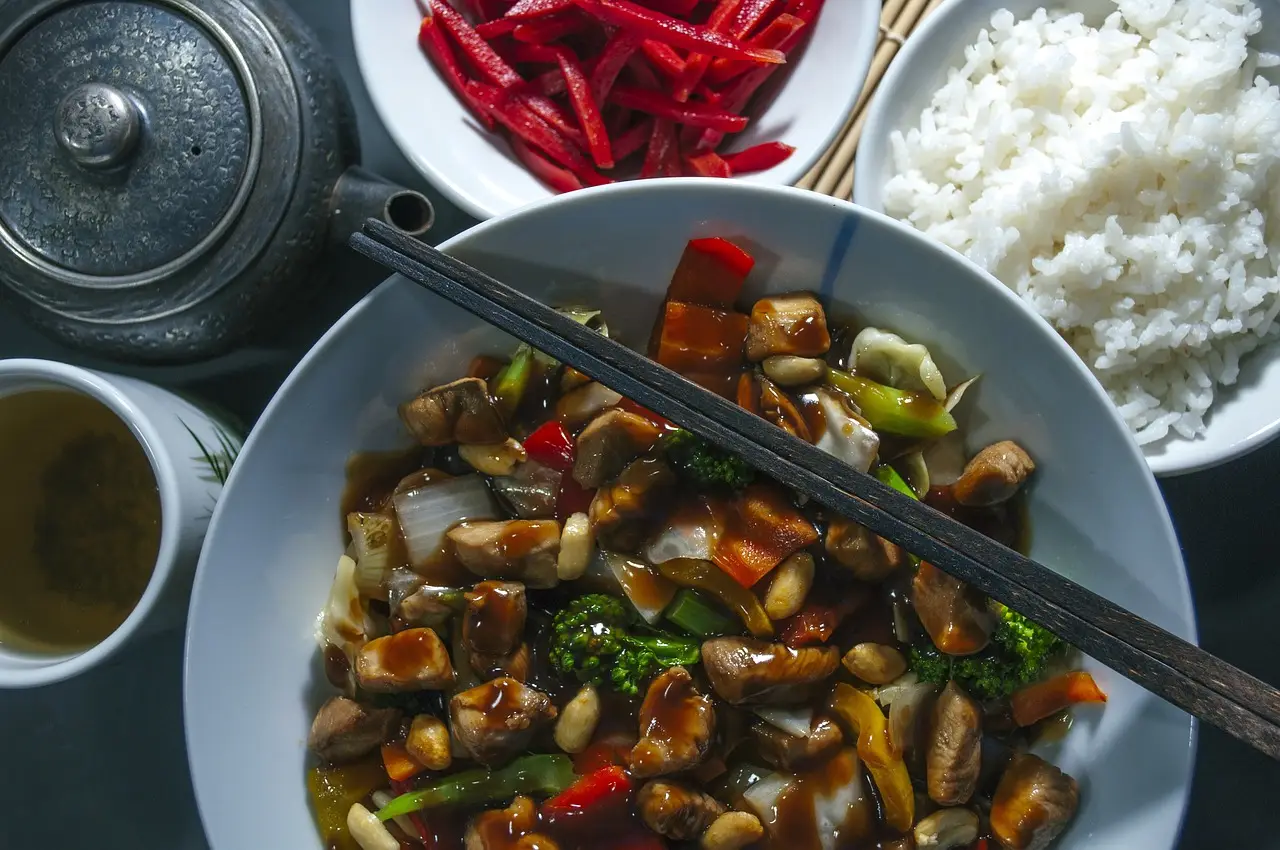
Picture a wok so hot the dried chillies start to darken the second they land, a cloud of smoke that makes everyone in the kitchen cough, then chicken, a splash of sweet-sour sauce, and a handful of peanuts tossed in last so they stay crunchy. That's gongbao jiding, the dish the rest of the world knows as kung pao chicken. It's named after a governor, it once got cancelled by a revolution, and three Chinese provinces still argue over who owns it 1.
Background
The name is a job title. "Gongbao" is short for Taizi Shaobao, roughly "tutor to the Crown Prince", an honour held by a Qing official called Ding Baozhen. Friends called him Ding Gongbao, and the chicken took his nickname 3. "Kung pao" is just the old way of spelling it in English, and it stuck on menus outside China 1.
Sichuan cooks have names for their flavours, and this dish wears two. Hula wei is the toasty taste of chillies scorched in oil. Lizhi wei means "litchi flavour", which sounds lovely until you learn there's no litchi in it: black vinegar, sugar, soy and salt make a sweet-sour balance that only reminds you of the fruit 7. Fuchsia Dunlop, the English cook who trained at Sichuan's top cooking school, describes the sauce as lightly sweet and sour, with chilli heat and the buzzy, lip-tingling Sichuan pepper on top 2. Peanuts are the classic; cashews make it fancy, and the same trick works with pork or prawns 2.
History
Ding Baozhen was born in Guizhou in 1820, passed the imperial exams in 1854, ran Shandong for ten years, then governed Sichuan until he died in Chengdu in 1886 3. So which of those places gave us the dish? Everyone has a story, and nobody has proof.
One says Ding brought it from home in Guizhou. Another has him slipping out in plain clothes and finding it in a humble little restaurant. A third claims his chef diced the chicken small because the governor had bad teeth, which Dunlop politely calls implausible 2. Writer Andrew Leonard tells a version where Ding met it in Shandong and tweaked it in Sichuan, then raises an eyebrow: this is cheap, peasant home cooking, hardly what a governor's private chef would dream up 6.
The paper trail is even funnier. Historian Thomas DuBois points out that a 1902 guide to Chengdu lists nearly 100 local dishes and doesn't mention it once. It turns up in cookbooks only in the 1950s, and a 1956 recipe deep-fries the chicken in pork fat and pours fermented tofu juice over the top. Some later recipes swapped in pork. Cookbooks only settled on the version we'd recognise in the 1990s 1.
The heat is older. Chillies came from the Americas with Portuguese and Dutch traders and reached China in the late 1500s. Poor, salt-starved Guizhou fell for them first, because it had no salt wells and salt was taxed to the hilt 8.
Then came the Cultural Revolution. A dish named after an imperial official? Not on. It was renamed "fast-fried chicken cubes" or "chicken cubes with seared chillies" until it was quietly forgiven in the 1980s 2.
Abroad, it showed up sooner than you'd think. Word sleuth Barry Popik found "Kung Pao chicken" in a San Mateo, California, restaurant ad from February 1961, and a 1971 New York Times review raving about "kung po chicken" with fiery red peppers 4. American cooks worked with one hand tied: the US banned Sichuan peppercorns over fears they carried citrus canker, and only let heat-treated ones back in from 2005. In 2016 the USDA found no link between the two diseases at all 5. That's a big reason the American version leans sweet and saucy instead of numbing.
Customs, rules and rituals
This is weeknight food, not feast food. It goes in the middle of the table with a bowl of rice for everyone. Sichuan, Shandong and Guizhou each cook it their own way and each has a fair claim to it 1.
The real ritual happens in the wok. Chillies and Sichuan pepper sizzle until they darken but don't burn, the chicken follows, then the sauce, and the nuts go in last 27.
Place in human experience
For a long time chillies were poor people's food. Cao Yu notes that the gentry sniffed at them as coarse and unhealthy, while ordinary families in the southwest couldn't do without them 8. Kung pao chicken is a peasant stir-fry wearing a fancy title, which is exactly why the 1960s radicals objected to the name, not the taste 26. Meanwhile Mao Zedong, who came from chilli country, loved spicy food, and the red pepper became a little symbol of fiery, rebellious spirit 8.
Overseas, the dish is a monument to making do: decades of cooks in America turning out Sichuan food without real Sichuan pepper 5. DuBois has the best take of all. Hunting for the "real" kung pao chicken is a fool's errand, he says, because the first one was already a riff on something else 1. So the version in your wok counts too.
Sources
- Thomas DuBois, "The 'Real' Kung Pao Chicken — And Why I Hope I Never Find It", Sixth Tone. https://www.sixthtone.com/news/1013993
- Fuchsia Dunlop, "Gong Bao (Kung Pao) Chicken With Peanuts", excerpt from Land of Plenty, NPR (via VPM). https://www.vpm.org/npr-news/2008-05-02/gong-bao-kung-pao-chicken-with-peanuts
- "Ding Baozhen", Wikipedia. https://en.wikipedia.org/wiki/Ding_Baozhen
- Barry Popik, "Kung Pao Chicken (Kung Po Chicken)", The Big Apple. https://barrypopik.com/blog/kung_pao_chicken_kung_po_chicken
- Susan Jung, Chris Dwyer and Clarissa Wei, "Why Sichuan peppercorns in the U.S. aren't as good as they could be", Goldthread. https://www.goldthread2.com/food/sichuan-peppercorns-united-states-regulations/article/3034007
- Andrew Leonard, "Death knell for dynasties: 'The people are eating insipid food.'", The Cleaver and the Butterfly. https://andrewleonard.substack.com/p/death-knell-for-dynasties-the-people
- The Mala Market, "Lizhi Wei (Litchi Flavor) Ingredients and Recipes". https://themalamarket.com/blogs/news/june-2026-lizhi-wei-litchi-flavor-ingredients-and-recipes
- Cao Yu, "How the Chili Pepper Conquered China", Sixth Tone. https://www.sixthtone.com/news/1007963