
Lasagna
Lasagna is sheets of pasta stacked with sauce and cheese, then baked until the edges go crisp and the middle sets just enough to cut. Italy calls it home,…
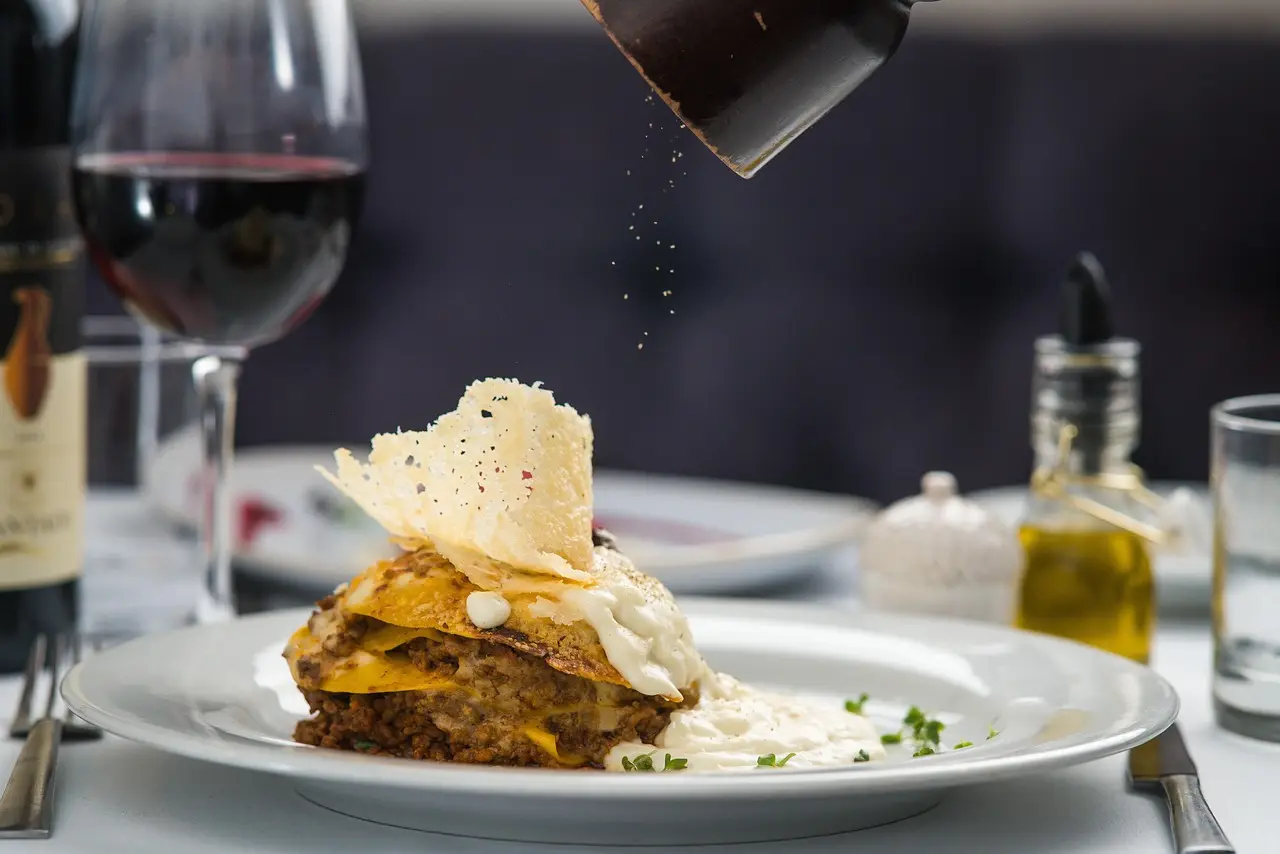
Lasagna is sheets of pasta stacked with sauce and cheese, then baked until the edges go crisp and the middle sets just enough to cut. Italy calls it home, Bologna claims the classic, Naples has its own carnival version, and even medieval England once tried to stake a claim. Under all the arguing sits a simple truth: lasagna is the dish families make when they have time, company and a reason to celebrate.
Background
For Italy's official food guardians, the Accademia Italiana della Cucina, the benchmark is lasagne verdi alla bolognese: green spinach egg pasta layered with ragù, béchamel and Parmigiano Reggiano 12. The Accademia certified that recipe on 28 May 2003 and lodged it by notarial deed with the Bologna Chamber of Commerce on 4 July 2003 2. It asks for at least six layers, even and tidy, with ragù that is "abundant but not excessive" 2.
A proper Bolognese version uses a slow meat ragù of veal, pork and offal, and leaves out both garlic and mozzarella 1. It should hold its shape when cut yet give way to a fork, not slump across the plate 1. Italian chef Giorgio Locatelli likened the sloppy British pub version to shepherd's pie, and Guardian food writer Rachel Roddy remembers her English childhood as "the bad lasagne years" 1. Harsh, but fair warning.
History
Ancient roots. Ancient Greece had laganon, which some describe as the first pasta: sheets of dough cut into strips 1. The Romans likely borrowed the name for their lagane, the base of a dish called lasagne patina, and the little we know about it is that it called for sow's belly and fish 1. Don't expect that one on a menu soon.
Where the word comes from. Two theories compete. One traces it to Latin lasanum, a cooking pot (and, less appetisingly, a chamber pot); Italian etymologists tend to prefer Greek laganon, the flat unleavened sheet 3.
Medieval kitchens. The first Italian mention of lasagne dates to 1281 3. The 14th-century Italian manuscript known as the Liber de Coquina gives a recipe "de lasanis": thin sheets of fermented dough cut into squares about three fingers wide, boiled in salted water, then layered with grated cheese and powdered spices 4. Diners picked the pieces up with a pointed wooden stick 4. No tomato, no meat sauce.
The English detour. Some researchers once claimed lasagne for England, pointing to a dish called loseyns in The Forme of Cury, the recipe collection made for Richard II's court in 1390 3. Word historian Michael Quinion explains the catch: loseyns is an old form of "lozenge", describing pasta cut into diamond shapes, and Italian lasagne was on record a century earlier 3.
Tomatoes arrive late. In Naples, tomato sauces did not join baked pasta until probably the late 1800s 5.
Customs, rules and rituals
Carnival in Naples. Lasagna di Carnevale is the last big feast before the meat-free weeks of Lent 5. It piles pasta with ricotta, mozzarella, tiny fried meatballs, sausage, tomato ragù and hard-boiled egg, and it traditionally takes at least four hours to make 5. The dish probably took shape in Naples in the early 1700s 5.
Christmas Eve without meat. Italy's meatless Christmas Eve tradition gets its own version in the Dolomites: baked lasagne with spiced apples and nuts 1.
Every region, its own rules. Liguria swaps ragù for pesto and keeps the béchamel creamy 1. Sardinia layers its lasagne with pane carasau, a paper-thin flatbread nicknamed carta da musica, "sheet music", for the noise it makes when you crunch it 1.
Sunday food. A lasagne made the Bolognese way is not a weeknight job. The ragù alone cooks for at least two hours 1, the pasta is rolled fresh, and the whole thing needs assembling layer by layer 2. That effort is exactly why it belongs to days when families gather.
Place in human experience
Lasagna is a dish of patience and plenty. In Naples it marks the edge of the church calendar: one huge, rich tray before forty days of restraint 5. In the Dolomites it fits inside the rule of a meatless vigil and still feels like a feast 1. Either way, the layers carry the meaning: abundance, built slowly, shared out in squares.
It also shows how proud people get about home cooking. Bologna went as far as a notary to fix its recipe in writing 2. England's brief claim on lasagne turned into a small international squabble settled by a word historian 3. And chefs keep playing with it. Massimo Bottura, at Osteria Francescana in Modena, built a whole dish called "The Crunchy Part of the Lasagne" 1. Anyone who has fought over the corner of the tray understands. New York chef Mark Ladner, formerly of Del Posto, went the other way and stacked a 100-layer version 1.
Ask anyone about lasagna and you will usually hear about a person: who made it, which tray, which corner they stole. That is the real recipe.
Sources
- Sarah Barrell, "Lasagne: the history and countless variations of a true Italian classic", National Geographic Traveller (UK), updated 24 April 2023. https://www.nationalgeographic.com/travel/article/lasagne-history-countless-variations-true-italian-classic
- "Lasagne verdi alla bolognese", Bologna Welcome (official tourism site of Bologna). https://www.bolognawelcome.com/en/other/recipes-and-typical-products/lasagne-verdi-alla-bolognese-2
- Michael Quinion, "Lasagne", World Wide Words. https://www.worldwidewords.org/tw-las1.html
- "Lasanis" (from the Liber de Coquina, after The Medieval Kitchen: Recipes from France and Italy, trans. Edward Schneider, University of Chicago Press, 1998), Medieval Cuisine. https://www.medievalcuisine.com/culinary-journey/recipe-index/lasanis
- Moriah House, "Lasagna Is Done A Little Differently In Naples, Italy", The Takeout, 30 June 2026. https://www.thetakeout.com/2201643/naples-italy-lasagna-explained/