
Moussaka
Silky aubergine, cinnamon-warm lamb, and a thick golden lid of béchamel that puffs up in the oven. That's moussaka to most of the world, and it feels as…
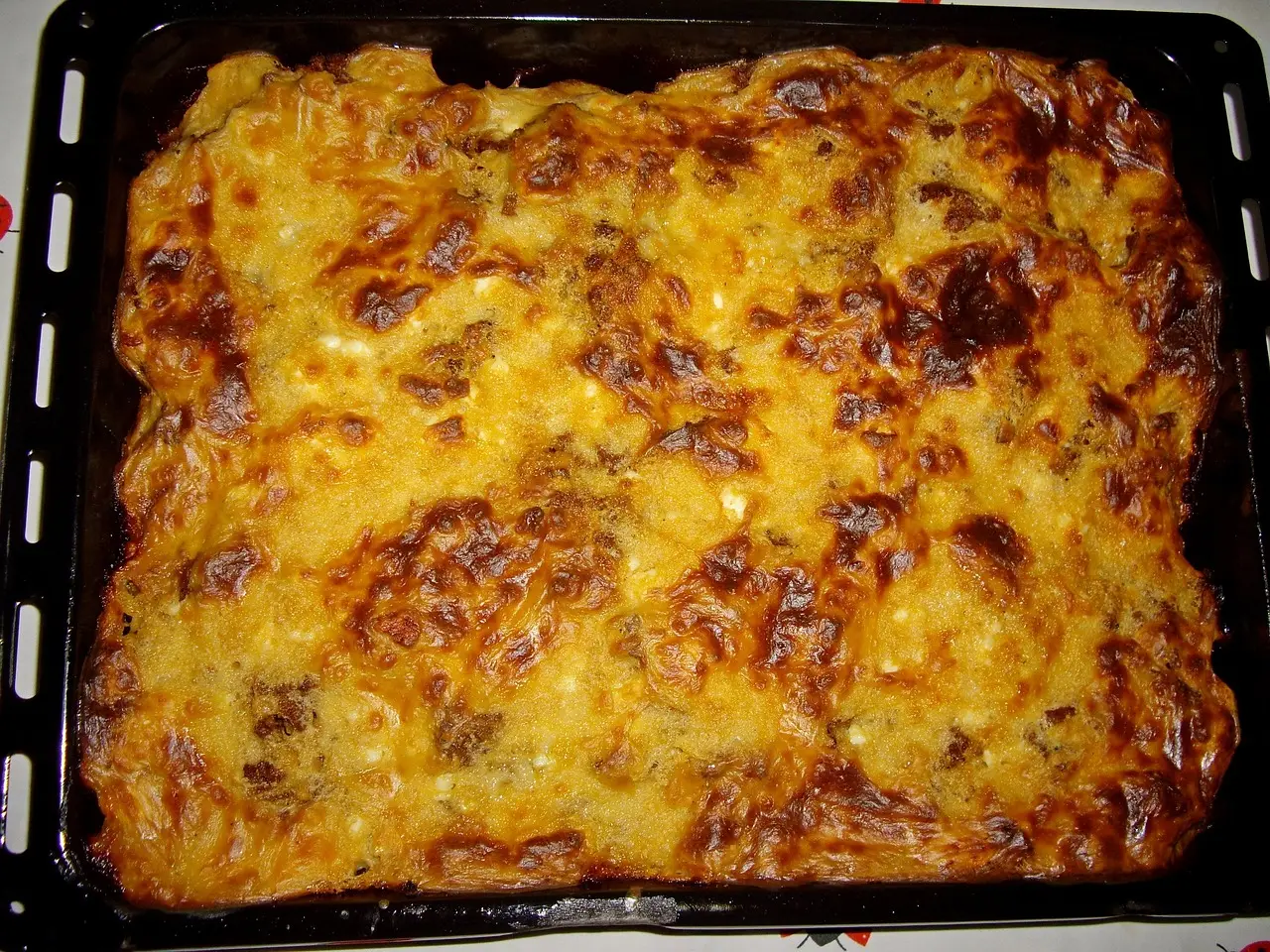
Silky aubergine, cinnamon-warm lamb, and a thick golden lid of béchamel that puffs up in the oven. That's moussaka to most of the world, and it feels as Greek as the Acropolis. Here's the twist: that version is barely a hundred years old, and one chef invented it on purpose 25. The older dish, without the white sauce, has been cooked from Baghdad to Cairo to the Balkans for centuries 3. So pull up a chair. This one's a good story.
Background
Even the name has travelled. English got "moussaka" from Greek, Greek got it from Ottoman Turkish, and Turkish got it from Arabic 3. Nobody quite agrees what the Arabic meant. One reading says "pounded" or "cold" 3, and one researcher glosses it as "cold dish" 6. Food historian Charles Perry prefers "moistened", as in soaked in broth 3, while Greek food writer Aglaia Kremezi links "moistened" to the tomato juices 2. Pick your favourite; the scholars haven't settled it.
Cross a border and the dish changes shape. In Turkey, musakka isn't layered at all: fried aubergine slices sit in a tomato and mince sauce with green peppers and garlic, eaten with rice pilaf and the cool yoghurt dip cacık 3. In Lebanon it's closer to an aubergine and tomato stew, often with chickpeas, served hot or cold as a meze 3. Egyptian mesaqa'ah layers fried aubergine soaked in tomato sauce, usually with spiced beef, and cooks like to chill it for a day so the flavours settle 3. Head into Albania, Bulgaria, the former Yugoslavia or Romania and potatoes push the aubergine out, topped with milk or yoghurt beaten with egg 3.
History
Layering aubergine with spiced meat is old news. A thirteenth-century Arabic cookbook, Kitab al-Tabikh, attributed to Muhammad bin Hasan al-Baghdadi, has dishes called maghmūmat: aubergine slices and spiced minced meat with onion, stacked in a pan 3. Food writer Felicity Cloake notes the recipe adds fat and a vinegar gravy 1. Swap the vinegar for béchamel and you're nearly there.
The name turns up in print in the 1800s. An 1862 English translation of an Ottoman cookbook gives English its first "moussaka", and the Turkish Ev Kadını of 1882 has a recipe too 3. In 1893 Ahmed Ibrahim, cook to Egypt's ruler Isma'il Pasha, put one in an Arabic cookbook 3. Back then, Cloake explains, the Ottoman word just meant fried vegetables with mince, not one particular bake 1.
Enter Nikolaos Tselementes. Born on the island of Sifnos in 1878, he trained for a year in Vienna and later studied in America 5. He launched a cookery magazine in 1910 and published his Cooking and Patisserie Guide in 1930 5; Kremezi dates his big influence on Athens' middle and upper classes to the 1920s 2. His book gave moussaka a whole chapter, six recipes in all 2. The star layered sautéed aubergine with lamb cooked in tomato, cinnamon and allspice, all under béchamel 3, and he beefed up the sauce with egg and kasseri cheese so it rose like a soufflé 4.
Kremezi puts it bluntly: before Tselementes there was no moussaka as Greeks know it now, just fried aubergine topped with meat and tomato sauce 12.
Customs, rules and rituals
Greek moussaka is not a Tuesday-night throw-together. Kremezi describes it as a treat baked in city homes for guests and family on festive days 2. And it needs patience after the oven too: cook Elisavet Sotiriadou tells Cloake to let it rest so the flavours can bloom 1. (Translation: don't burn your mouth.)
Then there's Lent. Orthodox Christians traditionally give up meat, dairy, eggs, fish with backbones, olive oil and wine on weekdays in Great Lent, with gentler rules for the elderly and unwell 7. A lamb-and-béchamel bake breaks pretty much all of those at once. So cooks improvised. Tselementes himself wrote a fasting moussaka with minced aubergine, vegetables, tomato sauce and breadcrumbs, no meat and no dairy 13. Romanian cooks swap in mushrooms or onion and rice 3, and Egyptian mesaqa'ah happily goes meat-free too 3.
Local cooks play with the veg. Some Cycladic islands use artichokes, and cooks in Macedonia add potatoes to stop the layers sliding about 1. Greek kitchens also tuck in courgette or mushrooms, or stuff whole little aubergines and call them papoutsákia, "little shoes" 3. In Gaza, cooks add tomato and fall back on canned meat when fresh is scarce 3.
Place in human experience
That béchamel wasn't just about flavour. Tselementes thought centuries of Ottoman rule had left Greek food greasy and over-spiced, and he wanted it tidied up by "learned cooks" 12. Artist Anna Housiada's research for the Delfina Foundation describes his mission as clearing out "oriental" influence: less garlic and spice, more butter, cream and French sauces 6. A white sauce, in other words, that said "Greece is European".
It stuck. His surname now means "cookbook" in Greek, and calling someone a Tselementes is a compliment to their cooking 56. Moussaka became such a national emblem it even landed on Greek postage stamps 6. And as Greeks moved to Western Europe, the United States, Canada and Australia through the 1900s, the casserole went with them and became one of the best-known faces of Greek food abroad 4.
Yet the old versions never left. A cold Lebanese aubergine stew and a puffy Athenian holiday bake still share one name, and a long shared past. Not bad for a pan of aubergines.
Sources
- Felicity Cloake, "Everything you need to know about moussaka", National Geographic Traveller (UK), 23 August 2023. https://www.nationalgeographic.com/travel/article/everything-you-need-to-know-about-moussaka-classic-greek-dish
- Aglaia Kremezi, "The Origins of Mousaka, and my Sloppy Version", aglaiakremezi.com. https://www.aglaiakremezi.com/the-origins-of-mousaka-and-my-sloppy-version/
- "Moussaka", Wikipedia. https://en.wikipedia.org/wiki/Moussaka
- Steve Dunn, "Moussaka: Greece's Iconic Casserole", America's Test Kitchen, 8 August 2022. https://www.americastestkitchen.com/articles/5744-moussaka-greeces-iconic-casserole
- "Nikolaos Tselementes", Wikipedia. https://en.wikipedia.org/wiki/Nikolaos_Tselementes
- Anna Housiada, "Moussaka and the Politics of Spices", Delfina Foundation, 2024. https://www.delfinafoundation.com/platform/moussaka-and-the-politics-of-spices/
- "The Discipline of Fasting", Serbian Orthodox Diocese of Eastern America. https://www.easterndiocese.org/news_170226_1