
Naan
Tear a naan straight from the oven and it fights back a little: a crisp, blistered outside, a soft and stretchy middle, a puff of steam and the smell of…
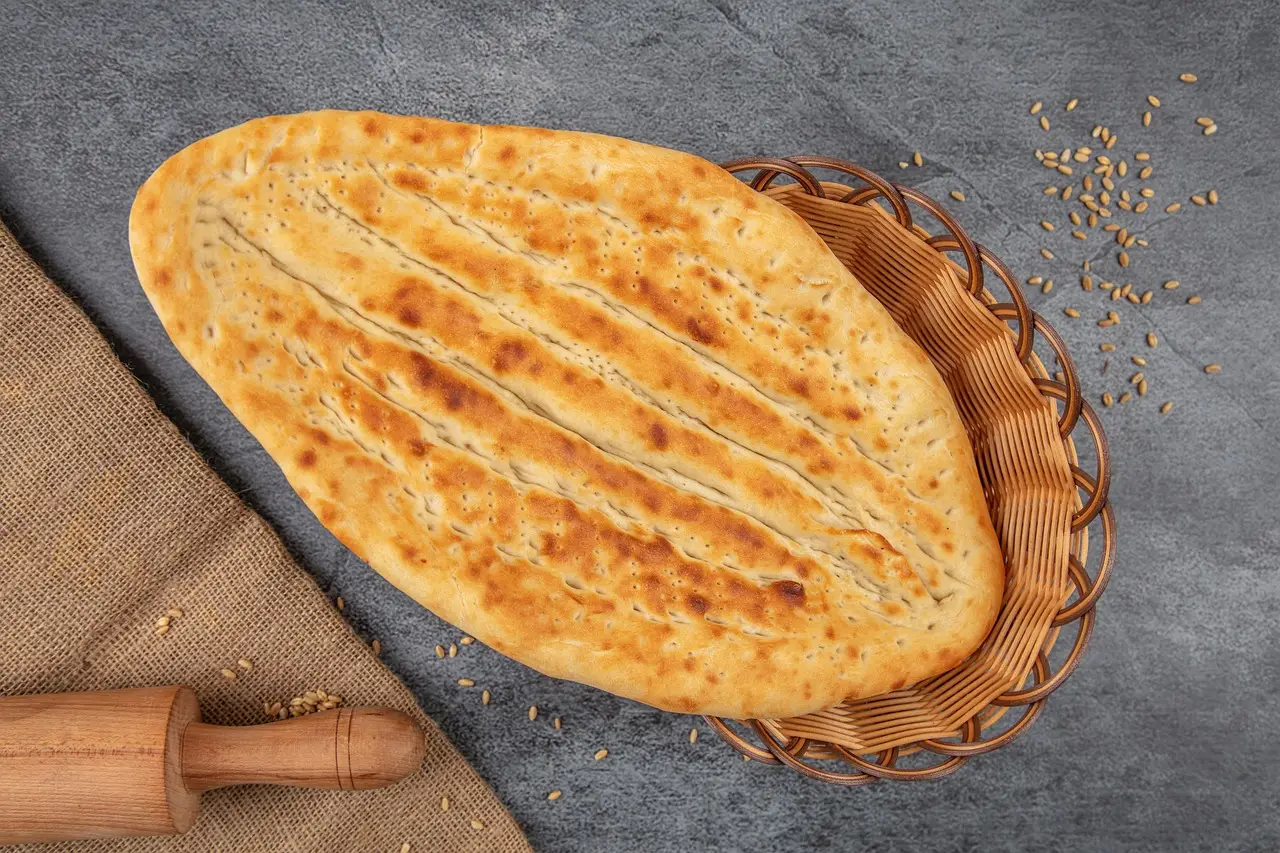
Tear a naan straight from the oven and it fights back a little: a crisp, blistered outside, a soft and stretchy middle, a puff of steam and the smell of charred wheat and butter. Then you swipe it through a curry and the evening improves. Naan is a leavened flatbread from Central and South Asia, and its name simply means "bread". It started life as food for sultans, and now it turns up beside takeaway curries from Melbourne to Manchester.
Background
The word comes from Persian nân, a general word for any bread 1. The dough is white or wholemeal wheat flour, a leavening agent (usually yeast), water, salt, ghee and yoghurt 1. Yoghurt is the secret to that tender, slightly tangy chew.
What makes naan naan, though, is the oven. Bakers roll the dough into balls, flatten them and slap them onto the inside wall of a tandoor, a clay oven that can reach about 480 °C 1. The bread sticks, bubbles and chars in a minute or two, then comes off on a long hook. Hot work, and a real skill.
Cousins of naan turn up across Iran, Afghanistan, Central Asia, Myanmar and western China, each with its own local twist 1.
History
The oven is far older than the bread's name. "Tandoor" comes from Persian tanūr, which goes back to the Akkadian tinūru, a word that shows up in the Epic of Gilgamesh 2. Armenians built underground versions called tonirs, and Turkmen families still bake in clay tamdyr ovens 2.
Naan's first written appearance in India comes from the poet Amir Khusrau in the 1300s. Khusrau describes two breads eaten by Muslim nobles: naan-e-tunuk, light and thin, and naan-e-tanuri, heavier and baked in the tandoor 1. Gulf News writer Alisha Roy adds a lovely Delhi detail: the wife of 13th-century sultan Alauddin Khilji would seek out bread blessed by the Sufi saint Nizamuddin Auliya 3.
Under the Mughals, from the 1520s, naan stayed a luxury. Leavening took time, and few bakers knew the craft 1. Mughal royals ate it at almost every meal with kebabs and gravies 3. By the 1700s it had reached ordinary people in the Mughal cities 1.
The modern restaurant naan has a more recent, more dramatic story. Rural Punjab had shared village tandoors for generations 2, but tandoori cooking only went mainstream after the 1947 Partition, when Punjabi Sikhs and Hindus resettled in cities such as Delhi 2. Two men, Kundan Lal Gujral and Kundan Lal Jaggi, fled Peshawar and opened Moti Mahal, an open-air restaurant in Old Delhi where diners could watch their food cooked 4. Tandoori chicken and butter chicken followed, mopped up with naan.
Who invented what is now a court case. In January 2024 the Gujral family's Moti Mahal Delux sued Daryaganj, a chain run by Jaggi's descendants, over the claim to butter chicken 4. Each family credits its own Kundan. Naan, happily, belongs to everyone.
The English spelling "naan" took over from the 1970s, as curry houses spread through Britain and beyond 1.
Customs, rules and rituals
Bread across this region is more than a side dish. In Azerbaijan, Iran, Kazakhstan, Kyrgyzstan and Türkiye, making and sharing flatbread is recognised by UNESCO as living heritage, inscribed in 2016 5. It takes at least three people, often family, to roll, stretch and bake 5.
Bread marks life's big moments too. At weddings in Azerbaijan and Iran, bread goes on the bride's shoulders or is crumbled over her head as a wish for plenty, and Turkish neighbours bring the couple bread as a gift 5. Kazakh families bake bread when someone dies, believing it protects the departed at judgement, and Kyrgyz families share it to ease the way to a better afterlife 5.
In old Punjab the shared village tandoor did a similar job: one oven shared by the whole village, a habit some places keep today 2.
Place in human experience
Naan carries a whole social ladder in one bread. It began as a noble's luxury, because yeast, time and a scorching oven cost more than a quick griddle roti 1. Over centuries it moved down the ladder to city streets 1, and after Partition it travelled with refugees who rebuilt their lives around a clay oven 24.
That's why naan tastes of home for so many families in the diaspora. It's the bread of Sunday takeaway, of a restaurant founded by people who'd lost everything, and of a court battle between two families who both remember a grandfather at the tandoor 4.
And there's a softer thread. A sultan's wife sought bread blessed by a saint 3. Brides in Iran wear it on their shoulders 5. Bread, in this part of the world, has always been a blessing you can eat.
So next time you tear a warm naan, remember: you're holding a bread named in Persian, praised by a 14th-century poet, baked in an oven older than Gilgamesh.
Sources
- "Naan", Wikipedia, Wikimedia Foundation. https://en.wikipedia.org/wiki/Naan
- "Tandoor", Wikipedia, Wikimedia Foundation. https://en.wikipedia.org/wiki/Tandoor
- Alisha Roy, "Naan: A bread that made Sultans come seeking", Gulf News. https://gulfnews.com/food/naan-a-bread-that-made-sultans-come-seeking-1.1667818202436
- "Who invented butter chicken? A court in India will decide", NBC News. https://www.nbcnews.com/news/world/invented-butter-chicken-court-india-will-decide-rcna153870
- "Flatbread making and sharing culture: Lavash, Katyrma, Jupka, Yufka", UNESCO Intangible Cultural Heritage. https://ich.unesco.org/en/RL/flatbread-making-and-sharing-culture-lavash-katyrma-jupka-yufka-01181