
Pizza
Blistered crust, leopard-spotted from a blazing oven. A puddle of tomato, molten mozzarella, a few basil leaves wilting in the heat. Pull a slice and the…
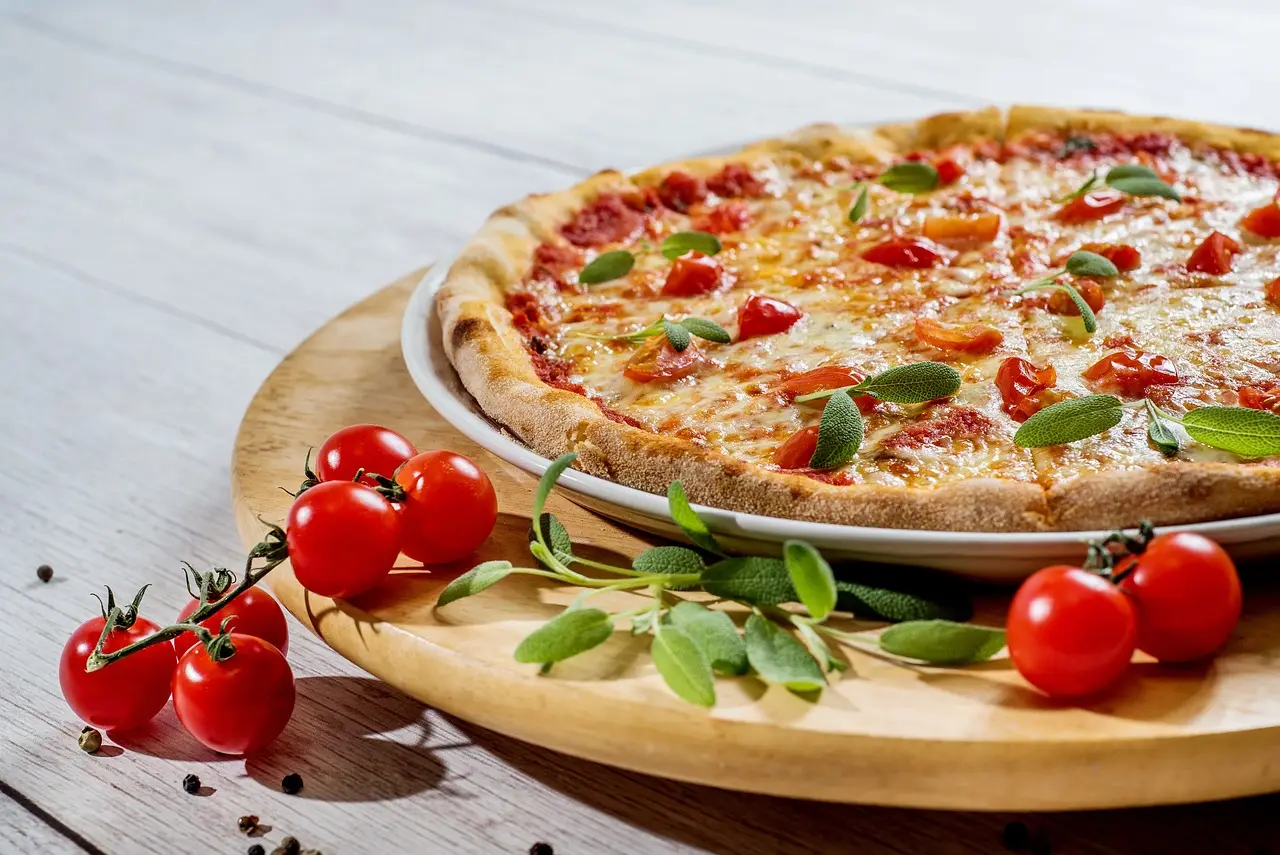
Blistered crust, leopard-spotted from a blazing oven. A puddle of tomato, molten mozzarella, a few basil leaves wilting in the heat. Pull a slice and the cheese stretches in a string you have to wind round your finger. Pizza began as cheap street food for the poor of Naples and became the world's favourite dinner. Along the way it picked up a bishop, a queen, a few disputed legends and a UNESCO listing.
Background
At its simplest, pizza is a flat yeasted dough topped and baked hot. The Neapolitan version is the benchmark: the European Union gave it Traditional Speciality Guaranteed status in 2009–2010 1, and UNESCO recognised the art of the Neapolitan pizzaiuolo in 2017 2.
Pizza is now a global business worth about US$128 billion, and around 13 per cent of Americans eat it on any given day 1.
History
Flatbreads with things on top are ancient. In 2023 archaeologists at Pompeii uncovered a first-century fresco showing a flatbread on a silver plate beside a cup of wine, perhaps topped with fruit, spices or a pesto-like sauce 3. The site's director, Gabriel Zuchtriegel, put it nicely: "Obviously it is not a pizza but perhaps it could have been a distant ancestor of this food" 3. No tomato, no mozzarella: tomatoes had not yet crossed from the Americas 3.
The word itself first appears in 997 AD, in a Latin document from Gaeta, south of Rome. Tenants owed the bishop duodecim pizze, twelve pizzas, every year 1. Whatever those were, they didn't look like today's.
Modern pizza took shape in Naples in the 18th or early 19th century. It was food for the poor, sold by street vendors and open-air stalls 1. Around 1830 pizzerias started offering seats, turning a snack into a meal 1.
Now for the famous story, and why you should take it with a pinch of salt. Legend says that on 10 June 1889, pizzaiolo Raffaele Esposito made a pizza for Queen Margherita in the colours of the new Italian flag: red tomato, white mozzarella, green basil. The queen loved it, the pizza took her name, and a thank-you letter still hangs in his old shop, now Pizzeria Brandi 4.
The evidence is shakier. In 2014 researcher Zachary Nowak questioned the letter's authenticity, no newspaper of the day reported the royal visit, and the Margherita story was first promoted in the 1930s and 1940s 4. Better still, Francesco De Bourcard described pizzas topped with thin mozzarella slices and basil in 1866, 23 years before the queen supposedly tasted one 4. A lovely legend; a doubtful history.
Pizza then sailed. Italian migrants carried it to America, and about four million Italians had arrived by the 1920s 5. Lombardi's opened in Manhattan in 1905, the first licensed pizzeria in the United States 5. Soldiers returning from Italy after the Second World War came home hooked 5. In 1947 the New York Times complained that pizza "could be as popular a snack as the hamburger if Americans only knew about it" 5. They soon did: pizza parlours jumped from 500 in 1934 to 20,000 by 1956 5. Chicago's Pizzeria Uno launched deep-dish in 1943, and Domino's, founded in 1960, made free home delivery normal 5. Britain caught on after the war, helped along by PizzaExpress from 1965 1.
Customs, rules and rituals
In Naples, pizza making is a performance. UNESCO describes four phases of preparing the dough and baking it in a wood-fired oven, with a twirling, rotating movement by the baker 2. The pizzaiuolo stands at the centre of the bottega, the workshop, like an actor on stage, and the job passes down by apprenticeship as young cooks watch the masters 2. About 3,000 pizzaiuoli work in Naples, and families keep the art alive at home too 2.
Italian-American communities built their own rituals, from "pizza and sausage" clubs to friendly pizza-making contests, and claimed it as their "national" dish 5. By 1963, American schoolkids ranked pizza third among cafeteria favourites, behind only hamburgers and hot dogs 5.
Place in human experience
Pizza is a class story told in dough. It started as the cheapest food on Naples' streets 1. Even the Pompeii fresco plays with that contrast: a humble flatbread on a silver plate 3.
It's also a story of invented tradition. The Margherita legend linked a poor city's street food to a queen and a newly united nation 4. Whether or not Esposito ever met her, the story did a job: it gave Naples, and Italy, a patriotic pizza.
For Italian migrants, pizza was a taste of home in a strange city, and then something better: a way in. A food once sold from street stalls in Naples ended up on American school menus 5. Few dishes have climbed so far so fast.
So whether you grab a slice from a delivery box or sit down to a blistered Margherita in Naples, you're joining a 1,000-year conversation that started with twelve pizzas owed to a bishop.
Sources
- "Pizza", Wikipedia, Wikimedia Foundation. https://en.wikipedia.org/wiki/Pizza
- "Art of Neapolitan 'Pizzaiuolo'", UNESCO Intangible Cultural Heritage. https://ich.unesco.org/en/RL/art-of-neapolitan-pizzaiuolo-00722
- "Pizza's distant ancestor found in painting on wall of Roman house in Pompeii", ABC News (Australia), 28 June 2023. https://www.abc.net.au/news/2023-06-28/pizza-distant-ancestor-painting-roman-house-pompeii/102533868
- "Pizza Margherita", Wikipedia, Wikimedia Foundation. https://en.wikipedia.org/wiki/Pizza_Margherita
- "American Pie", American Heritage. http://www.americanheritage.com/content/american-pie