
Risotto
Risotto asks for twenty minutes of your attention and pays you back handsomely. Onion softening in butter, rice crackling as it toasts, a splash of wine,…
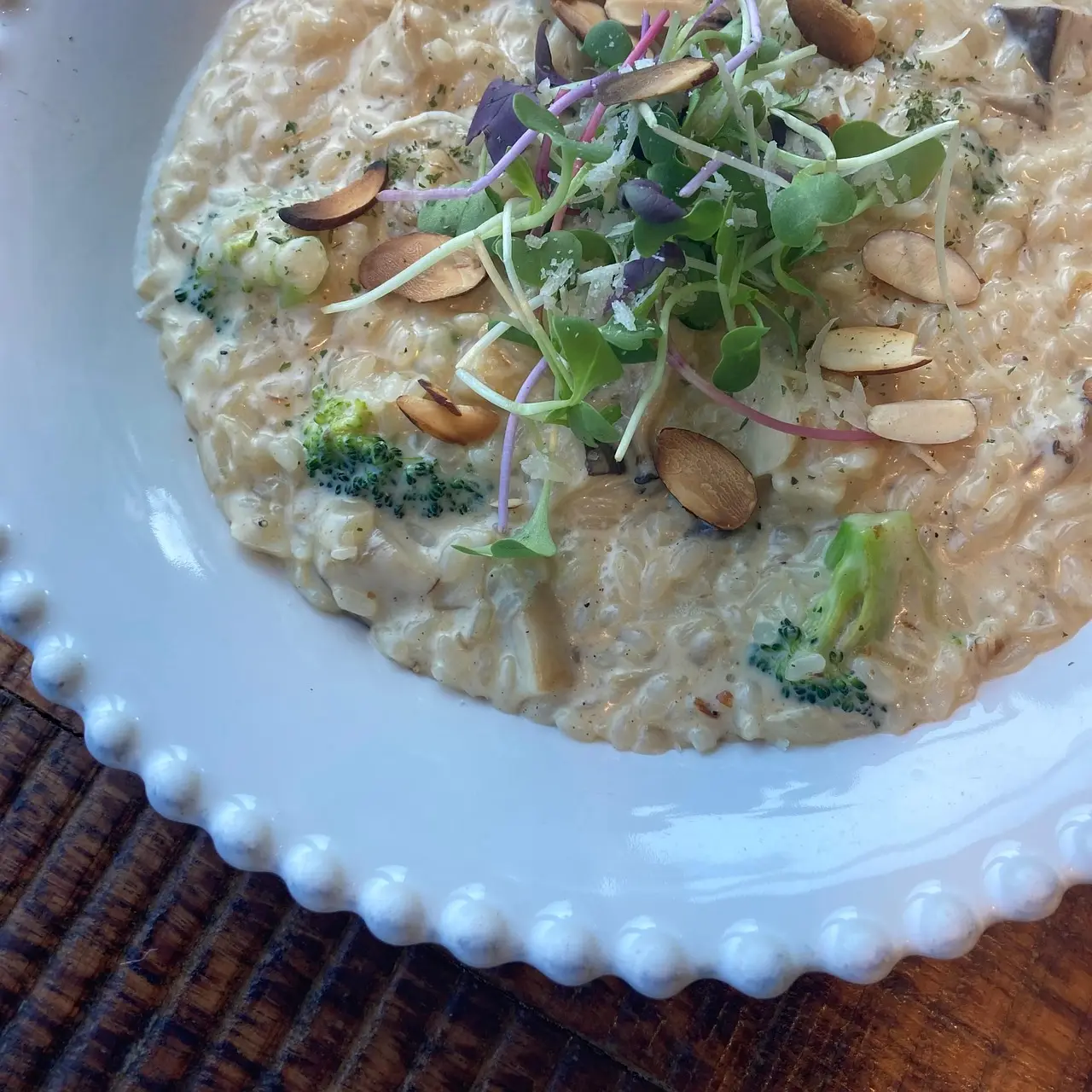
Risotto asks for twenty minutes of your attention and pays you back handsomely. Onion softening in butter, rice crackling as it toasts, a splash of wine, then ladle after ladle of hot stock while you stir and the kitchen fills with steam. At the end, a knob of cold butter and a fistful of Parmesan beaten in until the whole pot turns glossy and loose. Risotto is northern Italy's creamy rice, born in the wet fields of the Po Valley, and its golden Milanese version is practically a civic emblem.
Background
Risotto uses short-grain, high-starch rice, mainly Arborio, Carnaroli and Vialone Nano 1. The method matters as much as the grain: toast the rice in butter and onion, add warm stock a little at a time, keep stirring so the starch releases, then finish with mantecatura, beating in Parmesan and cold butter 1. Don't rinse the rice first; you'd wash away the starch that makes it creamy 1.
The classics include saffron-yellow risotto alla milanese, inky black risotto al nero di seppia with cuttlefish ink, and Venice's risi e bisi, rice and spring peas so loose it's properly eaten with a spoon 1.
History
Rice was a luxury in Italy long before it was a staple. The Accademia Italiana della Cucina, Italy's guardian of culinary tradition, says rice probably first grew in Sicily, brought by the Arabs around the same time they spread it in Spain in the 7th century, if not earlier 2. Through the Middle Ages, Italians mostly bought rice from spice merchants as a medicine or for sweet dishes 2. In 1250 the Sant'Andrea hospital in Vercelli bought rice to make biancomangiare, rice with almonds, to build up the sick 2. In 1386 Milan capped its price at twelve imperiali a pound, and Lombard merchants imported it from Catalonia alongside saffron 2.
Farming in the north took off in the 1400s. In 1475 Galeazzo Maria Sforza, Duke of Milan, sent twelve sacks of seed rice to Ercole I d'Este, Duke of Ferrara, to plant in the marshes 2. His son tried to stop rice seed leaving the duchy, without success; cultivation spread to Piedmont, the Veneto and Mantua 2. By the late 1400s Lombardy and Piedmont were already exporting rice to Switzerland 2. The Venetian Republic regulated rice growing from the 1500s and limited it to marshland, keeping good soil for wheat and fodder 2.
Milan's yellow risotto comes with a famous legend: Valerio Profondavalle, a glassmaker working on Milan Cathedral, supposedly added saffron to the rice at a wedding feast around 1574 1. Lovely, but legend. The Accademia tells a more grown-up story: saffron and rice met over a long period, and the recipe settled in the early 1800s 2. The first documented risotto recipe appeared in 1809 1, and in 1829 Giovanni Felice Luraschi named the risotto giallo alla milanese in his Nuovo cuoco milanese economico. His version toasted the rice with onion, beef fat and marrow and added half a saffron-spiced cervellata sausage, which may have inspired the saffron in the first place 2. Milan made the recipe official with a municipal De.Co. listing in 2007 2.
Customs, rules and rituals
Rice once paid wages. The mondine, the women who weeded the flooded rice fields, were partly paid in rice; in Vercelli the prized Maratelli variety, the "Sunday rice", was used to pay them 2. Their hard lives became the backdrop of Bitter Rice (Riso amaro), Giuseppe De Santis's 1949 film set among the women rice workers of the Po Valley, a landmark of Italian neorealism that launched Silvana Mangano to fame 3. The Accademia notes that Vercelli's rice workers won early labour rights: a nine-hour day in 1906 2.
Families had their own shortcuts. The Accademia recalls mothers sliding a fried egg onto plain boiled rice with plenty of butter; stirred through, it turned gold, a thrifty imitation of saffron risotto with eggs from the backyard hens 2.
In Biella, cooks made rice in a copper pot for the supper that ended the summer season in the high pastures 2.
Place in human experience
Risotto tells a tale of rice climbing and descending the social ladder. In the Middle Ages it was an expensive import for banquets and the sick 2. In the Po Valley it became food for the poor, even wages for the mondine, and then a dish for every table 2.
It also tells a story about belonging. The Accademia describes Milan's yellow risotto as a metaphor for newcomers who find their place in the city, just as rice and saffron, both from the distant East, found theirs 2. Few dishes get a compliment like that.
And it carries memory. A mother's egg-yellow rice 2, a summer supper in the mountains 2, a film about women bent over flooded fields 3: Italians eat risotto with all of that in the pot.
So keep stirring. You're cooking with a duke's seed, a sausage-maker's saffron and the sweat of the mondine.
Sources
- "Risotto", Wikipedia, Wikimedia Foundation. https://en.wikipedia.org/wiki/Risotto
- La cucina del riso (Itinerari di cultura gastronomica), Accademia Italiana della Cucina. https://www.accademiaitalianadellacucina.it/sites/default/files/print_pdf/AIC_Itinerari%20del%20riso_All.compressed.pdf
- "Bitter Rice", Wikipedia, Wikimedia Foundation. https://en.wikipedia.org/wiki/Bitter_Rice