
Satay
Follow the smoke. Somewhere ahead a vendor fans a long, narrow charcoal grill, and rows of little skewers sizzle and char, dripping marinade onto the…
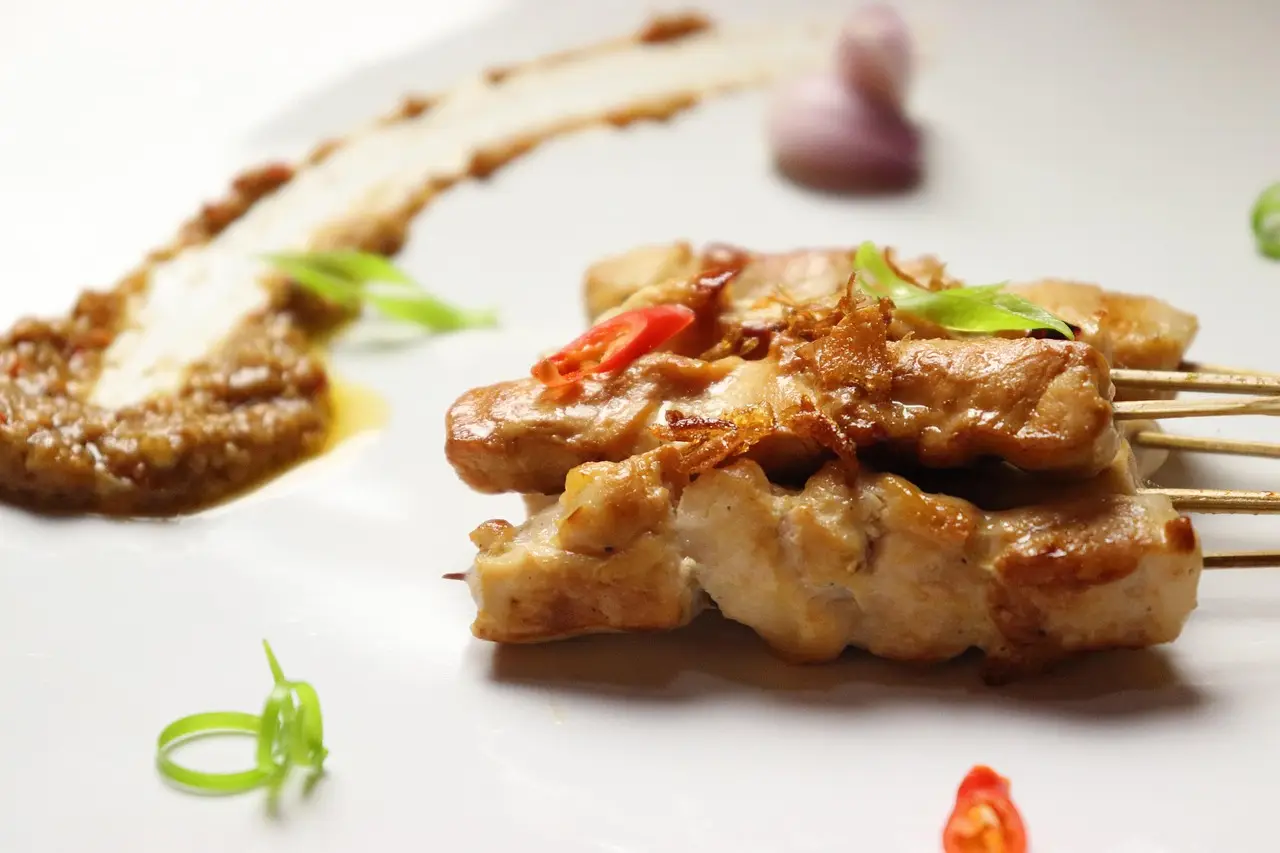
Follow the smoke. Somewhere ahead a vendor fans a long, narrow charcoal grill, and rows of little skewers sizzle and char, dripping marinade onto the coals. You get a fistful of sticks, a bowl of peanut sauce, maybe some compressed rice cakes and cucumber, and you eat them hot, because waiting is a crime. Satay is marinated meat grilled on skewers, a street food of Java that spread right across Southeast Asia and well beyond.
Background
Satay means small pieces of marinated meat, usually chicken, beef or mutton, threaded on thin bamboo or metal sticks and grilled 3. Indonesia alone has at least 40 kinds 2. A few favourites:
- Sate Padang: beef and offal in a dark red spiced sauce, from West Sumatra 2
- Sate lilit: Balinese minced fish wrapped round flat bamboo skewers 2
- Sate klatak: goat seasoned with little more than salt and pepper, grilled on bicycle spokes 2
- Sate ayam: chicken satay, a speciality of Madura island 2
Indonesians take it seriously. According to SBS Food, fans can eat 15 skewers in a sitting, and the rule is to eat them straight away, however hot 2.
History
Satay was born where trade routes crossed. Food expert Arie Parikesit points out that cooks in India, Pakistan and Central Asia grill meat on metal sticks; Indonesian cooks swapped in bamboo and local spices 2. Historians link satay to the Indian seekh kebab, itself a cousin of the Turkish shish kebab 3.
Muslim merchants brought Middle Eastern kebabs to the port cities, Tamil and Gujarati traders brought seasoned grilled meats, and Chinese migrants may have contributed the bamboo skewer and bite-sized pieces 1. Even the name shows the mix: it most likely comes from the Tamil catai, "flesh", via Javanese saté and Malay satai 13. A competing theory traces it to a Hokkien phrase for "three pieces of meat", though that theory looks unlikely 1.
The peanut sauce has its own journey. Peanuts came from the Americas on the Spanish Manila galleons and went on to become satay's signature partner 1.
By the 1800s colonial writers described satay as a popular street and festival food across the Indonesian archipelago and the Malay Peninsula 1. In the late 19th century it crossed the Strait of Malacca to Malaysia, Singapore and Thailand 3. Javanese labourers took it to Suriname, Indo-Dutch families to the Netherlands, and Cape Malay communities to South Africa, where it became the sosatie 1.
Customs, rules and rituals
In Jakarta the satay seller used to come to you. Restaurant owner Alfonso remembers his family buying 50 sticks for dinner every week; when the seller's bell rang, people ran out, and the smoke told you the meat was fresh 2.
Singapore built satay into its street life. Early hawkers sold noodles, curries and skewered meat from their home countries 5, and Malay hawkers in particular became known for flame-grilled meat sticks 6. The satay man, usually Malay, carried skewers and peanut sauce into Chinese neighbourhoods too 5. Singapore's Satay Club became famous for evenings of shared outdoor eating 1, and today satay hawkers still grill at Lau Pa Sat 5. In 2020 UNESCO recognised Singapore's hawker culture as intangible heritage 5.
Satay also crosses faiths. It features in Islamic celebrations, and in Bali's Hindu rituals sate lilit stands for male strength, unity and prosperity 1. In Malaysia the town of Kajang is famous for it, and in Thailand it spread through Malay-Muslim communities in the south 1.
Place in human experience
Satay is a dish made by a crowd. Tamil words, Arab and Indian grilling, Chinese skewers, American peanuts and Javanese spice all landed in one stick 12. It's a fine reminder that "national" foods are often the most international of all.
And yet it's fiercely national. In 2018 Indonesia's Tourism Ministry named satay one of five national dishes, chosen because it represents the country and can be found everywhere 4. Malaysia claims it too, and Indonesia has even put it on postage stamps 1.
It's also a dish that breaks down walls between communities. Writing about Singapore, National Geographic notes that hawker centres are often the first place people try another community's food 5. A Malay satay man walking into a Chinese neighbourhood with a grill was everyday diplomacy 5.
For migrants, satay is home on a stick: Javanese families in Suriname, Indo-Dutch families in the Netherlands and Cape Malay cooks in South Africa all kept the skewers turning 1.
So when you hear that sizzle, grab a stick and eat it now. The vendors are right: no matter how hot it is.
Sources
- "Satay", Wikipedia, Wikimedia Foundation. https://en.wikipedia.org/wiki/Satay
- "A peek at Indonesia's 40 ways with satay", SBS Food. https://www.sbs.com.au/food/article/a-peek-at-indonesias-40-ways-with-satay/q8er44p9n
- "From Java's street vendors to Southeast Asian icon: the story of sate or satay", SEAsia.co, 12 July 2023. https://seasia.co/2023/07/12/from-javas-street-vendors-to-southeast-asian-icon-the-story-of-sate-or-satay
- "Kemenpar Tetapkan 5 Makanan Nasional Indonesia, Ini Daftarnya", Kompas, 10 April 2018. https://travel.kompas.com/read/2018/04/10/171000627/kemenpar-tetapkan-5-makanan-nasional-indonesia-ini-daftarnya
- "Why UNESCO is honoring Singapore's street food", National Geographic. https://www.nationalgeographic.com/travel/article/why-unesco-is-honoring-singapore-street-food
- "Serving Up a Legacy", Roots.sg, National Heritage Board, Singapore. https://www.roots.gov.sg/stories-landing/stories/Serving-Up-a-Legacy