
Souvlaki
Charred edges, juicy middle, a squeeze of lemon and a shake of oregano. Wrap it in warm pita with tomato, onion, tzatziki and a few chips, roll it in…
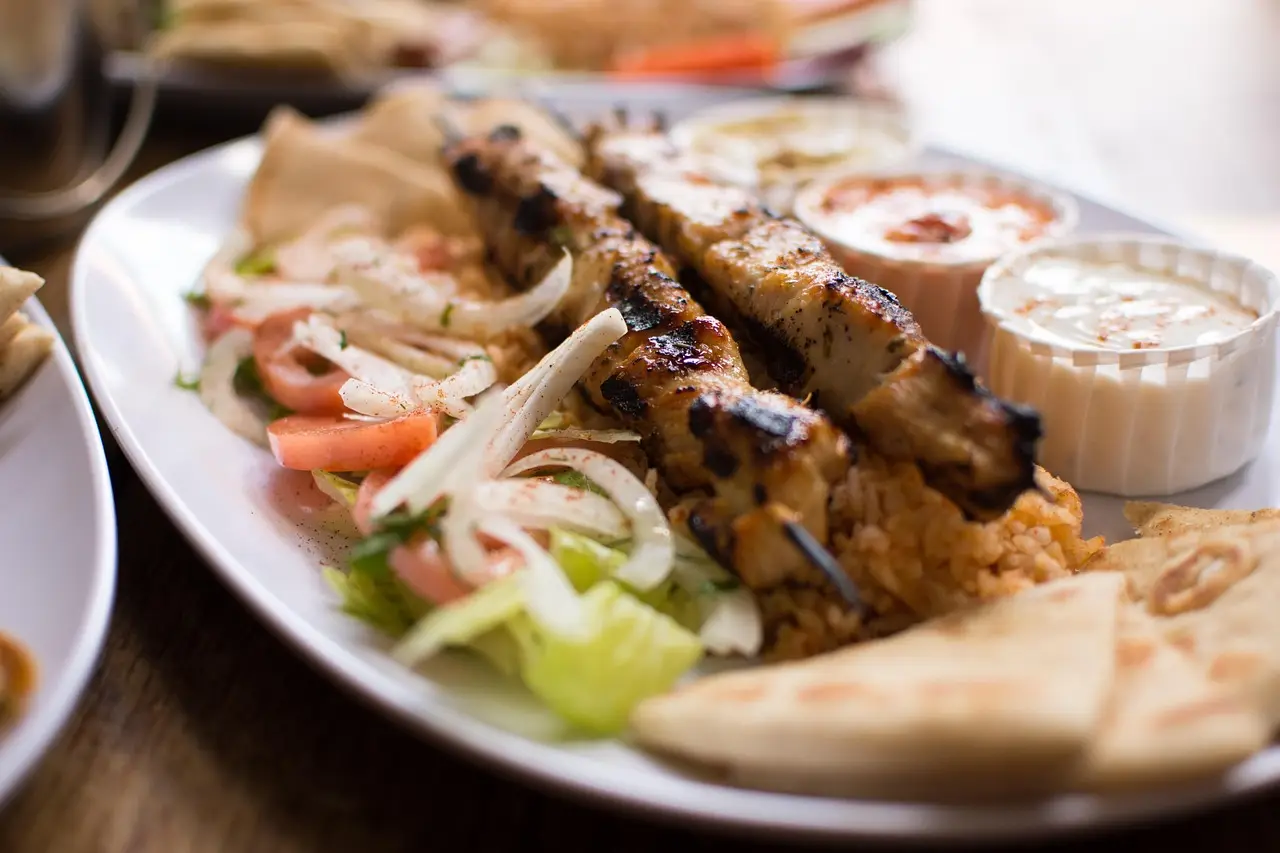
Charred edges, juicy middle, a squeeze of lemon and a shake of oregano. Wrap it in warm pita with tomato, onion, tzatziki and a few chips, roll it in paper, and try not to drip garlic sauce down your front on the walk home. Souvlaki is Greece's skewered grilled meat, and while the takeaway version is barely seventy years old, Greeks have been cooking meat on spits for more than three thousand years.
Background
Souvlaki means small pieces of meat grilled on a skewer. It's eaten straight off the stick or wrapped in pita with tomatoes, onions, sauce and fried potatoes 1. Pork is the traditional meat in Greece and Cyprus, though chicken and lamb are common too 1.
The name comes from the medieval Greek soúvla, "skewer", borrowed from Latin subula 1. In northern Greece many people call it kalamaki, "little reed" 1. Cypriots go bigger: larger chunks of meat in a pocket pita with cabbage and yoghurt 1.
History
This might be one of the oldest recipes still on the menu. On Santorini, archaeologists found sets of stone cooking supports used before the great Thera eruption of the 17th century BC 1. Bronze Age Greeks were grilling.
The Mycenaeans even had portable barbecues. In 2014 archaeologist Julie Hruby of Dartmouth College presented a study of Mycenaean "souvlaki trays", ceramic grill pans from the late Bronze Age 2. With ceramicist Connie Podleski she made replicas and cooked on them using ingredients from Linear B tablets. The trays worked best with hot coals placed inside, so they could be carried, rather than set straight into a fire 2. Professional cooks, Hruby concluded, prepared feasts for the Mycenaean elite 2.
Homer's heroes ate this way too. In Book 1 of the Iliad, after a sacrifice to Apollo, the Greeks "cut up the rest and spitted it, and roasted it carefully, and drew all off the spits", then feasted together 3. Aristophanes' comedies mention meat roasted on spits as well 1.
In Byzantine Constantinople, "hot meat shops" sold spit-roasted meat much like souvlaki 1. The Byzantines also made a dish identical to today's kokoretsi, offal wrapped in intestines and grilled on a spit 4.
The souvlaki you buy at a late-night shop is much newer. Grilled meat as everyday fast food only took off in Greece after the Second World War, and street vendors made it hugely popular in the 1960s 1.
Customs, rules and rituals
In Homer, cooking meat on spits was a religious act. Thigh pieces went to the god as burnt offerings, the worshippers tasted the entrails, and the rest became a shared feast where nobody went without 3. Sacrifice and barbecue were one event.
The spit still marks Greece's biggest feast. At Orthodox Easter, families roast the lamb as the main dish and snack on kokoretsi while it cooks 4.
The everyday ritual is simpler: order at the counter, choose pork or chicken, wrapped or on the stick, and eat standing up or walking. Wherever souvlaki goes, it stays a food of the street 1.
Place in human experience
Souvlaki ties modern Greeks to an unbroken line of fire and skewers, from Santorini's stone supports 1 to Mycenaean trays 2 to Homer's feasts 3. Few takeaway foods can claim a Bronze Age pedigree.
It also shows how status shifts. In the Mycenaean world, skewered meat cooked by professional cooks fed the elite 2. In Homer, it fed the community after a sacrifice 3. From the 1960s, street vendors made it everyday fast food 1. Same skewer, very different tables.
And it travelled with Greek migrants. Australia received one of its largest migrations from Greece after the Second World War and the Greek Civil War, peaking in 1971 with 160,200 arrivals 5. Melbourne became the heart of Greek Australian life, and Victoria counted 181,184 people of Greek ancestry in the 2021 census 5.
So when you bite into a souva at midnight, you're eating a recipe that Homer's heroes, Byzantine shopkeepers and Mycenaean cooks would all recognise. Extra tzatziki is optional; history is included.
Sources
- "Souvlaki", Wikipedia, Wikimedia Foundation. https://en.wikipedia.org/wiki/Souvlaki
- "Mycenaean Souvlaki Tray", Archaeology (Archaeological Institute of America), 9 January 2014. https://archaeology.org/news/2014/01/09/140109-mycenaean-souvlaki-tray-2/
- Homer, Iliad, Book 1, lines 457–470, trans. A.T. Murray, Perseus Digital Library, Tufts University. https://www.perseus.tufts.edu/hopper/text?doc=Hom.+Il.+1.465&fromdoc=Perseus:text:1999.01.0134
- "Kokoretsi", Wikipedia, Wikimedia Foundation. https://en.wikipedia.org/wiki/Kokoretsi
- "Greek Australians", Wikipedia, Wikimedia Foundation. https://en.wikipedia.org/wiki/Greek_Australians