Spring rolls
A spring roll is a thin wrapper rolled around a filling, then fried crisp or served soft and fresh. The name is a literal one: in China these rolls belong…
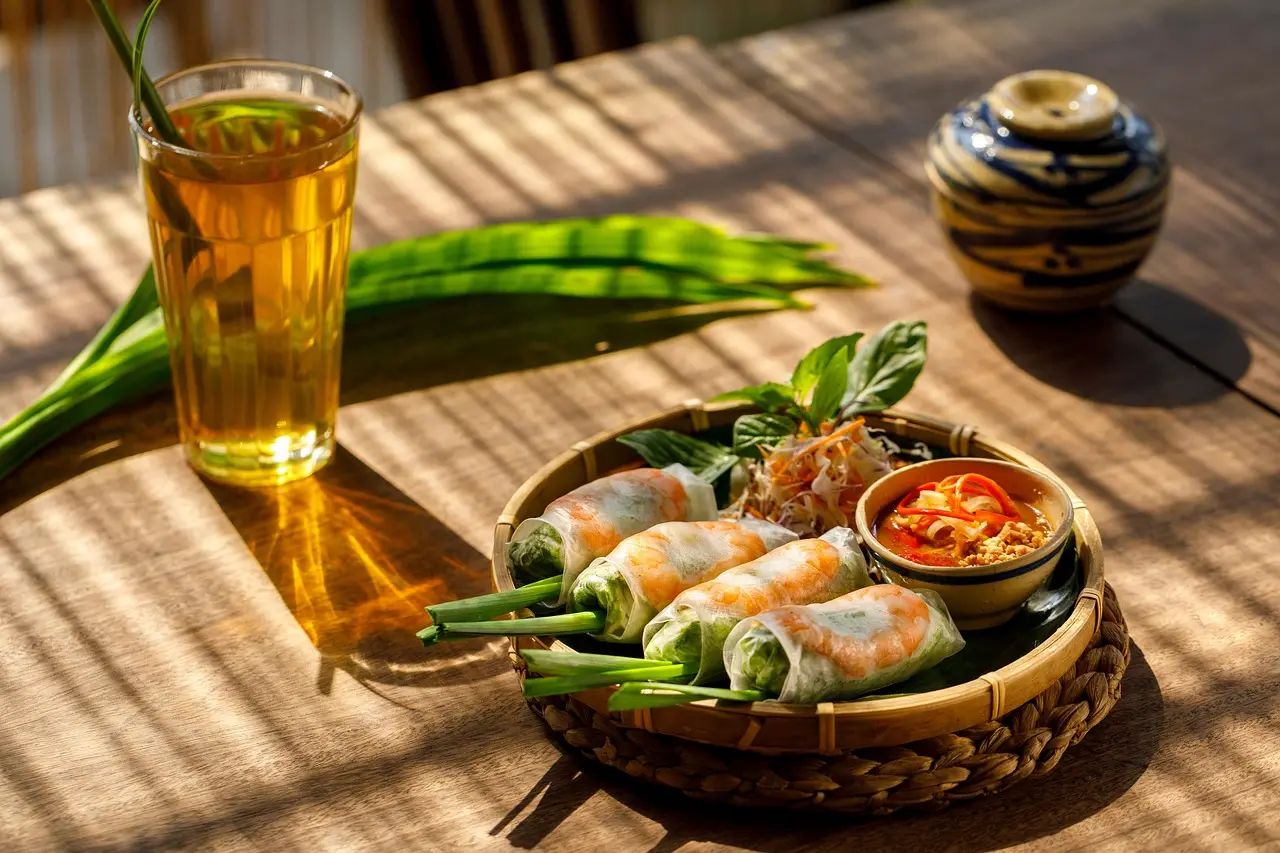
A spring roll is a thin wrapper rolled around a filling, then fried crisp or served soft and fresh. The name is a literal one: in China these rolls belong to the start of spring and the Lunar New Year 1. From that seasonal plate, the idea travelled with migrants across Asia and beyond, becoming Filipino lumpia, Singaporean popiah, Vietnamese chả giò and the American egg roll 3567. Every version tells you something about the people who carried it.
Background
Spring rolls come in two big families. One uses a wheat-flour pancake or pastry skin; the other, common in Vietnam, uses rice paper 6. Some are fried until golden, like Vietnamese chả giò, packed with seasoned pork, mushrooms, glass noodles and grated vegetables 6. Others stay soft, like Fujian's runbing, the ancestor of lumpia and popiah 35.
What they share is the joy of wrapping. Fillings change with the season, the region and whatever is in the fridge. In Yangzhou, cooks use willow sprouts in spring, leeks in summer, peas in autumn and mushrooms in winter 1. In Guiyang, a version called siwawa, "sliced baby", wraps shredded vegetables in a flour pancake and comes with a sour soup 1.
History
The spring roll began as a plate, not a roll. Under the Jin dynasty (265 to 420), people ate "five pungent foods on one plate", garlic, wild onions, leeks, canola and coriander, to chase the cold out of the body at the turn of the season 1. A record from the same era describes plates of the five pungents prepared on New Year's Day 8. By the Tang dynasty (618 to 907) the "spring plate" had grown colourful, with lettuce, bamboo shoots, radishes and eggs 1.
Folklore credits the rolled version to the Song dynasty, when a scholar's wife supposedly wrapped food in pancakes so the scholar could eat without leaving the exam books. It is a lovely story, but the earliest firm record comes later, in a Yuan dynasty household guide with a rich recipe of mutton, lotus root, nuts and ginger 2. By the Qing dynasty spring rolls had gone from street snack to palace food, listed among the nine imperial snacks of the famous Manchu-Han Imperial Feast 24. Records also say the emperor handed out spring cakes to officials at the Beginning of Spring 4.
Then the rolls went to sea. Fujianese and Teochew migrants took popiah through South-East Asia and to Taiwan 5. In the Philippines and Indonesia the Hokkien name lun-pia, "soft pastry", became lumpia 3. Semarang, in Central Java, tells a love story about it. In the late 19th century, Tjoa Thay Yoe, a newcomer from China, sold pork and bamboo-shoot dishes at the city's Johar market. There Tjoa met Wasih, a Javanese cook selling shrimp and potato snacks. The two married, dropped the pork and created lumpia Semarang, still filled with bamboo shoots. Their daughter, Tjoa Po Nio, carried the business on 7.
Across the Pacific, the American egg roll appeared in the early 20th century. Its origins are disputed. Food historian Andrew Coe suggests it was probably invented in a New York Chinese restaurant in the early 1930s, by either Lung Fong or Henry Low, both of whom claimed credit 9. Nobody is quite sure why it is called an egg roll, since the filling is mostly cabbage. One theory blames the sound of the Chinese words for "egg" and "spring" 9.
Customs, rules and rituals
In China, spring rolls belong to lichun, "spring begins", the first of the 24 solar terms, around 4 February. Families across the country make them to welcome the season 1, and eating spring pancakes is a wish for a good harvest 24. In Jiangsu and Zhejiang, cooks fill them with the year's first Chinese chives 2. Lettuce in the filling is a happy pun, because its name sounds like "generate money" 4.
Further south, popiah is eaten at the Qingming Festival, when families tend their ancestors' graves, and at other celebrations 5. Fujian has its own origin tale too, linking its rolls to General Zheng Chenggong in the last days of the Ming dynasty 2.
In the Philippines, lumpia Shanghai, small, slim and crisp, almost always turns up at family gatherings, fiestas and potlucks. There is even a sweet cousin, turon, rolled around banana 3. In Vietnam, the north calls fried rolls nem rán and the south chả giò, which causes some friendly confusion. Diners often wrap each one in lettuce with herbs and dip it in fish sauce 6.
Place in human experience
The Qing poet Lin Lanchi wrote that the spring roll "rolls the whole spring in" 2. That line captures why the dish lasts. A spring roll is a season you can hold in your hand: fresh greens after winter, a blessing for the harvest, a gift passed between neighbours.
It is also a migrant food. Wherever Chinese families settled, the roll took on local ingredients and local languages, and sometimes local family ties, as in Semarang 7. Kompas, the Indonesian newspaper, calls lumpia Semarang the product of two cultures, sweet Chinese flavours with a Javanese-style scrambled filling 7. Vietnamese diaspora restaurants made chả giò a familiar starter in Europe, North America and Australia 6. Chinese-American cooks turned it into the egg roll 9.
So whether yours is crackly and golden or soft and fresh, rolled at a fiesta or at a New Year table, you are holding a dish that has always been about beginnings: new seasons, new homes and new families.
Sources
- "On a Spring Roll", The World of Chinese (2023). https://www.theworldofchinese.com/2023/02/on-a-spring-roll/
- "Spring It On", The World of Chinese (2019). https://www.theworldofchinese.com/2019/02/spring-it-on/
- "Lumpia Shanghai: The History Behind The Filipino Egg Roll", Tasting Table. https://www.tastingtable.com/1511068/lumpiang-shanghai-filipino-egg-roll-history
- "Spring foods and customs", Visit Beijing (Beijing Municipal Bureau of Culture and Tourism). https://english.visitbeijing.com.cn/article/4BYRWQhaywa
- "Popiah", Wikipedia. https://en.wikipedia.org/wiki/Popiah
- "Chả giò", Wikipedia. https://en.wikipedia.org/wiki/Ch%E1%BA%A3_gi%C3%B2
- Nur Rohmi Aida, "Mengenal Sejarah dan Cara Membuat Lumpia Semarang", Kompas.com (22 January 2023). https://www.kompas.com/tren/read/2023/01/22/060500765/mengenal-sejarah-dan-cara-membuat-lumpia-semarang
- Filippo Costantini, "Disgusting vegetables: Wuxin taboo in Daoist prescription's texts", Rocznik Orientalistyczny LXXV (2022), Polish Academy of Sciences. https://journals.pan.pl//Content/123795/PDF/ROrient%2075%20z.%201-22%209Costantini.pdf
- "Egg roll", Wikipedia (citing Andrew Coe, Chop Suey: A Cultural History of Chinese Food in the United States). https://en.wikipedia.org/wiki/Egg_roll