Tabbouleh
Tabbouleh looks like a salad and behaves like a dare: a bowl so green it's practically a lawn, flecked with tomato, sharp with lemon, with just a whisper…
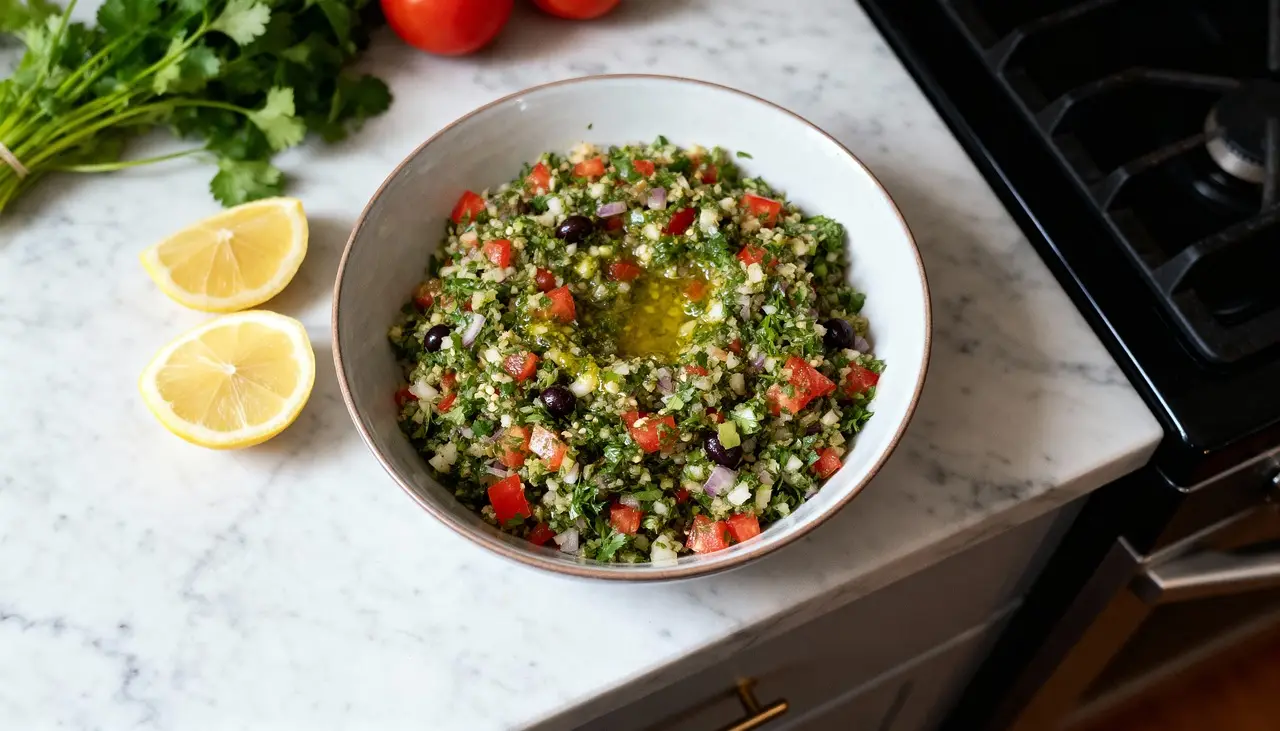
Tabbouleh looks like a salad and behaves like a dare: a bowl so green it's practically a lawn, flecked with tomato, sharp with lemon, with just a whisper of bulgur wheat. It comes from the mountains of Lebanon and Syria, and in Lebanon it carries the title of national dish 3. Food writer Anissa Helou, who grew up chopping parsley in a Lebanese kitchen, calls it a "global salad", one you now find on menus and deli counters all over the world, often in a form that raises Middle Eastern eyebrows 12.
Background
Here's the big secret, and it surprises most people outside the Middle East: tabbouleh is a parsley salad, not a grain salad. Yotam Ottolenghi and Sami Tamimi say so flat out in their book Jerusalem: "this is essentially a parsley salad, not a bulgar salad" 1. Helou's own recipe uses 400 g of flat-leaf parsley and 70 g of mint against just 30 g of fine bulgur, plus ripe tomatoes, spring onions, lemon, olive oil and a pinch of cinnamon and allspice, with little gem lettuce on the side 2. Felicity Cloake worked out that the parsley comes to roughly one big bunch per diner 1.
The name tells you what the dish was always about. Tabbouleh comes from the Arabic taabil, meaning seasoning or spice 3. It turns up as part of mezze, the spread of small shared plates that opens a Levantine meal 3.
History
Nobody knows who first chopped a mountain of herbs and called it lunch. Arab America traces tabbouleh to the hillsides of Syria and Lebanon, and notes that edible herbs formed a large part of the Arab diet in the Middle Ages 3. Back then, greens did the heavy lifting; the grain came later and stayed small 3. So when western cafés serve a bowl of bulgur with a sprinkle of parsley on top, they've flipped the old recipe on its head. Helou says it's still rare to see tabbouleh made properly in the west, "with a lot more herbs than burghul" 2.
Like many good dishes, it travelled with the people who loved it. Armenian cooks make eetch, Turkish cooks make kısır, Cyprus has tambouli, and Lebanese migrants carried a version to the Dominican Republic, where it goes by tipile 3. Cookbook writer Sally Butcher describes the dish living in "various guises" across Turkey, Greece and the Middle East 1.
Customs, rules and rituals
Tabbouleh has rules, and cooks argue about them with real passion.
Slice, don't chop. Claudia Roden learnt this from a friend in Beirut named Kamal, whose main tip was to slice the parsley so it doesn't get crushed and mushy 1. Helou warns against the rocking mezzaluna for the same reason, and against the food processor too: "there are no short cuts" 12. A razor-sharp knife and patience are the only tools.
Fine bulgur, and not much of it. The Lebanese way uses fine bulgur, almost as small as couscous 1. Cooks rinse it in cold water and let it soften in the tomato juices rather than drowning it 1.
Mind the tomatoes. Helou drains her diced tomatoes so the salad stays crisp and keeps longer; Roden, Ottolenghi and Tamimi prefer to let the bulgur drink up the juice 1. Pick your side.
Spice lightly. Some cooks use only lemon and oil. Helou reaches for a Lebanese seven-spice mix of pepper, allspice, cinnamon, nutmeg, coriander, cloves and ginger 1.
And Lebanon throws it a party. The first Saturday of July is National Tabbouleh Day, when families gather to eat it at home, in parks and in restaurants 3. Being a dish of grain, herbs and vegetables, it sits happily on vegetarian and vegan tables too 3.
Place in human experience
Tabbouleh is a kitchen skill handed down by hand. Helou remembers perching on the cool marble worktops of her grandmother's kitchen as a child, carefully lining up parsley sprigs so her grandmother could slice them into neat slivers. Most Lebanese kitchens of that era had white marble counters, and Helou still chops parsley exactly the way her mother and grandmother did 2.
The skill came with pressure, too. Sami Tamimi recalls his mother warning Tamimi's sister that she'd never find a good husband without learning to chop parsley properly 1. That's a lot riding on a knife.
Far from home, the salad becomes a badge and a shorthand. Researchers studying the Lebanese community around London's Edgware Road, known locally as "Arab Street", found people linking Lebanese food closely to their sense of belonging, and describing cooking as something "we learnt from our parents and grandparents" 4. Yet they also pushed back on the shorthand. "There is much more to food than tabbouleh, hummus and shawarma," one focus group member said, adding that real Lebanese hospitality lives in Lebanese homes, where dishes take hours 4.
So tabbouleh holds two things at once: the friendly face Lebanese food shows the world, and a private test of patience and care at the family bench. Next time you make it, buy more parsley than feels sensible. Then buy a bit more.
Sources
- Felicity Cloake, "How to make the perfect tabbouleh", The Guardian, 2013. https://www.theguardian.com/lifeandstyle/wordofmouth/2013/jul/17/how-to-make-perfect-tabbouleh
- Anissa Helou and others, "20 best summer salad recipes: part 3", The Guardian (Observer Food Monthly), 2014. https://www.theguardian.com/lifeandstyle/2014/aug/06/20-best-summer-salads-part-3-tabbuleh-green-papaya
- "A History of the Origin of Tabbouleh: Lebanon's National Food", Arab America, 2021. https://www.arabamerica.com/a-history-of-the-origin-of-tabbouleh-lebanons-national-food/
- T. Fletcher, A. Abdallah and K. Hannam, "Lebanese food, 'Lebaneseness' and the Lebanese diaspora in London", Hospitality and Society, Leeds Beckett University Repository, 2018. https://eprints.leedsbeckett.ac.uk/id/eprint/5977/