
Tacos
A taco is a warm corn tortilla folded around something good, then finished with onion, coriander, a squeeze of lime and a hit of salsa . That's the whole…
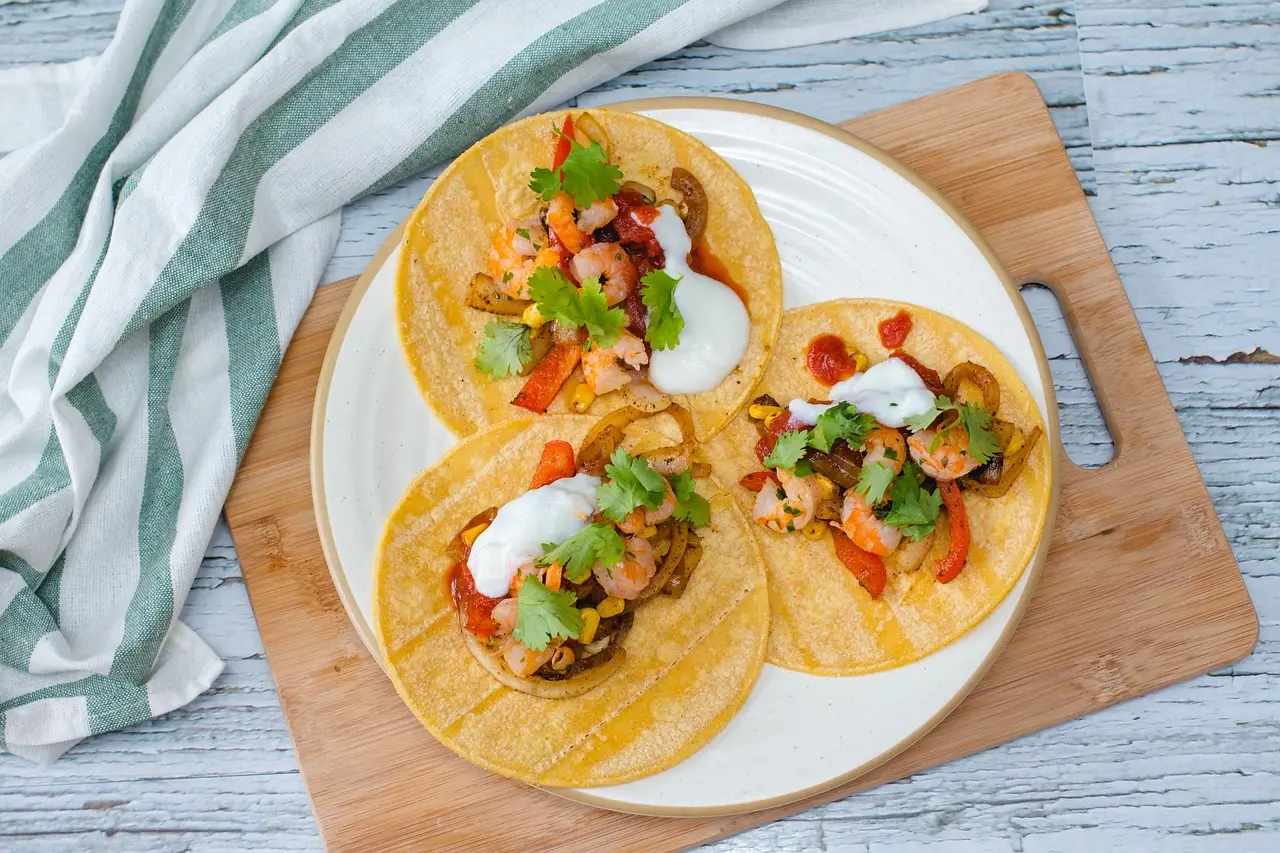
A taco is a warm corn tortilla folded around something good, then finished with onion, coriander, a squeeze of lime and a hit of salsa 5. That's the whole idea, and Mexico has spun it into endless variations: al pastor, carnitas, barbacoa, guisados, tacos de canasta and more 5. Behind that simple fold sits age-old corn know-how 4, a few great migration stories, and one very famous fast-food chain that never invented the crunchy shell 3.
Background
Start with the tortilla, because without it there's no taco. Traditional Mexican cuisine rests on corn, beans and chilli, and on a clever old trick called nixtamalisation: cooking maize with lime, which lifts its nutritional value 4. UNESCO added traditional Mexican cuisine to its list of the Intangible Cultural Heritage of Humanity in 2010, describing a whole system of farming, ritual, skills and community customs, from planting to eating 4.
The fillings are where cooks play. One taco can be pure restraint. At El Califa de León, a Mexico City stand just three metres by three metres, the famous Gaonera taco is beef fillet seasoned with salt and lime, cooked on a hot grill and wrapped in a fresh tortilla 5. "The secret is the simplicity of our taco," one of its long-serving chefs told the Associated Press 5.
History
Where the word "taco" comes from is a puzzle. One popular theory, reported by Smithsonian Magazine and repeated in MEL Magazine's oral history, links it to 18th-century Mexican silver mines, where "tacos" were paper-wrapped charges of gunpowder pushed into holes in the rock 3. Food historian Jeffrey Pilcher says the trail goes cold quickly: there are no archival sources for tacos before about 1890, though tacos may well be older 3. Writer Salvador Novo even imagined Cortés being served the first taco 3.
The taco's travels are better documented. In the late 19th and early 20th centuries, Christian families from Lebanon, Syria and Palestine settled in Mexico as the Ottoman Empire collapsed 16. They brought shawarma, the meat roasted on a vertical spit. By the 1930s, restaurants in Puebla were selling "tacos árabes" in Arab bread 1. Mexican diners weren't keen on lamb, so cooks tried beef, then pork, and pork stuck 1. In the 1960s, the children of those migrants added a chilli marinade and corn tortillas, and the taco al pastor was born 1. Mexico's national institute of anthropology and history puts it plainly: no dish is more Arab-Mexican than tacos al pastor 6. As for the pineapple on top? Nobody has a good answer 1.
The taco also crossed the border as tacos dorados, "golden" fried tacos 3. The earliest known English-language taco recipe appeared in 1914, in Bertha Haffner-Ginger's California Mexican-Spanish Cook Book 3. In 1937, Lucia Rodriguez opened Mitla Cafe in San Bernardino, California, near Route 66, after starting with a little taco stand 3. In the 1950s Glen Bell ran a burger stand across the street, watched the queues for Mitla's 10-cent tacos dorados, and later opened a taco place of his own, the start of the road to Taco Bell 3. Oaxacan immigrant Juvencio Maldonado built a machine in Manhattan to fry many shells at once, but it never took off beyond his own restaurant 3.
Customs, rules and rituals
Rule one: eat with your hands. Mexico City local Laura told The Guardian about taking friends to a fancy taqueria that handed them a knife and fork. Of El Califa de León, Laura said: "This is the real Mexican taco" 5. Rule two: stand up. At El Califa, diners grab plastic plates, share bowls of salsa and eat wherever they can squeeze in 5. In 2024 it became the first taco stand ever awarded a Michelin star, and queues stretched round the block 5.
Rule three: never argue about the best taco, because you'll lose. "Everyone has their favourite taco – it depends where they're from," one rival taquero said 5.
Tacos also keep time. Workers line up at Mexico City stalls at lunch 1, while tacos al pastor own the city's small hours 6. And corn carries sacred weight: tortillas and tamales form part of Day of the Dead offerings 4.
Place in human experience
Eating with a tortilla is a learned skill, like using chopsticks, Pilcher says 3. That's partly why the hard shell sold so well in the United States: it let outsiders try something exciting without the know-how 3. Pilcher also argues that Bell's real edge was selling tacos to people who wouldn't cross the segregation lines of post-war Los Angeles into Mexican neighbourhoods 3. Mitla Cafe's co-owner Michael Montaño remembers segregated swimming pools in San Bernardino, and the cafe as one of the few places where cultures came together 3.
Tacos keep absorbing new people. In Chicago, writer Lolly Bowean describes "Black tacos": corn tortillas filled with slow-cooked, highly seasoned meats from African American cooking, such as oxtails, sweet potatoes and fried pork chops 2. Chef Taylor Mason seasons with salt, black pepper, cayenne and garlic powder, deep-fries the tortillas, and remembers tacos at home as the dish that brought the community round the table: "you'd eat with your eyes first" 2.
Even Mexico forgets its own borrowings. Historian Rachel Laudan notes that most Mexicans now think al pastor is a traditional Mexican dish 1. Marco Antonio Buendía González, whose parents opened the El Huequito taqueria in 1959, puts it best: "We tropicalised it, we use national ingredients... the taco is 100% Mexican" 1. As food historian Martha Victoria Díaz de Kuri says, when cultures meet, kitchens never fight; they marry 6.
Sources
- Katy Watson, "Sharwarma: Taco al pastor's culinary ancestor", BBC News, 2015. https://www.bbc.com/news/magazine-33993719
- Lolly Bowean, "Black Tacos", Southern Foodways Alliance (Gravy). https://www.southernfoodways.org/black-tacos/
- "An Oral History of Hard-Shell Tacos", MEL Magazine. https://melmagazine.com/en-us/story/an-oral-history-of-hard-shell-tacos
- "Traditional Mexican cuisine – ancestral, ongoing community culture, the Michoacán paradigm", UNESCO Intangible Cultural Heritage. https://ich.unesco.org/en/RL/traditional-mexican-cuisine-ancestral-ongoing-community-culture-the-michoacan-paradigm-00400
- Thomas Graham, "Fans queue round the block as tiny Mexican taco stand wins Michelin star", The Guardian, 2024. https://www.theguardian.com/world/article/2024/may/18/fans-queue-round-the-block-as-tiny-mexican-taco-stand-wins-michelin-star
- "Seminario analiza la influencia libanesa en las cocinas mexicanas", Boletín 563, Instituto Nacional de Antropología e Historia (INAH). https://www.inah.gob.mx/boletines/seminario-analiza-la-influencia-libanesa-en-las-cocinas-mexicanas