
Tagine
A tagine is two things at once: a clay pot with a pointy hat, and the slow stew that comes out of it. The name covers both, and across Morocco and Algeria…
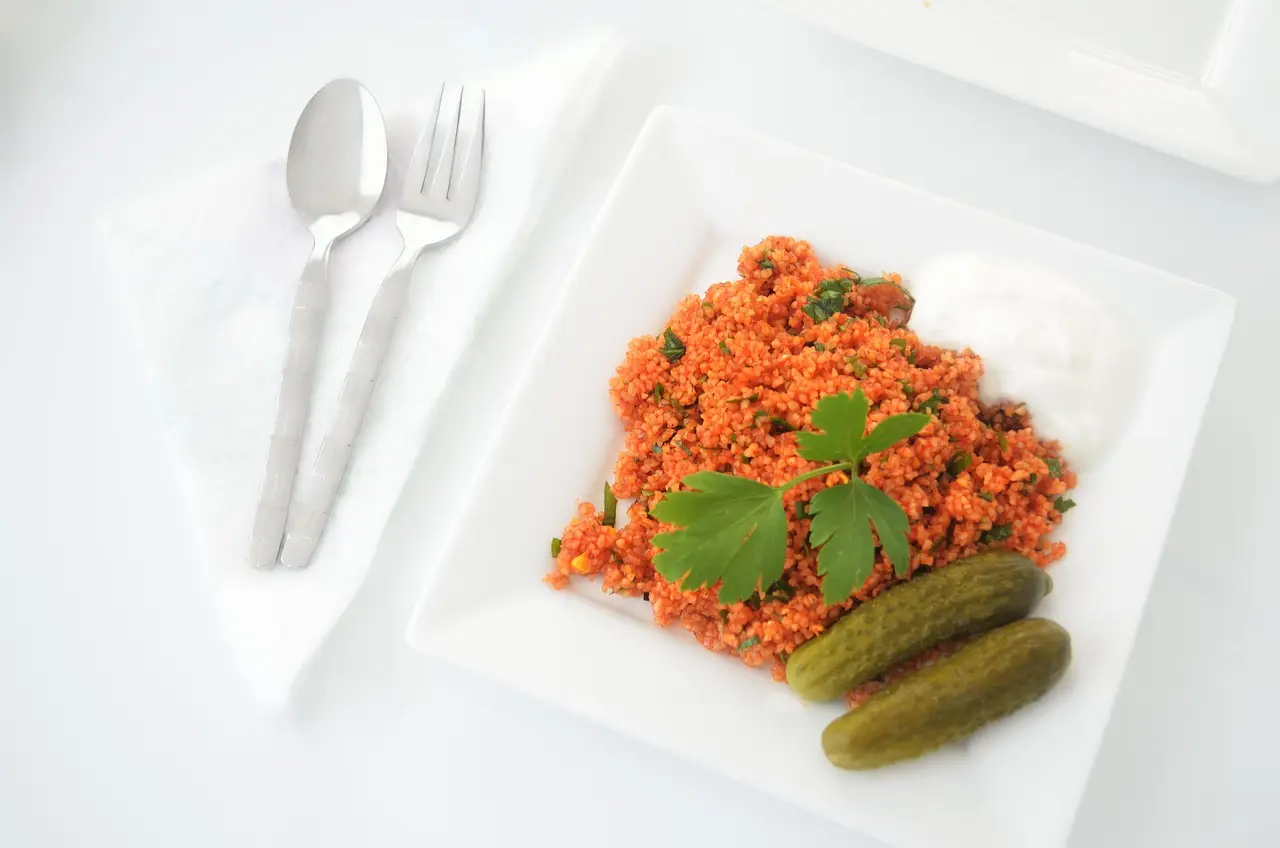
A tagine is two things at once: a clay pot with a pointy hat, and the slow stew that comes out of it. The name covers both, and across Morocco and Algeria it means spiced meat, chicken or fish cooked low and slow with vegetables or fruit 6. Lamb with prunes, chicken with olives and preserved lemon, meatballs in tomato with eggs cracked on top: every corner of Morocco has its own regional version 2. It matters because it shows how a clever pot can feed people well in a dry land, with almost no water and a lot of patience.
Background
Picture a shallow, round clay dish with low sides, and a tall cone or dome sitting on top 6. That lid is the whole trick. Steam rises, hits the cool clay, turns back into water and drips down onto the food, so the stew braises in its own juices with very little added liquid 6. Food writer Paula Wolfert calls it a "magical process" because one pot braises, steams and bakes in turn 6. Handy, where water is scarce 6.
The traditional heat source is a small clay brazier full of charcoal, called a kanun or majmar 6; the Fes Cooking school points out it is much cheaper than a stove 2. The BBC adds that tagines were also cooked in the leftover heat of bakers' ovens 3. On a modern stove, cooks use the lowest flame and a heat diffuser, because a sudden jump in temperature can crack the clay 6.
History
The word itself has travelled. The Arabic ṭajīn comes from the Ancient Greek tágēnon, a shallow clay frying pan, and several North African cooking pots carry names from the same root 6. Where the cone lid comes from is less settled. One account places its birth in Tafraout, in southern Morocco 6. Fes Cooking describes tagine as a historically Berber (Amazigh) dish, later layered with the spices, nuts and dried fruit that came with Arab rule, the olives and citrus of the Moors, and the preserved lemons of Morocco's Jewish cooks 2. Some writers instead trace the dish to the court of the Abbasid caliph Harun al-Rashid and the stories of the Thousand and One Nights, though French Wikipedia flags those sources as thin; others argue for a Berber or a Moroccan origin 7.
Here is the fun twist. In the 1990s, archaeologist Vivien Swan found North African-style pottery along the Antonine Wall in Scotland, Rome's northern frontier in the mid-second century AD 1. One casserole form may be an early ancestor of the tagine, and other pots suit the brazier cooking common in north-west Africa 1. The governor who built the wall, Quintus Lollius Urbicus, came from Numidia, roughly modern Algeria 1. Historic Environment Scotland calls a North African presence on the wall "highly likely" but not certain 1. So, quite possibly, somebody was cooking something tagine-like in the Scottish drizzle 1,800 years ago.
Customs, rules and rituals
In Fes, lunch is the big meal of the day. Families sit around a low table, someone carries round a basin and kettle so everyone can wash their hands, and the meal starts when the head of the family says "bismillah", in the name of God 2. Salads and a tagine or couscous land on the table together, and diners eat from one shared dish with the right hand and a piece of bread 2. Bread does the job of a fork and soaks up the sauce, and it is so respected that a piece dropped on the floor gets picked up and kissed 2. Because a tagine takes hours, the lunch tagine often goes on soon after breakfast is cleared 2.
At weddings the order runs pastilla, then tagine, then couscous, then fruit, then mint tea with almond pastries 2. Some tagines get a charred top by swapping the lid for a flat dish of hot coals, a method called "cooking between two fires" 6.
Tagine also belongs to North Africa's Jews. It is a mainstay of Sephardi cooking, served with couscous at Shabbat dinners and on holidays such as Rosh Hashanah and the meal breaking the Yom Kippur fast 6. Writing in Slate, Jeremy Stahl, raised by a French Moroccan mother, remembers holiday tables and a great-grandmother who pickled lemons for weeks for her lemon chicken 4. Moroccan Jewish cooks lean towards dried fruit, while Tunisian Jewish cooks often make a vegetable tagine with potatoes, carrots and zucchini 6.
The word changes shape as you travel. In Libya, tajin mahshi means vegetables such as capsicum, tomato, eggplant and zucchini stuffed with spiced mince and rice, then stewed 5.
Place in human experience
A tagine is a lesson in making do. A clay pot over a few coals produces a meal that tastes like far more effort than fuel or water went into it 6, 2. It also carries the whole story of Morocco: Amazigh roots, Arab spice, Andalusian fruit and Jewish preserving, all in one pot 2.
It travels with people, too. For diaspora families, the pot becomes a way to keep a holiday table looking like home. Stahl bought a clay tagine for US$60 and now also makes a quick, meatless version that has turned a holiday dish into an everyday one 4.
And if you have no clay pot? The BBC says you can make one without the special pot, even in a slow cooker 3. Generations of cooks would forgive you, as long as you bring bread.
Sources
- "Africans on the Antonine Wall?", Historic Environment Scotland blog, 2018. https://blog.historicenvironment.scot/2018/10/africans-antonine-wall/
- "The Art of Moroccan Cuisine", Fes Cooking. http://fescooking.com/come-cook-with-us/the-art-of-moroccan-cuisine
- "Tagine recipes", BBC Food. https://www.bbc.co.uk/food/tagine
- "Tagine recipe: For Rosh Hashanah, Yom Kippur, or just because you're hungry", Jeremy Stahl, Slate, 2014 (Internet Archive copy). https://web.archive.org/web/20191018061034/https://slate.com/culture/2014/09/tagine-recipe-for-rosh-hashanah-yom-kippur-or-just-because-youre-hungry.amp
- "Libyan Cuisine", Libyan Heritage House. https://libyanheritagehouse.org/arts-culture/libyan-cuisine
- "Tagine", Wikipedia. https://en.wikipedia.org/wiki/Tajine
- "Tajine", Wikipédia (French). https://fr.wikipedia.org/wiki/Tajine