
Tempura
Tempura is seafood and vegetables dipped in a thin batter and fried until the coating shatters like frost on a windowpane. It feels as Japanese as cherry…
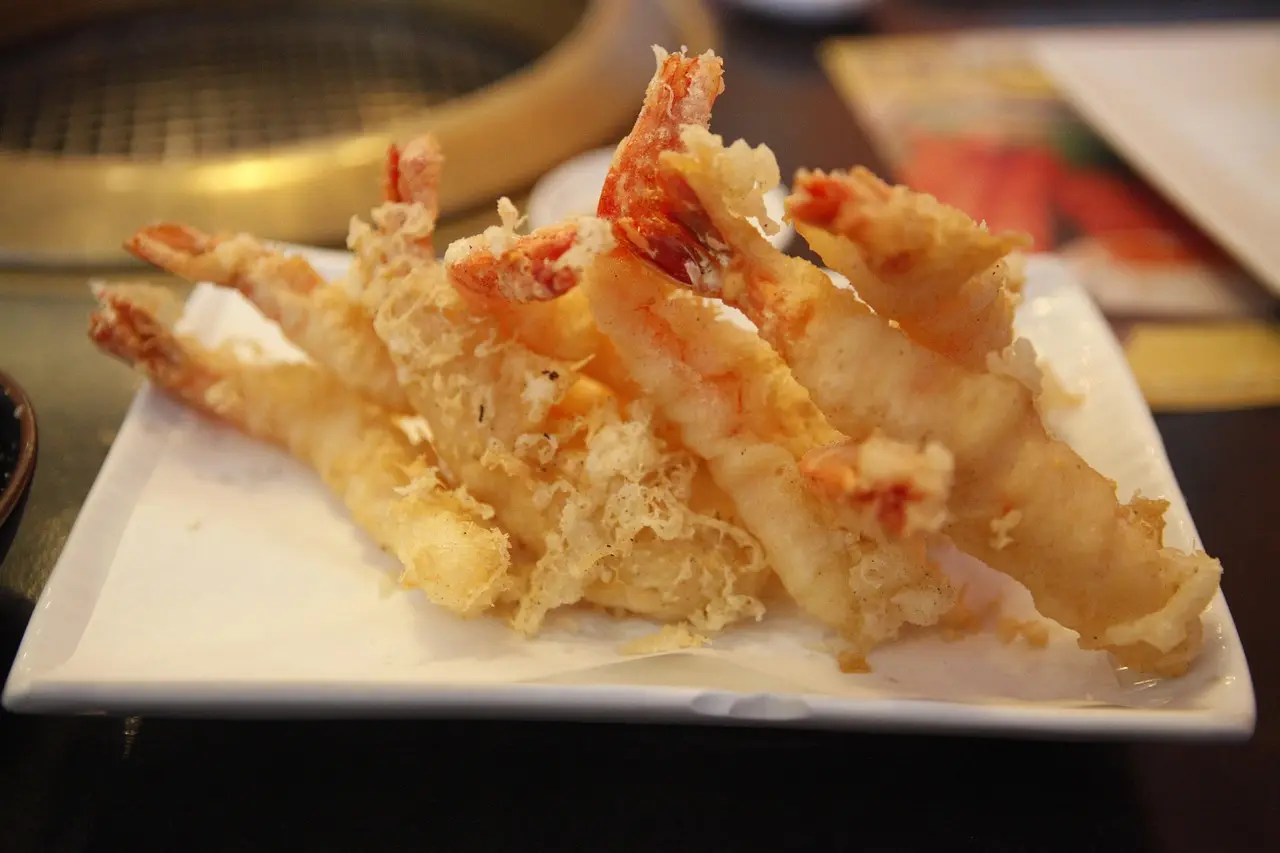
Tempura is seafood and vegetables dipped in a thin batter and fried until the coating shatters like frost on a windowpane. It feels as Japanese as cherry blossoms, yet the best-loved story about it starts on a Portuguese ship. Whether that story is true is one of the more fun arguments in food history, and it's worth knowing both sides before you heat the oil.
Background
Today tempura means fish, shellfish or vegetables coated in flour mixed with egg and water, then fried in vegetable oil. Vegetable-only tempura has its own name, shōjin-age 4. East and west Japan still do it a little differently. Around Tokyo, cooks mix egg into the batter, fry quickly in hot sesame oil, and serve it with grated daikon and a dipping sauce. Around Osaka, cooks skip the egg, fry more gently at a lower heat in plain salad oil, and reach for salt instead 2.
Here's a fun twist: in parts of western Japan, "tempura" can mean fried fish paste with no batter at all 24. So if you order it in the wrong town, you might get a surprise.
The word has wandered too. In everyday Japanese, tempura can mean something gold-plated or fake, because the outside isn't what's inside 4. Golfers even use it for a tee shot that sails sky-high and goes nowhere 4.
History
The Portuguese story. In 1543, three Portuguese sailors on a Chinese ship blew off course and landed on the island of Tanegashima, the first Europeans to set foot in Japan 1. Trade followed: guns first, then soap, tobacco and recipes 1. The Portuguese stayed until 1639, when the shogun Iemitsu expelled them 1. The tale goes that they left behind peixinhos da horta, "little fish of the garden": green beans battered and fried for Lent and the Ember days, when Catholics went without meat 1. Lisbon chef José Avillez reckons the Japanese "inherited the dish from us and they made it better" 1.
The Michelin Guide tells a similar story: Portuguese missionaries brought the habit of flouring and frying food in the sixteenth century, arriving around the same time as wine 2. Nagasaki still makes its own sweet-battered Nagasaki tempura. Japan's agriculture ministry dates it to about 400 years ago and says it was inspired by Portuguese fritters 3.
The word. Popular accounts trace "tempura" to the Portuguese tempero (seasoning or cooking) or têmporas (the Ember days of fasting) 13. A leading Japanese dictionary also lists a Spanish word, templo (temple), among the guesses 4.
The sceptic's view. The Heibonsha World Encyclopedia, Japan's big reference work, is blunt: these word origins rest on an assumption that tempura arrived in the age of European sailing, and no documents from the time back them up 4. The first written mention it finds is tenpurari in a 1669 book by a Kyoto doctor, and it reads more like minced bird meat in sauce than anything fried 4. The first clear recipe for batter-frying comes from 1748 4.
The same encyclopaedia busts another legend. You may have heard that the shogun Tokugawa Ieyasu died after eating too much sea bream tempura. The records only say the bream was fried in sesame oil 4.
So: the Portuguese connection is widely told and officially celebrated in Nagasaki, but the paper trail is thin. Enjoy the story; hold it lightly.
Edo street food. Whatever its roots, tempura became famous on the streets of Edo, now Tokyo, in the late eighteenth century 24. Frying in wood-and-paper houses risked fire, so it suited outdoor stalls 2. Vendors skewered each piece so customers didn't get greasy fingers, and served it with grated daikon to cut the richness 2. Sit-down tempura shops spread from around 1850, and in Meiji-era Tokyo tempura joined sushi as a city speciality 4.
Customs, rules and rituals
Religion shaped tempura in two directions. In the Portuguese story, it's food for Catholic fasting days 13. In Kyoto, with its strong Buddhist ties and rules against eating meat, cooks fried vegetables only, and called it shōjin tempura after the Buddhist word for vegetarian cooking 2.
How you eat it depends on where you are: dipping sauce and daikon in the east, a pinch of salt in the west 2. In Nagasaki, the batter is already seasoned with sugar and sake, so it needs no sauce at all, and it holds up well even cold 3.
Then there's ozashiki tempura: a small group sitting around a counter while the cook fries each piece in front of them. That style took off between the end of the Meiji era and the Taishō era, roughly the 1900s to 1920s 4. After the 1923 Great Kantō Earthquake, many Tokyo tempura cooks moved west, and Osaka and Kobe's tempura is said to have improved sharply as a result 4.
Place in human experience
Tempura is a lovely example of a food that started out cheap and climbed the ladder. In Edo it was cheap stall food 24. The Edo writer Shokusanjin wrote of holding a sake cup in one hand and leaning on a tempura skewer like a walking stick in the other 4. Only later did it move indoors and up-market 4.
Nagasaki's version went the opposite way. It was once fine food that only wealthy families could enjoy; now families make it at home, and schools serve it at lunch with local fish 3.
And the Portuguese story carries its own warmth, true or not. Chef Olivier da Costa says people in Portugal love peixinhos da horta out of nostalgia: everyone ate them as children 1. Avillez says Japanese diners sometimes spot the dish in his Lisbon restaurant and assume Portugal borrowed it from Japan. He enjoys telling them it's the other way around 1. Two countries, each sure the crispy thing on the plate is theirs. That's food for you.
Sources
- David Farley, "The truth about Japanese tempura", BBC Travel. https://www.bbc.com/travel/article/20170808-the-truth-about-japanese-tempura
- MICHELIN Guide Japan, "The History of Tempura", MICHELIN Guide, 7 July 2021. https://guide.michelin.com/hk/en/article/features/tempura_en
- "Nagasaki Tempura", Our Regional Cuisines, Ministry of Agriculture, Forestry and Fisheries (Japan). https://www.maff.go.jp/e/policies/market/k_ryouri/search_menu/4260/index.html
- "天麩羅 (Tempura)", entries from Digital Daijisen (Shogakukan), Seisenban Nihon Kokugo Daijiten (Shogakukan) and Heibonsha World Encyclopedia (Hirata Mario), via Kotobank. https://kotobank.jp/word/%E5%A4%A9%E9%BA%A9%E7%BE%85-578873