
Tom Yum
Tom yum is Thailand's hot and sour soup: a broth humming with lemongrass, makrut lime leaves and galangal, sharpened with lime and fired up with chilli.…
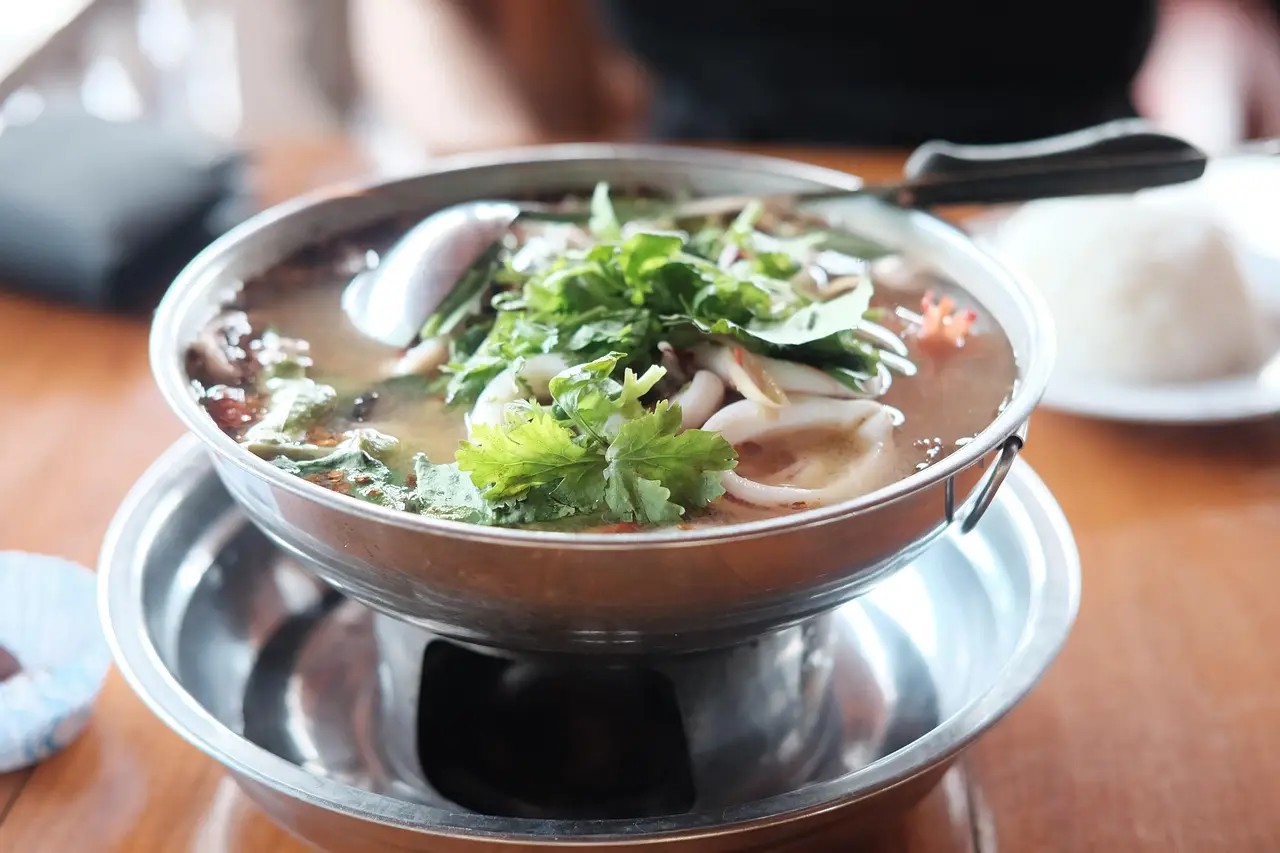
Tom yum is Thailand's hot and sour soup: a broth humming with lemongrass, makrut lime leaves and galangal, sharpened with lime and fired up with chilli. The prawn version, tom yum kung, is so loved that UNESCO added it to its list of the world's intangible cultural heritage in 2024 1. It even had a financial crisis named after it. More on that shortly.
Background
The name tells you how it's made. Tom means to boil, and yam means "mixed" 2. So: a boiled, mixed thing. Modest name, loud soup.
UNESCO describes tom yum kung as prawns boiled with lemongrass, makrut lime leaves, galangal and shallots, then seasoned with local condiments. Its flavours run from sweet and sour to savoury, spicy, creamy and a little bitter, all in one spoonful 1. Thai researchers list the herbal core as lemongrass, galangal, red chilli, shallot and makrut lime leaves 3, and the same lemongrass and galangal turn up across Thai curry pastes and soups 4. Thai markets even sell ready-tied bundles of the herbs for the pot 2.
There are two main styles. Tom yum nam sai is the clear version: bright, sharp and light. Tom yum nam khon is creamy, finished with evaporated milk or non-dairy creamer, and is a fairly new twist from the 1980s 2. If you've only ever had the creamy, orange version in a restaurant, the clear one is worth a try. It tastes like a different soup.
History
UNESCO traces tom yum kung to Buddhist communities living along the rivers of Thailand's Central Plains, a fertile region that has fed the country for centuries 1. These communities traditionally avoided killing large animals and ate the freshwater prawns that were plentiful around them. Add their knowledge of medicinal herbs, and you get this soup 1.
The chilli kick came later. Thai researchers credit Portuguese traders with bringing them to Siam in the sixteenth and seventeenth centuries; before that, Thai cooks got their heat from pepper 3. So the fiery tom yum we know is, in part, a product of global trade.
Exact dates for the soup itself are hard to pin down. Historian Giles Milton argues its roots lie in India's sour prawn soups 2, but Thailand's own account, the one UNESCO accepted, keeps it at home: riverside cooks, freshwater prawns and a garden of herbs 1.
The soup has travelled well. In Malaysia, where it's spelled tomyam, it caught on from around the 1980s and is now a must-have on restaurant menus, especially on the peninsula 2.
And then there's the crisis. When the Thai baht collapsed on 2 July 1997, setting off the Asian financial crisis, Thais called it the "Tom Yum Kung crisis" 5. Few dishes are famous enough to lend their name to an economic meltdown. That's real fame.
Customs, rules and rituals
There are no strict religious rules around tom yum, but Buddhism shapes its story. Theravada Buddhism, which most Thais follow, doesn't forbid eating meat except as a personal choice 3. Still, the Central Plains communities behind tom yum kung preferred not to kill large animals, which is why prawns, not beef or pork, became the classic choice 1.
The soup is also thought of as good for you. Thai families believe it boosts energy and wellbeing, particularly during the monsoon season 1. Picture a steaming bowl while rain hammers on a tin roof and you'll get the idea.
How do people learn to make it? Mostly by word of mouth. UNESCO notes that the know-how, from picking the herbs and prawns to caring for the river environment they come from, passes down orally within families and at community gatherings 1. Now that the dish is famous worldwide, restaurants, schools, universities and cooking classes carry it on too 1.
Place in human experience
UNESCO calls tom yum kung "a reflection of Thai Buddhist values" and an expression of local knowledge about the land and its resources 1. That's a lot to ask of a soup, but it fits. The dish only makes sense where rivers are full of prawns and gardens are full of lemongrass.
For Thailand, it's also a point of national pride. When UNESCO listed it, the Tourism Authority of Thailand celebrated the dish's "harmonious blend of hot, sour, salty, and sweet flavours" and pitched it as a reason to visit 6.
At home, though, it's simpler than all that. It's a pot on the stove, a handful of bruised lemongrass and torn lime leaves, and the sharp, clean smell that fills the kitchen the moment they hit the water. Make it once and you'll understand why families keep making it.
Sources
- "Tomyum Kung", UNESCO Intangible Cultural Heritage (inscribed 2024). https://ich.unesco.org/en/RL/tomyum-kung-01879
- "Tom yum", Wikipedia. https://en.wikipedia.org/wiki/Tom_yum
- Taddara Kanchanakunjara et al., "Traditional Curry Pastes During Sukhothai to Ratthanakosin: The Subjective Experience of the Past and Present", Asian Culture and History 7(1), Canadian Center of Science and Education, 2015. https://ccsenet.org/journal/index.php/ach/article/download/40378/23041
- "Plant ingredients in Thai food: a well-rounded diet for natural bioactive associated with medicinal properties", PeerJ, 2023 (via Europe PMC). https://europepmc.org/article/PMC/PMC9985418
- "1997 Asian financial crisis", Wikipedia. https://en.wikipedia.org/wiki/1997_Asian_financial_crisis
- "UNESCO Recognition for 'Tomyum Kung' and 'Kebaya' Enhances Thailand's Cultural Prestige", TAT Newsroom, Tourism Authority of Thailand, 11 December 2024. https://www.tatnews.org/2024/12/unesco-recognition-for-tomyum-kung-and-kebaya-enhances-thailands-cultural-prestige/