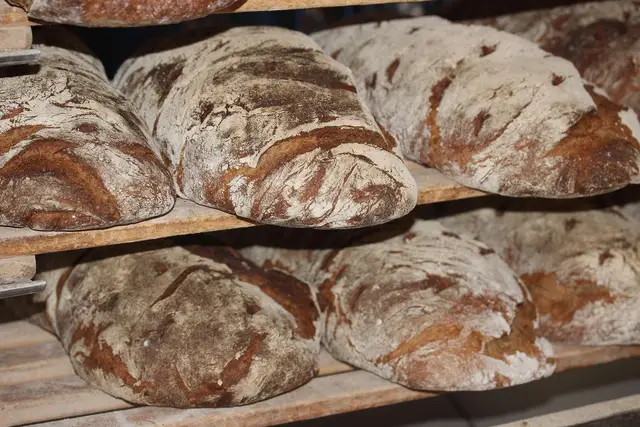
Kneading Dough
Push with the heel of your hand, fold the dough back over, give it a quarter turn, and do it again. Before long, a shaggy lump of flour and water turns…
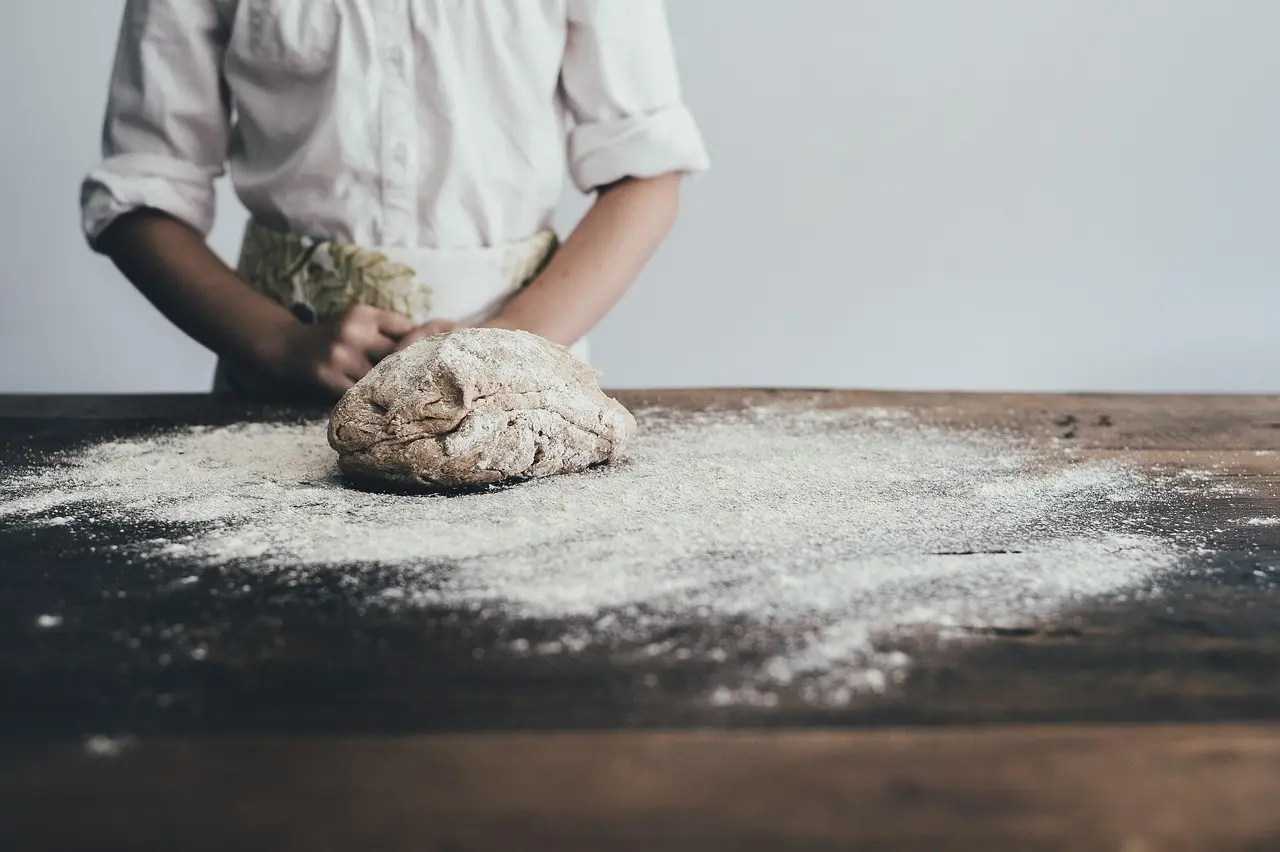
Push with the heel of your hand, fold the dough back over, give it a quarter turn, and do it again. Before long, a shaggy lump of flour and water turns smooth, springy and almost alive under your palms. That's kneading, one of the oldest kitchen jobs there is. Ancient Egyptians sometimes did it with their feet, the English word "lady" may hide a bread-kneader inside it, and in 2006 a New York baker told the world it could skip the whole thing.
Background
Kneading does two jobs. It mixes everything evenly, and it builds strength. When flour meets water, two proteins, gliadin and glutenin, swell and link up into gluten, a stretchy web that traps the gas from yeast and lets bread rise. Kneading speeds that up and works a little air into the dough as well. Skip it, and most yeasted breads come out heavy and dense 1.
The classic hand method: press with the heel of your hand, stretch, fold, turn 90 degrees, repeat on a lightly floured bench 1. After the first rise, many bakers "knock back" the dough, punching out big bubbles so the crumb comes out even and the yeast finds fresh food 1.
Kneading isn't always your friend, though. Pastry, muffins, scones and biscuits should be handled as little as possible, because the same gluten that makes bread chewy makes a scone tough and rubbery 1.
History
People have been working dough for a very long time. The oldest bread yet found comes from a Natufian site in Jordan's north-eastern desert, around 14,500 years old, thousands of years before farming 2. Wild yeast lives on grain, so any dough left to sit will start to rise on its own 2.
Egypt gives us the best picture of early bread-making. Bakers used emmer wheat, a tough grain to turn into flour: it was moistened, pounded with a pestle, dried, winnowed, sieved and ground on a saddle quern before anyone could knead it 3. Small tomb figurines show servants making bread, and New Kingdom tomb pictures show loaves shaped like people, fish, animals and fans 3. Most bread was made at home, with any extra sold 3.
Then there's the feet. The Greek traveller Herodotus listed the ways Egyptians did things backwards from everyone else, and among them: "they knead dough with their feet and clay with their hands" 4. Whether it was everyday practice or a good travel story, it's a wonderful image.
The Bible carries kneading into one of its biggest scenes. As the Israelites fled Egypt, "the people took their dough before it was leavened, their kneadingtroughs being bound up in their clothes upon their shoulders" (Exodus 12:34) 9. The dough never rose, and that hurried bread became matzah 8.
Machines took over much of the work in the 20th century. Britain's Chorleywood process, developed in 1961, uses intense mechanical mixing to cut fermentation time right down, making bread faster and cheaper 2. Then came the twist. In November 2006, Mark Bittman's "Minimalist" column in the New York Times shared baker Jim Lahey's no-knead loaf: a wet dough, a pinch of yeast, 12 to 18 hours of waiting, and a hot Dutch oven 10. Time lets the gluten line up without any elbow grease 10. The idea wasn't new. Eliza Smith printed a no-knead method in The Compleat Housewife in 1739, and Doris Grant championed a no-knead wholemeal loaf in wartime Britain in 1944 10. But Bittman's column set off a global baking craze 10.
Customs, rules and rituals
Jewish law turns kneading into a moment of blessing. Numbers 15 commands an offering from the dough, and the custom is called separating challah: a small piece is taken from the batch and set aside 7. Make a big enough batch, about 1.64 kg of flour or more, and the baker says a blessing first; Orthodox households usually burn the separated piece in the oven 7. Tradition counts it among three commandments especially linked with women, reflecting who did most of the household baking 7. The rule covers any bread, but families often bake Shabbat challah in a batch big enough to oblige the blessing, to honour the Sabbath 11.
Passover flips everything. Matzah dough counts as leavening 18 minutes after water touches the flour, so bakers mix and roll at speed, with no resting time at all 8. Here the art is in not giving dough the time it would usually get.
Place in human experience
Kneading sits close to the heart of the home, and language shows it. "Lady" comes from Old English hlæfdige, built from hlaf, "loaf", and a second part usually read as "kneader". Etymologists admit the sense is shaky, but nobody has a better explanation 5. Its partner "lord" comes from hlaford, the master of a household 5. "Knead" itself goes back to Old English cnedan, to press and squeeze, with cousins in Dutch kneden and German kneten 6.
Bread has long carried class, too: fine white loaves signalled status, darker ones poverty, and baking skill itself counted as a sign of civilisation in the ancient world 2. And kneading still carries meaning in faith, from Exodus to the Friday-afternoon challah 79.
Maybe that's why so many people still knead by hand even with a stand mixer on the bench and Lahey's no-knead loaf a click away. A few quiet minutes, flour up to the wrists, and dough that changes under your hands. It's hard to find a better kind of kitchen magic.
Sources
- "Kneading", Wikipedia. https://en.wikipedia.org/wiki/Kneading
- "Bread", Wikipedia. https://en.wikipedia.org/wiki/Bread
- "Ancient Egyptian cuisine", Wikipedia. https://en.wikipedia.org/wiki/Ancient_Egyptian_cuisine
- Herodotus, The History, Book II, trans. G. C. Macaulay, Project Gutenberg. https://www.gutenberg.org/ebooks/2707
- "lady (n.)", Online Etymology Dictionary. https://www.etymonline.com/word/lady
- "knead (v.)", Online Etymology Dictionary. https://www.etymonline.com/word/knead
- "Dough offering", Wikipedia. https://en.wikipedia.org/wiki/Dough_offering
- "Matzah", Wikipedia. https://en.wikipedia.org/wiki/Matzah
- Exodus 12:34 (King James Version), Bible Gateway. https://www.biblegateway.com/passage/?search=Exodus+12%3A34&version=KJV
- "No-knead bread", Wikipedia. https://en.wikipedia.org/wiki/No-knead_bread
- "Challah", Wikipedia. https://en.wikipedia.org/wiki/Challah