Coconut Milk
Here's a fun fact to drop at dinner: coconut milk isn't the sloshy water inside a coconut. It's made. Somebody grates the white flesh of a mature coconut,…
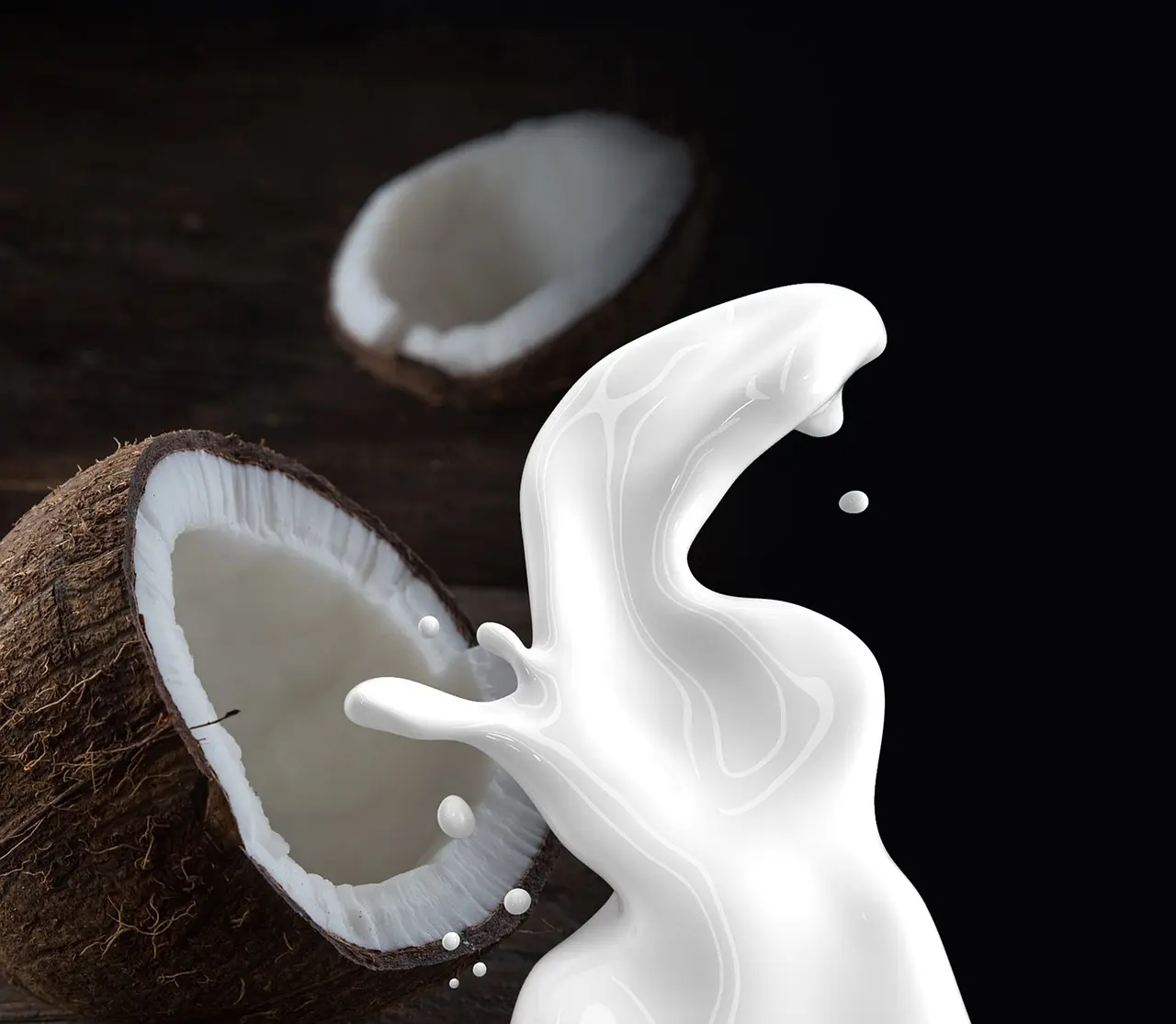
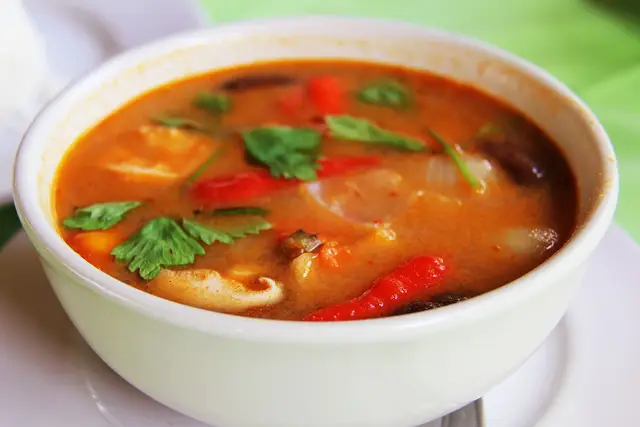
Here's a fun fact to drop at dinner: coconut milk isn't the sloshy water inside a coconut. It's made. Somebody grates the white flesh of a mature coconut, soaks it in a little hot water, then squeezes it hard 1. Out comes a thick, sweet, faintly nutty cream that turns a pot of curry silky, makes a Thai soup taste like a hug, and holds half the desserts of Southeast Asia together. For a cupboard staple that now lives in a tin, it has a surprisingly long and seafaring story.
Background
The opacity and the richness come from oil. Most of that fat is saturated, and it's what makes a spoonful taste so luxurious 1.
Traditional cooks get two grades from the same coconut. The first squeeze, with very little water, gives thick coconut cream at 20 to 50 per cent fat. Soak the squeezed pulp again in hot water, squeeze once more, and you get thinner coconut milk at 5 to 20 per cent 1. Many recipes still ask for both: the thin milk to simmer, the thick cream to finish.
Names change as you travel. It's santan in Indonesian and Malay, gata in Tagalog and Cebuano, and Filipino dishes cooked in it are called ginataán 1.
History
The story of coconut milk starts with the story of the coconut, and that's a story about boats.
In 2011 a team led by Bee Gunn, Luc Baudouin and Kenneth Olsen studied the DNA of more than 1,300 coconuts from around the world 2. Olsen expected "a mish-mash", because people have carried coconuts everywhere. Instead they found two clear families, pointing to two separate places where people first cultivated the palm: island Southeast Asia in the Pacific, and the southern edge of India, Sri Lanka and the Maldives in the Indian Ocean 2.
Then the sailors got involved. Ancient Austronesian voyagers carried Pacific coconuts west a couple of thousand years ago along trade routes to Madagascar and the east African coast 2. Coconuts in Madagascar and the Comoros are still a genetic blend of the two families, and the people of the Madagascar highlands descend from those same Austronesians 2. Those same voyagers took the coconut grater with them, as far as Polynesia in one direction and Madagascar and the Comoros in the other 1.
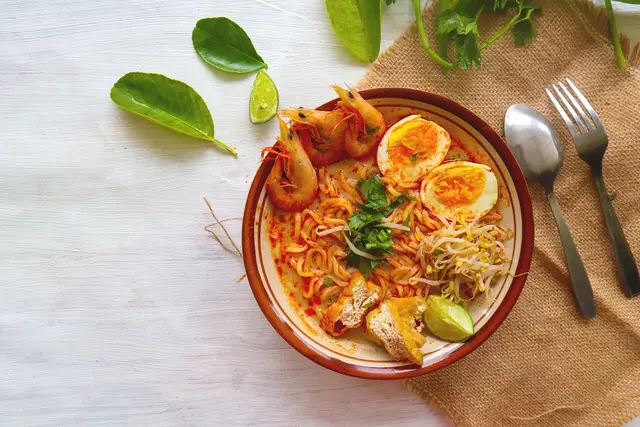
Much later, Europeans moved coconuts again. The Portuguese took Indian Ocean coconuts to West Africa, and from there they reached the Caribbean and Brazil. Spanish galleons carried Pacific coconuts from the Philippines to Mexico's Pacific coast 2. That is why coconut milk turns up in Brazilian seafood stews and Colombian coconut rice as naturally as in a Malaysian laksa 1.
Mechanical graters with a hand crank and serrated blade appeared in the mid-1800s, and are believed to be a British invention 1. Today factories crack, shred and press coconuts by machine, then gently pasteurise the milk at about 70°C 1.
Customs, rules and rituals
Before tins, coconut milk meant work, and the grater was the heart of the kitchen. In tropical Asia, the Pacific and eastern Africa, a manual grater is still standard household kit: a low stool you sit astride, with a serrated disc at one end. The disc is metal in Asia and Africa, and stone or shell in Oceania 1. Polynesian cooks may wring out the milk with a bundle of fibres from sea hibiscus, heliconia or the coconut itself 1.
In southern Thailand, where coconut goes into most dishes, those graters can be works of art. At one funeral at a Buddhist temple in Songkhla province, nearly a hundred hand-carved graters shaped like animals and mythical figures were brought together to cook for the guests. The family wanted to keep the old way alive. The graters even come in grades: blades with three or six teeth for desserts, ten teeth for savoury cooking 3.
In Sri Lanka, coconut milk sits at the centre of the year's most important meal. Kiribath, rice cooked in coconut milk (the name simply means "milk rice"), is the first food eaten at the Sinhala New Year, offered first to the Buddha and the gods, then shared by the family 4. It's breakfast on the first day of each month, the first solid food many babies eat, and at weddings the groom feeds it to the bride 4. On other special days, Sri Lankan cooks make yellow rice in coconut milk, bright with turmeric and dotted with cashews and raisins 5.
The everyday list is long, too: rendang and opor ayam in Indonesia, nasi lemak and laksa in Malaysia, tom kha kai and mango sticky rice in Thailand, and a whole family of Filipino rice cakes called kakanín 1.
Place in human experience
Coconut milk is a reminder that a kitchen staple can carry a map. The tin in your cupboard holds a plant that people first tended on two different coasts, and then shipped across two oceans in outrigger canoes and later in colonial galleons 2. Olsen's team put it neatly: far from being a mish-mash, coconut DNA preserves a record of cultivation, exploration, trade and colonisation 2.
It's also a food of beginnings. In Sri Lanka, kiribath marks every new start: a new year, a new month, a marriage, a baby's first meal 4. Families who cook it are saying something about hope and continuity, not just breakfast.
And it's a food of hands. The Thai family who gathered a hundred graters for a funeral remembered a time when no kitchen on their street owned an electric grater 3. Grating and squeezing coconuts was shared work, and memory lives in that work. Opening a tin is easier. It's worth knowing what the tin replaced.
Sources
- "Coconut milk", Wikipedia (citing the Philippine Coconut Authority, Tetra Pak Coconut Handbook and others). https://en.wikipedia.org/wiki/Coconut_milk
- Diana Lutz, "Deep history of coconuts decoded: Origins of cultivation, ancient trade routes, and colonization of the Americas", ScienceDaily (Washington University in St. Louis), 24 June 2011, reporting Gunn, Baudouin and Olsen, PLoS ONE 6(6): e21143. https://www.sciencedaily.com/releases/2011/06/110624142037.htm
- "Traditional coconut graters on show at southern funeral", Bangkok Post. https://www.bangkokpost.com/news/general/1360263/traditional-coconut-graters-on-show-at-southern-funeral
- "Kiribath", Wikipedia. https://en.wikipedia.org/wiki/Kiribath
- "Sri Lankan Food & Tropical Fruits", WWW Virtual Library Sri Lanka (lankalibrary.com). http://www.lankalibrary.com/food.shtml