Green Curry
Lift the lid on a pot of green curry and you get a wave of lime leaf, basil and chilli, with coconut milk bubbling a soft, pale green. In Thai it's kaeng…
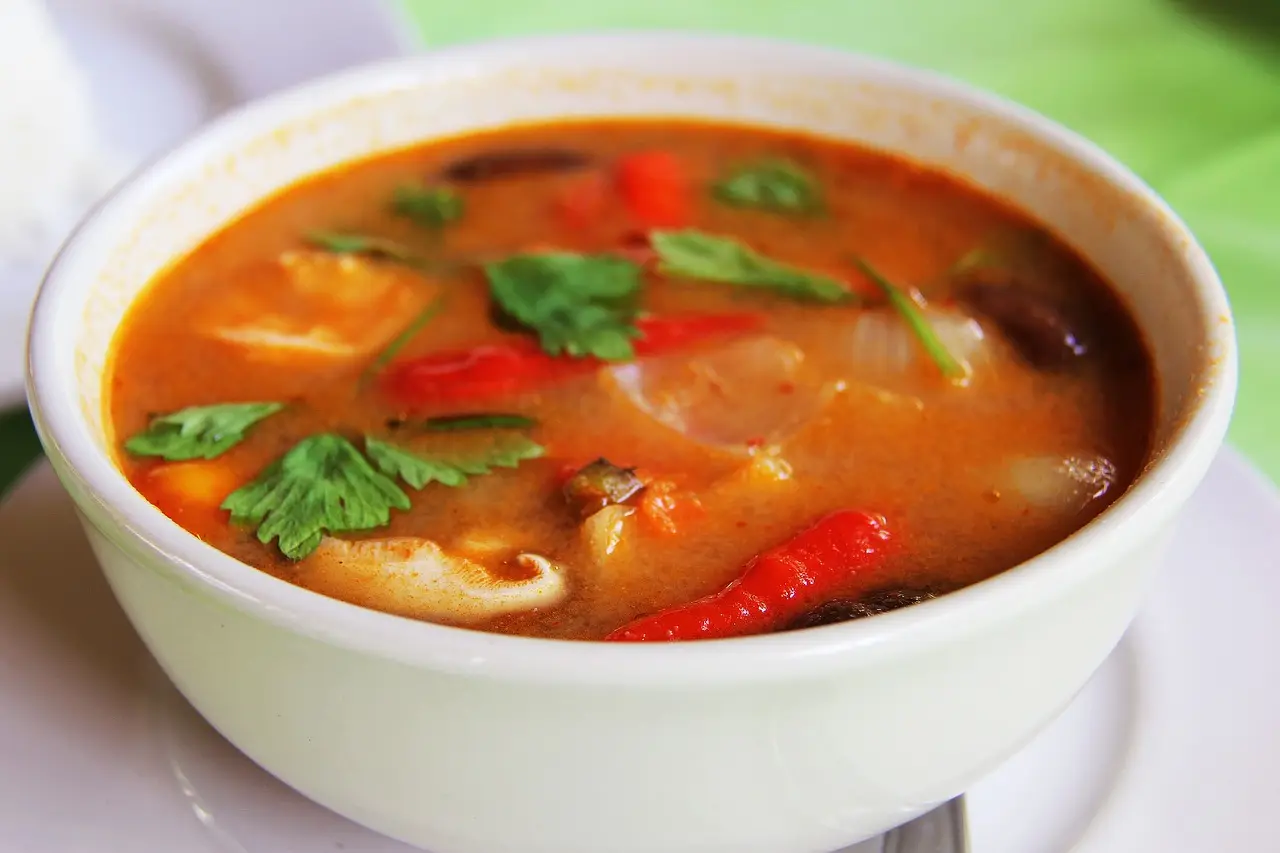
Lift the lid on a pot of green curry and you get a wave of lime leaf, basil and chilli, with coconut milk bubbling a soft, pale green. In Thai it's kaeng khiao wan, "sweet green curry", and here's the first surprise: the "sweet" isn't about sugar. It describes the colour, a creamy, gentle green 12. The second surprise? It's usually hotter than red curry 1. Born in central Thailand, it has become the dish half the world orders first at a Thai restaurant 23.
Background
The magic lives in the paste. A classic one pounds green bird's eye chillies, shallots, garlic, galangal, lemongrass, makrut lime peel, coriander root, cumin seed, white peppercorns, shrimp paste and salt 1. Note: coriander root, not the leaves. National Geographic points out that the leaves never go in, and that chefs and food writers mostly agree a homemade paste beats a jar 3. Thaifoodmaster, the school run by Chiang Mai food historian Hanuman Aspler, goes further: hand-pounded paste tastes different from a blender's 7. Good news for anyone who owns a mortar and pestle and some pent-up feelings.
The method is friendly. Fry the paste in coconut milk, cook your chicken, beef or fish balls in it, then add little round Thai eggplants and tiny pea eggplants and simmer until tender. Finish with makrut lime leaves, extra chillies, Thai basil, fish sauce and palm sugar 2. Traditionally the only sweetness came from the coconut milk; some cooks add palm sugar 3.
History
For such a famous dish, green curry is a youngster. Siam's first cookbook, Mae Khrua Hua Pa, came out as a book in 1908, written by Than Phu Ying Plean Phatsakorawong, and recorded early recipes such as massaman curry 4. National Geographic notes that the 1890s cookbooks talk about other curries but not this one, and that its first known appearance comes in a 1926 book by a writer with the pen name L Phaehtraarat 3.
Sources wobble a little on dates. Wikipedia places it in the reigns of King Rama VI or Rama VII, between 1908 and 1926 1; the Thailand Foundation says around 1910 to 1935 2. Either way: early twentieth century, central Thailand.
The ingredients tell older travel stories. Chillies came from the Americas, carried in by Portuguese traders in the late 1600s 3. White pepper and ground spices show an Indian thread, and contact with Persian, Indian and Malay cooks brought coconut into savoury pots 3. The Thailand Foundation says Thai curries started as clear broths, got richer once coconut milk and pastes arrived, and that green paste is really red paste with fresh green chillies swapped in for dried red ones 2. One fun find in Thaifoodmaster's archive: a 1920s "gaeng khiao" from Mrs Yim Pichaiyat Bunnag in a Muslim style, made with ghee, yoghurt, chicken liver, gizzard and heart, and warm spices like cinnamon, clove and cardamom 7. "Green curry" clearly once meant more than one thing.
Then it went travelling. Britain's first Thai restaurant, Bangkok on Bute Street in London, opened in 1967, and in 1988 the Churchill Arms in Notting Hill became the first UK pub to serve Thai food 3. In 2002 the Thai government launched its Global Thai programme to put Thai food on tables worldwide, with a "Thai Select" badge for restaurants using trained chefs, Thai ingredients and authentic dishes 6. Thai restaurants abroad jumped from about 5,500 to over 10,000 in a decade, and by 2014 roughly a quarter of Australian restaurants served Thai food 6. In a 2015 Thai government survey of international diners, green chicken curry came second among favourite Thai dishes 3.
Customs, rules and rituals
Green curry is made for sharing. A Thai meal usually means several dishes in the middle of the table, a plate of rice each, and everyone taking small, one-bite helpings as they go 5. The Tourism Authority of Thailand calls rice, ideally jasmine, the canvas: you balance sour, sweet, salty and bitter across the dishes, bite by bite 5.
Grab a spoon and fork, not chopsticks. The fork nudges food onto the spoon, and the spoon handles curry and rice far better 5. Green curry comes with steamed jasmine rice or khanom chin, soft fermented rice noodles 12, and sometimes with roti 1. With khanom chin it becomes a meal in one bowl 1.
Place in human experience
Green curry shows how fast a dish can become "traditional". It took shape in central Thai and Bangkok kitchens within living memory of its first printed recipe 23, and now stands in for Thai food as a whole. The Thailand Foundation sees it as a showcase of Thai heritage and of a love for fresh local ingredients balanced hot, salty, sweet and creamy 2.
Its world tour wasn't pure luck either. The Global Thai programme treated food as national diplomacy, backed by loans of up to US$3 million for Thai nationals opening restaurants abroad 6. Green curry, already a crowd favourite, rode that wave into takeaways from London to Sydney 36.
At home, though, it comes back to family. The Tourism Authority of Thailand describes food for Thais as a lifelong passion rooted in family, and sharing at the table as a kind of giving 5. One pot, many spoons, and someone always reaching for more rice.
Sources
- "Green curry", Wikipedia, https://en.wikipedia.org/wiki/Green_curry
- "Kaeng Khiao Wan: Thailand's Iconic Green Curry", Thailand Foundation, https://thailandfoundation.or.th/kaeng-khiao-wan-thailands-iconic-green-curry/
- "Thai green curry: revealing the spicy secrets of a culinary classic", National Geographic, https://www.nationalgeographic.com/travel/article/thai-green-curry-revealing-spicy-secrets-culinary-classic
- "Mae Khrua Hua Pa", Wikipedia, https://en.wikipedia.org/wiki/Mae_Khrua_Hua_Pa
- "Sharing and giving: Thai food culture", Tourism Authority of Thailand Newsroom, https://www.tatnews.org/2017/04/sharing-giving-thai-food-culture/
- "How Gastrodiplomacy Brought Thai Food To The World Stage", Madeline Rae, Food Republic, https://www.foodrepublic.com/1318428/how-gastrodiplomacy-brought-thai-food-world-stage
- "Thai Green Curry with Roasted Duck and Young Chilies", Thaifoodmaster, https://thaifoodmaster.com/thai_food_recipes/thai_curry_recipes/6440