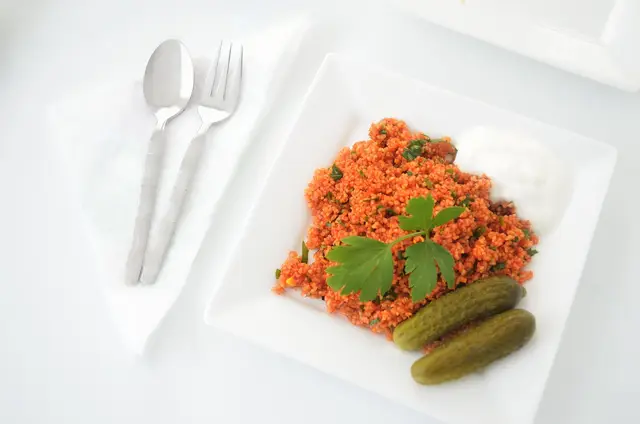
Couscous
Couscous looks like the humblest thing in the pantry: tiny golden grains you pour boiling water over on a busy weeknight. But in North Africa it's the…
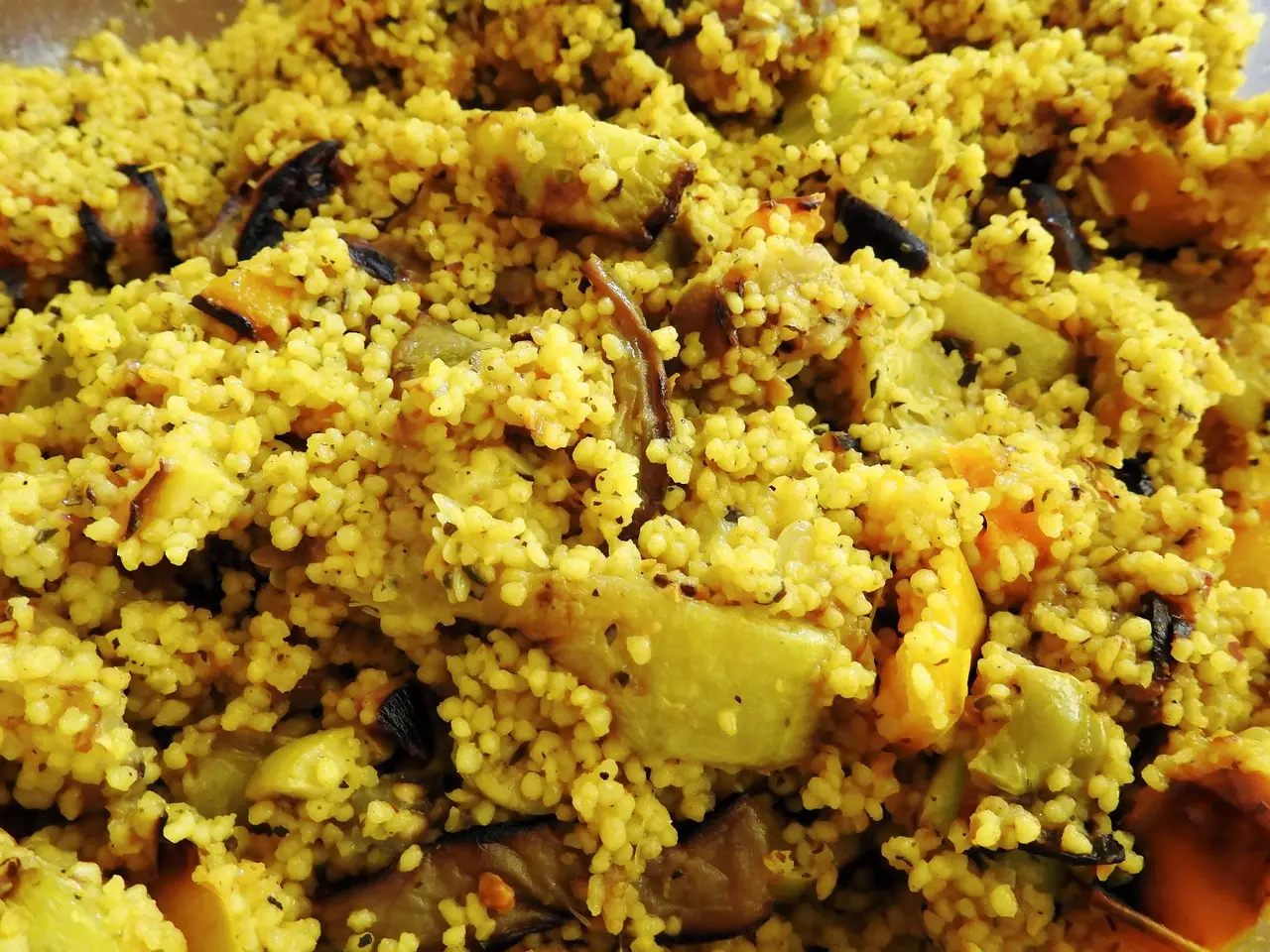
Couscous looks like the humblest thing in the pantry: tiny golden grains you pour boiling water over on a busy weeknight. But in North Africa it's the dish at every Friday lunch, every wedding and the feast at the end of Ramadan, piled high on a big shared platter and crowned with meat, chickpeas and vegetables 12. It's so loved that in 2020 four countries that don't always get along, Algeria, Morocco, Tunisia and Mauritania, teamed up to have it listed by UNESCO as part of the world's cultural heritage 34. Not bad for a grain that's really rolled-up semolina.
Background
Here's the surprise: couscous isn't a grain at all. It's made from grain. Traditionally a cook sprinkles salted water and a little flour over freshly ground durum wheat on a wide flat plate, then rolls it under the palms until little granules form, sieves them to an even size and dries them in the sun 1. A medieval cookbook from al-Andalus asks for grains "the size of ants' heads" 2.
Wheat is the classic, but barley, sorghum, corn and millet all get the same treatment 14. And the cooking is a ritual of its own. The grains go into the top of a two-part steamer, the couscoussier, sitting over a pot of bubbling stew. Every ten or fifteen minutes the couscous comes out, gets rubbed with oil or butter by hand so it doesn't clump, and goes back to steam again 1. The result is light, fluffy, every grain separate. (Precooked couscous, now sold everywhere, skips all that, which is why it makes such a good weeknight standby 1.)
History
Nobody knows exactly who first rolled couscous, and historians don't agree on when. The food historian Lucie Bolens argued Berbers were making it as early as the second or third century BCE. Charles Perry, a specialist in medieval Arab food, places its birth much later, between the 11th and 13th centuries 1. The historian Marianne Brisville, writing in L'Histoire, sides with a medieval birth in the western and central Maghreb, today's Morocco and Algeria, probably among rural communities, with a Berber rather than Arab origin 2. The word itself comes from the Berber k'seksu 1.
The written trail starts in the 12th and 13th centuries, when kuskusu appears in cookbooks from Muslim Spain and North Africa. One of them says plainly that ordinary couscous with broth "is known to all" 2. Its earliest recipes already sound familiar: beef broth, seasonal vegetables such as cabbage, turnip, carrot, broad beans and eggplant, and a dusting of cinnamon, pepper and ginger on top 2.
Then it travelled:
- Spain and Portugal. Couscous spread with Berber dynasties into the Iberian peninsula. Later, the Inquisition treated eating it as a sign of hidden Muslim faith among the Moriscos, and the dish faded from Spain 1.
- The Sephardic world. Jews expelled from Spain in 1492 took couscous with them 1.
- Sicily. Trapani still makes cùscusu with fish stew, though nobody agrees whether it arrived in the Muslim period or later 1.
- Brazil. Portuguese and African influences brought cuscuz across the Atlantic in the 16th century; in the north it's now a sweet tapioca and coconut milk breakfast 1.
Travellers loved it. In 1470 the Flemish visitor Anselm Adorne ate couscous outside Tunis, served with meat and chicken wrapped in cabbage, and watched diners roll it into balls with their fingers and pop them in 2. Leo Africanus described the people of Fez eating it in winter, all dipping into the same dish without a spoon 2.
Customs, rules and rituals
Couscous is the Friday dish across much of the Maghreb. One Moroccan restaurant owner told AFP it's "impossible not to eat it every Friday" 4. It also comes out for the end of Ramadan, births and weddings, and that link with feasting ties it to ideas of abundance, fertility and baraka, God's blessing 1.
It's eaten together, from one big platter: couscous at the bottom, meat or fish and vegetables on top, broth on the side, maybe spiked with chilli sauce 1. Every country does it a bit differently. Algerian versions lean on tomatoes and vegetables, Moroccan cooks love saffron, and Tunisians add fish, chickpeas and fiery harissa. In the Sahara it's served without broth 1. There are sweet versions too, with raisins, cinnamon, butter and sugar 2.
Making the grain has traditionally been women's work, and a social event. UNESCO notes that women keep alive not only the technique but "the songs, gestures, characteristic oral expressions and ritual organisation" that go with it 4. Algerian chef Rabah Ourrad says he learned it from "decades of observing the mother, the sisters and all North African women who are experts in this" 4.
Place in human experience
The four countries' joint UNESCO bid called couscous "at once ordinary and special": ordinary because families eat it all the time, special because it brings communities together to share 4. UNESCO itself describes it as full of meaning tied to "solidarity, conviviality, sharing meals and togetherness" 3. The knowledge still passes the old way, by watching and copying, though more formal teaching has grown up recently 3.
That joint bid was a quiet bit of diplomacy too. Algeria had annoyed Morocco a few years earlier by planning a solo nomination; the 2020 bid brought the whole region together, and Ourrad put it simply: "the couscous is Maghrebi, the couscous is ours" 4.
Couscous also crossed into Europe with North African migrants. Brisville notes it settled into mainland France in the 1960s and now ranks among French people's favourite dishes 2. So a bowl of couscous carries a lot: Berber villages, Andalusian kitchens, Sephardic exile, Sicilian fishermen, Brazilian breakfasts and Friday lunch at a French kitchen table.
Sources
- "Couscous", Encyclopedia of Food and Culture (Scribner, 2003), via Encyclopedia.com. https://www.encyclopedia.com/sports-and-everyday-life/food-and-drink/food-and-cooking/couscous
- Marianne Brisville, "Et le Moyen Age inventa le couscous", L'Histoire. https://www.lhistoire.fr/et-le-moyen-age-inventa-le-couscous
- "Knowledge, know-how and practices pertaining to the production and consumption of couscous", UNESCO Intangible Cultural Heritage, inscribed 2020. https://ich.unesco.org/en/RL/knowledge-know-how-and-practices-pertaining-to-the-production-and-consumption-of-couscous-01602
- "UNESCO adds couscous to list of intangible world heritage", Al Jazeera (AFP), 16 December 2020. https://www.aljazeera.com/news/2020/12/16/unesco-adds-couscous-to-list-of-intangible-world-heritage