
Eggplant
Glossy, purple and a little bit smug, the eggplant has been charring over coals, melting into stews and soaking up olive oil for at least two thousand…
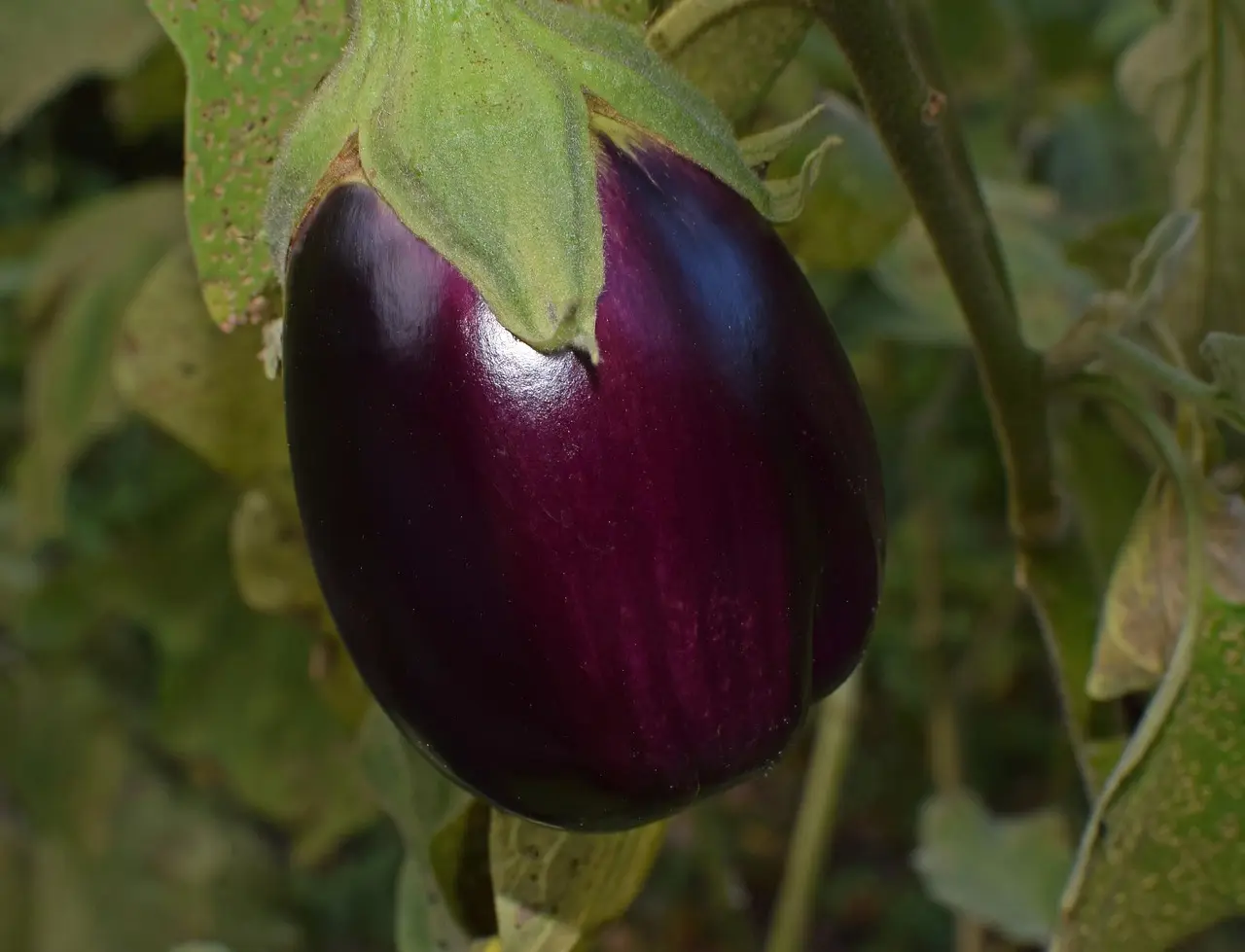
Glossy, purple and a little bit smug, the eggplant has been charring over coals, melting into stews and soaking up olive oil for at least two thousand years. Australians and Americans say eggplant, the British and French say aubergine, and South Asia says brinjal, and all three names turn out to be the same word that has travelled right round the world and come home again 3. Few vegetables have been feared, mocked and dreamed about for luck. This one has managed all three.
Background
The eggplant is Solanum melongena, a cousin of tomatoes and potatoes in the nightshade family. It looks Asian on the plate, but its family story starts in Africa. A 2018 study from London's Natural History Museum and the University of Helsinki read the chloroplast genomes of eggplant and 22 relatives and found the group began in north-eastern Africa about two million years ago 1. One lucky seed dispersal carried it to tropical Asia, where a wild species, Solanum insanum, became the plant people later tamed 1.
The best bit: in Africa, elephants and impalas eat the wild fruit and spread the seeds. The researchers put it plainly: protect the elephants, because the eggplant's wild gene pool depends on them 1.
In 2022 the world grew about 59 million tonnes. China grows almost two thirds of it and India most of the rest, with Egypt, Turkey and Indonesia a long way behind 7.
History
Where people first domesticated it is still argued over. The Helsinki team points to the region spanning China and India 1. The oldest reliably dated record of anyone actually growing it comes from China: Wang Bao's Tong Yue, dated 59 BC, gives the spring job to "separate and transplant seedlings of eggplant and scallion" 2.
Chinese texts then let you watch farmers improve it over centuries. A 2008 paper by Wang, Gao and Knapp in Annals of Botany traced how early writers compared the fruit to tiny pellets, how it reached teacup size by the twelfth century, and how Qing-era varieties weighed up to about 1.5 kilograms 2. Early sources call it unpleasant to eat. Later ones call it sweetish, as growers bred the bitterness out 2.
Its name tells the westward journey. Linguist Steven Kaye traces it from a Dravidian word into Sanskrit vātiṅgaṇa, Persian bādenjān, Arabic al-bādhinjān, then Catalan albergínia and French aubergine 3. Medieval Latin made it melongena and Italian melanzana, which speakers heard as mela insana, "mad apple". English borrowed that label in the 1500s, helped along by the nightshade family's poisonous reputation 3. "Eggplant" arrived in the eighteenth century for small white varieties that really did look like eggs. Portuguese beringela sailed to India and became brinjal, bringing the word back to the land it started from; Caribbean English then turned brinjal into "brown-jolly" 3.
Customs, rules and rituals
In medieval Spain the eggplant marked who you were. Food historian Hélène Jawhara Piñer writes that it became strongly tied to Spanish Jews, and that Inquisition investigators and nosy neighbours used eggplant-eating as a sign of Jewish identity; Cervantes mocked converso food habits along the same lines 4. A thirteenth-century eggplant recipe still survives, mostly in Mediterranean and Turkish Jewish kitchens 4.
When Jews left Spain, the eggplant was waiting for them. Turkish food writer Aylin Öney Tan points out that while it was nearly unknown to Christian Europe, it was a mainstay of Ottoman cooking, which helped Sephardic families settle into their new kitchens 5.
In Japan, an eggplant can make your whole year. The first dream of the new year, hatsuyume, is said to forecast the twelve months ahead, and the old saying ranks the luckiest dreams "Mount Fuji first, hawks second, eggplants third" 6. One theory says the three were famous in Suruga, the province linked to the shogun Tokugawa Ieyasu; another hears a pun, since nasu (eggplant) sounds like the verb "to accomplish" 6. Some families still slip a picture of a treasure ship under the pillow to help the dream along 6.
Place in human experience
In India, brinjal is so ordinary it became political. In October 2009 regulators approved a genetically modified "Bt brinjal". Before deciding, Environment Minister Jairam Ramesh held public hearings in seven cities, attended by about 8,000 farmers, scientists and activists, most of them opposed. On 9 February 2010 he announced an indefinite moratorium, saying "There is no hurry to introduce Bt brinjal on the pretext of food security" 8. Major growing states including West Bengal, Bihar, Orissa and Andhra Pradesh had asked for a delay 8. A vegetable on almost every Indian table turned into a national argument over who controls seeds and science.
The eggplant's arc in Europe runs from suspicion to celebration. A fruit once labelled a "mad apple" 3 and used to single out a persecuted minority 4 now anchors moussaka, parmigiana and baba ghanoush. Its story is a good reminder that what counts as a strange foreign food in one century becomes comfort food in the next, usually because families carried it with them.
For home cooks, the takeaway is happy: whatever you call it, you are cooking a plant with elephants in its past, a 2,000-year-old Chinese farm text in its paperwork and a lucky New Year dream in its future.
Sources
- "How Eggplants became Asian – genomes and elephants tell the story", University of Helsinki, https://www.helsinki.fi/en/news/life-sciences/how-eggplants-became-asian-genomes-and-elephants-tell-story
- Wang J-X, Gao T-G, Knapp S, "Ancient Chinese Literature Reveals Pathways of Eggplant Domestication", Annals of Botany (2008), Oxford University Press via PubMed Central, https://pmc.ncbi.nlm.nih.gov/articles/PMC2712397
- Steven Kaye, "The Story of Aubergine", Surrey Morphology Group, University of Surrey (22 June 2022), https://morph.surrey.ac.uk/index.php/page/2/?cat=-1
- Hélène Jawhara Piñer, "Sephardic Cuisine: How It Emerged, Evolved, and Persisted", My Jewish Learning, https://www.myjewishlearning.com/article/sephardic-cuisine-how-it-emerged-evolved-and-persisted/
- Aylin Öney Tan, "A long journey, a long table", Hürriyet Daily News, https://www.hurriyetdailynews.com/opinion/aylin-oney-tan/a-long-journey-a-long-table-182598
- "Jirō Dreams of Fuji: Japan's 'Hatsuyume' Tradition", Nippon.com, https://www.nippon.com/en/nipponblog/m00061/
- "List of countries by eggplant production" (FAOSTAT data, 2022), Wikipedia, https://en.wikipedia.org/wiki/List_of_countries_by_eggplant_production
- "Moratorium on Bt brinjal: Jairam Ramesh", Centre for Science and Environment, https://www.cseindia.org/moratorium-on-bt-brinjal-jairam-ramesh-1051