Feta
Feta is the salty white cheese crumbled over half the Mediterranean dinners you have ever loved. True feta is Greek by law: a brined cheese made from…
Feta is the salty white cheese crumbled over half the Mediterranean dinners you have ever loved. True feta is Greek by law: a brined cheese made from sheep's milk, or sheep's milk with a little goat's, from set regions of Greece 12. It is tangy, a bit crumbly, a bit creamy, and in Greece it turns up at nearly every meal 3. If you have only met the squeaky supermarket block, the real thing is worth a detour.
Background
The rules are short and strict. Feta must be at least 70 per cent sheep's milk, with goat's milk capped at 30 per cent, and the animals must graze in one of nine regions: West, Central and East Macedonia, Thrace, Epirus, Thessaly, Central Greece, the Peloponnese and the island of Lesbos 2. The curd drains under its own weight, never pressed, then gets coarse salt and a long soak 2. It must sit in brine for at least three months before sale 1.
That brine is the secret. It keeps the cheese moist and gives feta its sharp, clean bite. The acidity lands around pH 4.4 to 4.6, which is why it tastes so bright next to sweet tomato or watermelon 1.
Shopping tip from Greek dietitian Elena Paravantes: read the label for sheep's milk, maybe goat's, rennet and salt, and nothing else. Good feta looks bright white, not yellow, and often has tiny holes on the surface 3.
History
Greeks love to point to Homer. In the Odyssey, the Cyclops Polyphemus makes cheese from his flock in his cave. Scholars still argue over whether that cheese looked anything like feta or was closer to a rinded cheese such as pecorino, so treat Polyphemus as the cheese's mythical great-grandfather rather than its inventor 1.
Firmer evidence turns up in the Byzantine era. The eleventh-century writer Michael Psellos describes a fresh cheese called prósphatos, meaning "recent" 1. In the late fifteenth century, an Italian visitor, Pietro Casola, noted Greeks storing their cheese in brine 1.
The name is the twist. "Feta" comes from the Italian fetta, a slice, and from the Latin offa, a morsel. It only spread widely in the nineteenth century, probably because cheesemakers cut the cheese into slabs to pack it into barrels 1. So the most Greek of cheeses carries an Italian name.
Then came the cheese wars. Greece started writing down production rules in the 1930s and made them law in 1988 2. It applied to the European Union in 1994 to make "feta" a protected name, won in 1996, lost the protection in 1999 after objections from other members, and won it back in 2002 2. Denmark and Germany took the case to the European Court of Justice, backed by France 1. Their argument: "feta" had become a generic word, like "cheddar." On 25 October 2005 the Court disagreed, ruling the name had not become generic and that it belonged to cheese from Greece 4.
It mattered for money as well as pride. Greece makes around 115,000 tonnes of feta a year, but before the ruling Denmark, France, Germany and the UK held most of the export market, often with cow's milk versions 2. By 2013 Greek cheese exports reached about 287 million euros, and feta made up 86 per cent of them 2.
Customs, rules and rituals
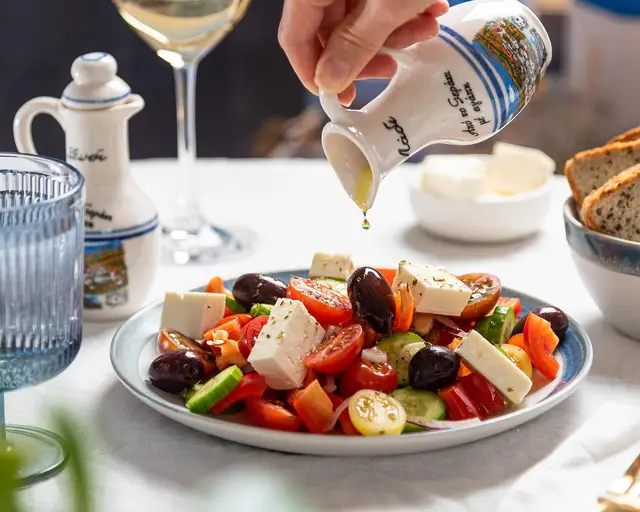
In Greece, feta is less a cheese than a table setting. Paravantes compares it to bread: it is there whatever else is served, eaten with vegetables, meat, beans, olives, and with watermelon or cantaloupe on a hot day 3.
The Orthodox calendar gives feta its own week. Before Easter, the Church eases families into the Great Lent fast in stages. Meatfare week is the last week for meat. Then comes Cheesefare week, or Tyrini, when meat is off but dairy, eggs, fish and olive oil are allowed every day 5. Devout families eat cheese even on the Wednesdays and Fridays they would normally keep free of it 67. Then, on Clean Monday, the strictest stretch of the fast begins, and dairy disappears from the table until Easter 5. If you see a cheese pie on a Greek table in late winter, check the calendar.
Place in human experience
Few foods carry a national argument quite like feta. To Greeks, the 2005 ruling was not a trade footnote. It recognised a link between a landscape, its sheep and goats, and a way of making cheese that families had kept going for generations. The Court tied the name to that place: protected feta comes only from Greece 4.
Greeks eat more cheese per person than almost anyone, somewhere between 23 and 30 kilograms a year by Paravantes's estimate, and at least half of it is feta 3. For a cheese Greeks treat like bread, losing the name would have felt like losing a bit of breakfast, lunch and dinner.
Sources
- "Feta", Wikipedia, https://en.wikipedia.org/wiki/Feta
- "Defining a Name's Origin: The Case of Feta", World Intellectual Property Organization (WIPO) IP Advantage, https://www.wipo.int/ipadvantage/en/details.jsp?id=5578
- Elena Paravantes, "6 Things You Need to Know About Feta Cheese", HuffPost, https://www.huffpost.com/elena-paravantes/feta-cheese-tips_b_1899983.html
- Court of Justice of the European Communities, Press Release 92/05 on Joined Cases C-465/02 and C-466/02 (Germany and Denmark v Commission), 25 October 2005, https://curia.europa.eu/jcms/jcms/P_27769/
- "Triodion Period", Wikipedia, https://en.wikipedia.org/wiki/Triodion_Period
- "Orthodox Christians begin Cheesefare Week ahead of Great Lent", Orthodox Times, https://orthodoxtimes.com/orthodox-christians-begin-cheesefare-week-ahead-of-great-lent/
- Seraphim Holland, "Cheesefare Week: 'kind of' like being in Great Lent", St Nicholas Orthodox Church, https://orthodox.net/redeemingthetime/?p=690