
Jasmine Rice
Lift the lid on a pot of jasmine rice and the steam smells faintly of pandan leaves . That perfume is the whole point. Thais call it Hom Mali; the rest of…
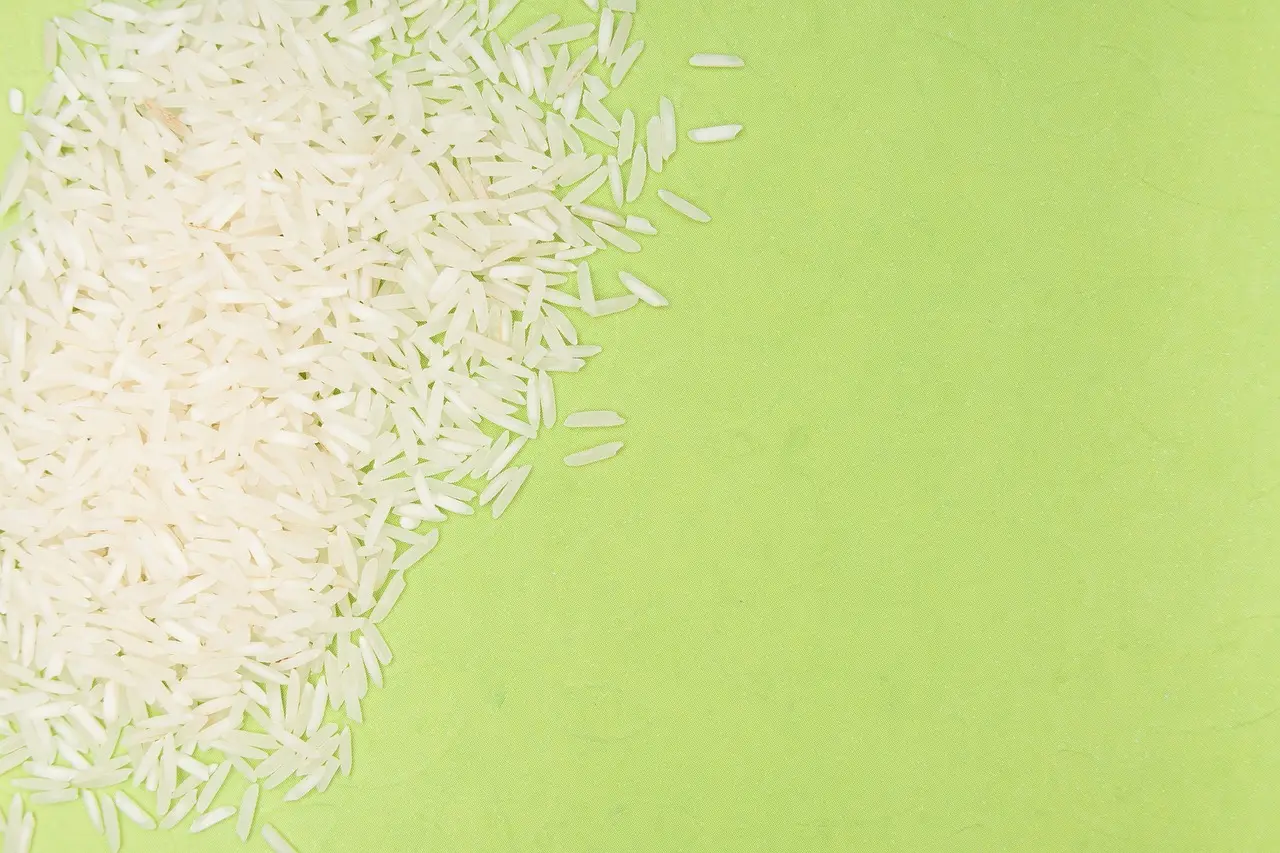
Lift the lid on a pot of jasmine rice and the steam smells faintly of pandan leaves 2. That perfume is the whole point. Thais call it Hom Mali; the rest of us know it as Thai jasmine rice 1. Here's the surprise: the variety in most bags, Khao Dawk Mali 105, only reached Thai farmers in 1959 1. Young as it is, it carries everything rice means in Thailand.
Background
Almost all Thai jasmine rice comes from two varieties: Khao Dawk Mali 105, or KDML105, and RD15, a quicker-growing offshoot released in 1978 1. Thailand grows about 9.4 million tonnes of it a year, and KDML105 fills roughly 70 per cent of the country's rain-fed lowland paddies, mostly in the north-east 1.
That gorgeous smell comes down to one compound, 2-acetyl-1-pyrroline, and one broken gene. A tiny deletion on chromosome 8 switches off an enzyme that would normally break the compound down, so it builds up in the grain instead 1. A happy accident of genetics, in other words.
Where it grows matters too. On the Thung Kula Rong Hai plain in Roi Et province, the soil carries sodium and silica and the fields rely on scarce rain. That hardship makes the plants more fragrant than the same rice grown anywhere else 2. Farmers there plant once a year, April to August, and harvest from October to December 2. Premium Hom Mali must be at least 92 per cent genetically pure, because pollen from neighbouring fields can muddle the seed 3.
History
Ask who found jasmine rice and you get two answers.
A 2018 review by Thai rice breeders says a farmer spotted the fragrant local rice in Chonburi province in 1945. Breeders began selecting from seed collected in Chachoengsao province in 1951 and picked line number 105 for its looks and eating quality 1.
Prachatai, a Thai news site, tells it differently. It credits Suntorn Seehanoen, a young rice officer in Bang Khla district of Chachoengsao, who put forward a local rice "popular among the wealthy" when American advisers arrived to help improve Thai varieties. Of 200 ears sent off for testing, only the 102nd and 105th passed, and only the 105th went the distance. Hence the number 4. Both stories land on the same release year, 1959 14.
Then came the copycats. In 1993 a Texas company, RiceTec, registered a US trademark for "Jasmati", an American-grown rice 5. Thai campaigners discovered it in 1998 and things got heated. Farmers and activists protested; they called the name a bid to confuse shoppers and said Jasmati actually came from Della, a US rice descended from Italian stock 6. Thailand tried to cancel the trademark and, in June 1998, filed its own "Thai Hom Mali" certification mark 5.
The lesson stuck. In 2013 Thung Kula Rong Hai jasmine rice became the first Thai product protected as a geographical indication in the European Union 2.
Customs, rules and rituals
In Thailand, instead of "how are you?", people often ask "have you had rice yet?" It's a way of saying you care 7.
Farming families have long honoured Mae Phosop, the rice goddess. In the Tham Khwan Khao ritual, farmers make offerings to her, because without her, the belief goes, the rice won't thrive 8. A 2021 Thai study notes the ritual fading as tractors and commercial farming take over 8.
Then there's the Royal Ploughing Ceremony, a Brahmin rite dating to the Sukhothai era (1238–1438) that opens the planting season each May, on a date chosen by astrologers or Brahmin priests 9. A senior agriculture official picks one of three lengths of cloth to predict the rains. Sacred oxen are offered seven foods, and whatever they eat forecasts the year: rice or corn means a good harvest, and if they go for the alcohol, trade will boom 9. Afterwards farmers collect the blessed seed for luck in their own fields 9. The ceremony stopped in 1936 and came back in 1960 9.
Place in human experience
For a farmer in Roi Et, jasmine rice is a living, and a fragile one. In the 2020 drought, Thung Kula yields fell to about 375 kilograms per rai against a normal 488, and some fields gave as little as 100 4.
For Thailand as a whole, it is something closer to a national treasure. The Jasmati row shows how deeply that runs: a trademark filed in Texas brought farmers out in protest and pushed the government to write new law 56.
And under the trade disputes and purity standards sit the older meanings: a goddess in the paddy, oxen choosing the nation's fortune, and a greeting that asks whether you've eaten 789. So when you steam a pot in a suburban kitchen, you're cooking a rice bred by named officers in the 1950s and defended in trade law, which still carries all of that.
Sources
- Vanavichit A. et al., "Thai Hom Mali Rice: Origin and Breeding for Subsistence Rainfed Lowland Rice System", Rice 11 (2018), Springer / PubMed Central. https://pmc.ncbi.nlm.nih.gov/articles/PMC5891439
- "Thai Hom Mali Rice from Thung Kula Rong-Hai – A World-Recognized GI", World Intellectual Property Organization (WIPO), IP Advantage. https://www.wipo.int/en/web/ip-advantage/w/stories/thai-hom-mali-rice-from-thung-kula-rong-hai-a-world-recognized-gi
- Vanavichit A., "Thai jasmine rice", Open Access Government, 3 February 2022. https://www.openaccessgovernment.org/thai-jasmine-rice/95306/
- "The Struggle of Thung Kula Rice Farmers to Grow Hom Mali Rice", Prachatai English, 28 February 2021. https://prachataienglish.com/node/9124
- Lightbourne M., "The Jasmati trademark affair", GRAIN (from IP Asia, February 1999), 26 March 1999. https://grain.org/en/article/2060-the-jasmati-trademark-affair
- "Development Bulletin-Thailand: Farmers Protest Copycat 'Jasmine' Rice", Inter Press Service, 16 May 1998. https://www.ipsnews.net/?p=64646
- Alfonso-Gregorio N., "The many meanings of rice in Asian culture", SBS Food, 20 July 2022. https://www.sbs.com.au/food/the-cook-up-with-adam-liaw/article/the-many-meanings-of-rice-in-asian-culture/bh7lpre0h
- Thongmeethip K. and Phayakka N., "Tham Khwan Khao Ritual and the Change of Agricultural Practice", Thai Agricultural Research Journal 39(3), 2021. https://li01.tci-thaijo.org/index.php/thaiagriculturalresearch/article/view/251340
- "The Royal Ploughing Ceremony", Thailand Foundation. https://thailandfoundation.or.th/royal-ploughing-ceremony/