Lentils
Lentils are the little lens-shaped seeds that have quietly fed the world for about 12,000 years. They were one of the very first crops anyone farmed, they…
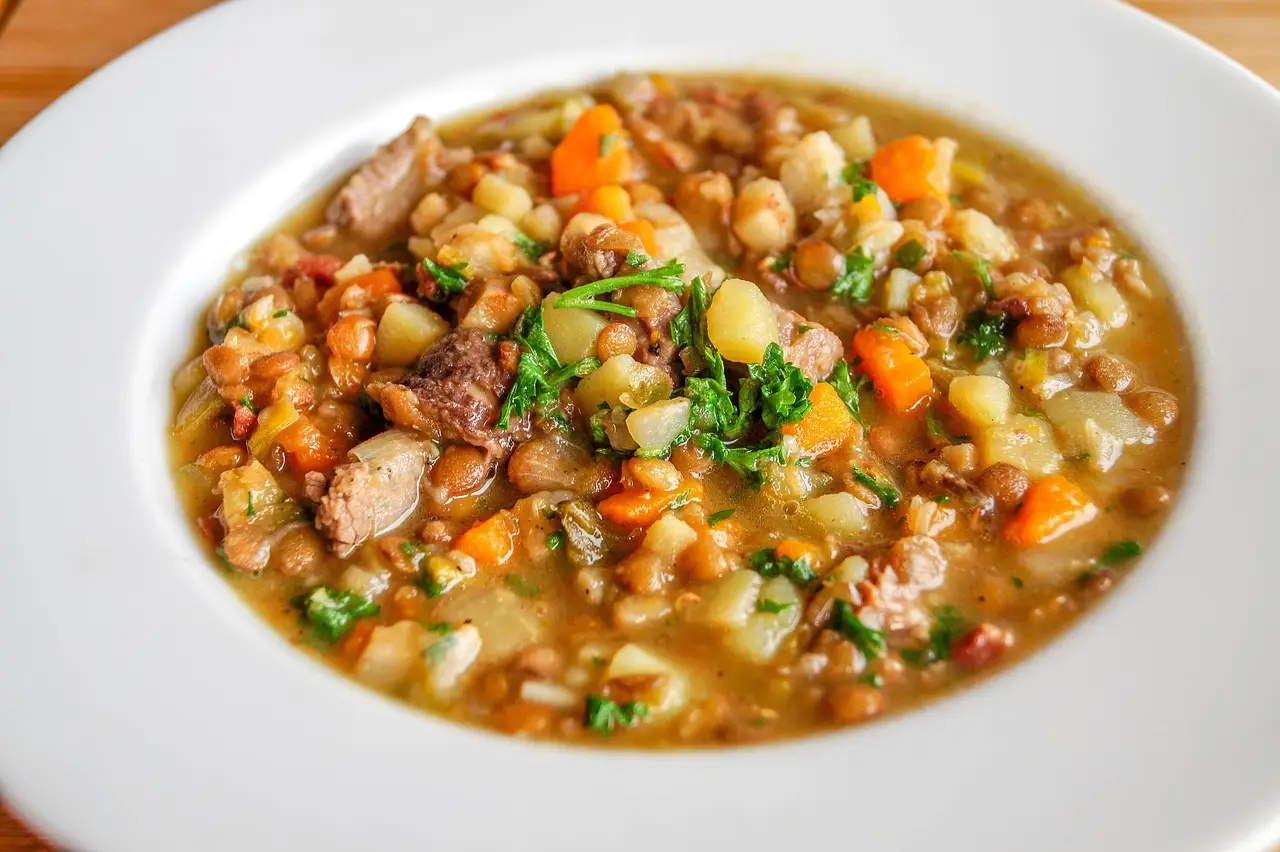
Lentils are the little lens-shaped seeds that have quietly fed the world for about 12,000 years. They were one of the very first crops anyone farmed, they cost next to nothing, and they turn into dinner in one pot. A bowl of dal in Delhi, a pot of fakes in Athens and a plate of koshari in Cairo all start with the same humble seed. Along the way lentils have comforted mourners, fed fasting monks and promised Italians a richer new year 136.
Background
The plant is Lens culinaris, and its wild ancestor, Lens orientalis, still grows across the Near East 1. Our word comes from the Latin lens. Romans liked naming families after food: the Lentuli took theirs from the lentil, just as Cicero's family took theirs from the chickpea 1.
Lentils come whole or split, in brown, green, black, yellow and red. In South Asia, split lentils are dal, and so is the dish you make with them 14. Today three countries grow most of the world's crop: in 2023 Australia, Canada and India produced about 72 per cent between them 1. India is also the biggest eater, and there lentils rank second only to chickpeas among winter crops 3.
History
The first farmers. Lentils sit with wheat and barley in the small club of crops that started farming in the Fertile Crescent, about 12,000 years ago according to the dryland research centre ICARDA 3. The oldest charred lentils, from Franchthi Cave in Greece, date to around 11,000 BC 1. Those were probably picked wild, though. Telling wild from farmed is tricky, because lentils only grew plumper after people started choosing the best seed 7. Clear farm sites follow in Syria, Turkey, Iran and Greece between about 6250 and 5000 BC 1.
Heading east. From there lentils travelled into Europe, North Africa and across to the Ganges plain 1. ICARDA puts them in Georgia by 5000 to 4000 BC and in India and Pakistan by about 2000 BC, with signs of lentil dishes in India's early Harappan period 3. The ancient Sanskrit Yajurveda already lists masha (urad), mudga (mung) and masura (masoor) as everyday pulses 4.
In the Bible. The most famous lentil stew in history is the one Jacob sells Esau for his birthright: "bread and pottage of lentils" (Genesis 25). Lentils also turn up among supplies brought to King David, and in the bread Ezekiel bakes in hard times, a trick also known in ancient Egypt 2. Food snobs of the ancient world had opinions, naturally: red lentils were rated best, and those from Pelusium on the Nile Delta best of all 2.
Koshari. Egypt's beloved lentils-and-rice dish shows up in Richard Burton's 1853 travel book as the breakfast of Suez. You will hear it descends from a pharaonic "koshir", a lovely story with one problem: scholars cannot find the word in the ancient source usually cited 6. Koshari began on street carts, fed working Cairo, and in 2025 joined UNESCO's intangible heritage list 6.
Customs, rules and rituals
Comfort for mourners. In Jewish tradition lentils are a food of grief. One rabbinic reading says Jacob's famous stew was really the mourners' meal for his grandfather Abraham, and mourners coming home from the cemetery once ate lentils as their round food 5. Why lentils? They are round, like the wheel of misfortune that turns to every family sooner or later, and they have no opening, like a mourner sitting in silence 25.
Fasting food. Catholic households leaned on lentils through Lent, when meat and fish were off the table. In Greece, a pot of fakes with a splash of vinegar at the end is a fasting-season classic 8.
Money for New Year. At midnight on New Year's Eve, Italian families eat lentils with cotechino or zampone, rich pork sausages from Modena. Each little disc stands for a coin, so the more you eat, the richer your year. People love to say the Romans gave each other purses of lentils hoping they would turn into money. It is a charming tale, but nobody telling it cites an ancient source, so file it under folklore 9.
Dal, every day. Dal crosses every line of caste, region and income in India. Bengali cooks bring out chana dal for celebrations, eastern Indian families give masoor dal to someone getting over an illness, and "dal-roti" is shorthand for a simple shared meal 4. There is even an old Hindu saying: "Rice is good, but lentils are my life" 3.
Place in human experience
Lentils have long been the food of getting by. The Talmud contrasts lentils, food for people, with barley, food for cattle 2. The food historian K. T. Achaya identified masha with jaggery and oil as a poor family's meal in Vedic India 4. The Greek philosopher Diogenes made a point of living on lentils 8. And the whole sting of the Esau story is how cheap that stew was.
But cheap food is shared food. Because almost everyone could afford lentils, they became the food of the big moments everyone goes through: a funeral, a fast, the first meal of a new year. The shape does a lot of the talking. The same small circle means fate turning to a Jewish mourner and money rolling in to an Italian family.
And lentils travel. A bag of dried lentils survives a ship's hold or a suitcase, cooks on one burner and tastes like home. No wonder dal follows South Asian families wherever they settle 4. If you have a bag in your cupboard, you are holding one of the oldest dinners on earth.
Sources
- "Lentil", Wikipedia, https://en.wikipedia.org/wiki/Lentil
- "Lentils", Jewish Encyclopedia, https://www.jewishencyclopedia.com/articles/9750-lentils
- "A Brief History of the Mighty Lentil in India", ICARDA, https://icarda.org/node/17326
- Salma Husain and Vijay Thukral, "When did dal become India's favoured food?" (excerpt from Pull of Pulses), Scroll.in, https://scroll.in/magazine/880178/when-did-dal-become-indias-favoured-food-and-what-was-ramas-preferred-preparation
- Rabbi N. Daniel Korobkin, "Lentil Soup", Jewish Journal (2008), https://jewishjournal.com/judaism/torah/67299/
- "Koshary", Wikipedia, https://en.wikipedia.org/wiki/Koshary
- G. Sonnante, K. Hammer and D. Pignone, "From the cradle of agriculture a handful of lentils: history of a domestication", Rendiconti Lincei (2009), CNR record, https://data.cnr.it/data/http://www.cnr.it/ontology/cnr/individuo/prodotto/ID28164
- "Fakes: how do you make lentil soup? Let us count the ways", Neos Kosmos, https://neoskosmos.com/en/165716/fakes-how-do-you-make-lentil-soup-let-us-count-the-ways
- Marianna Pitonzo, "Festive Curiosities: Why do we eat lentils at midnight?", La Panza Piena, https://lapanzapiena.substack.com/p/festive-curiosities-why-do-we-eat