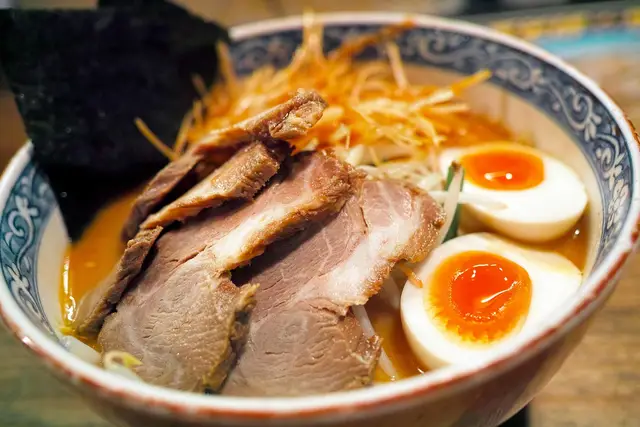
Miso
Miso is a salty, savoury paste of soybeans fermented with salt and a friendly mould called koji. Stir a spoonful into hot dashi and you have miso soup,…
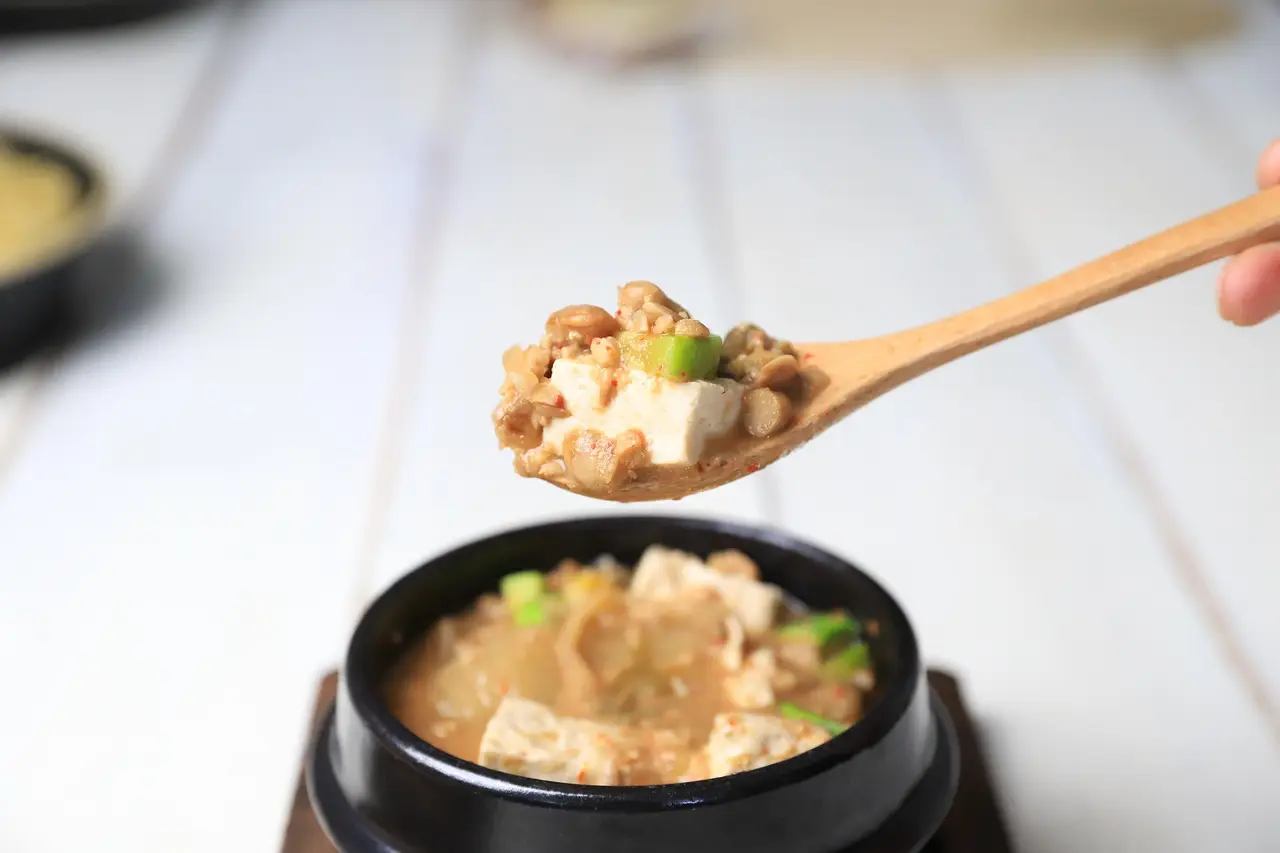
Miso is a salty, savoury paste of soybeans fermented with salt and a friendly mould called koji. Stir a spoonful into hot dashi and you have miso soup, Japan's everyday comfort bowl. Its family tree runs back to ancient China, its spread owes a lot to Buddhist monks and a famous warlord, and cooks well beyond Japan keep discovering it. One small tub, a couple of thousand years of history 12.
Background
The magic worker is koji, the mould Aspergillus oryzae. Grown on rice, barley or soybeans, it breaks starch and protein down into sugars and savoury amino acids, which is where miso's deep, rounded flavour comes from 1.
Miso comes in roughly three moods. Shiromiso, white miso, ferments briefly and tastes mild and a little sweet. Akamiso, red miso, ages longer and hits harder. Awasemiso blends the two. Broadly, eastern Japan leans dark and western Japan leans light 1. Some regional styles have centuries behind them: Hatcho miso from central Japan dates to the late 1400s or early 1500s, and Sendai miso to 1593 3.
History
Miso's grandparent is Chinese jiang, a fermented paste that William Shurtleff and Akiko Aoyagi, the great chroniclers of soy foods, call perhaps the oldest condiment known. Early jiang was not made from soybeans; written references go back to around the 3rd century BC, and a soybean version is described in detail in the Qimin Yaoshu, a farming manual of the 530s AD. By the Tang dynasty, jiang was honoured at court as the "ruler of foods" 2.
How it reached Japan is a little hazy. Wikipedia's summary has a related paste, hishio, arriving with Buddhism in the 6th century 1; Shurtleff and Aoyagi say miso's ancestors came from China or Korea before 700 AD 2. Japan was not starting from scratch, though. Archaeology in the northeast points to home-grown fermented fish hishio 3,000 to 4,000 years old 2. During the Nara period (710 to 794), the word misho appeared, which in time became "miso" 1.
Monks and soup. In the Kamakura era (1185 to 1333), Buddhism nudged Japanese cooks away from fish-based ferments towards grain-and-soy miso. Zen temples ran vegetarian shojin eateries serving cheap meals with miso, and miso soup became the food of ordinary people. A saying grew up: "Everything's alright as long as there is miso" 3.
Warlords and rations. Miso keeps for ages, costs little and cooks in minutes, which made it perfect army food. The warlord Takeda Shingen (1521 to 1573) taught farmers across Shinshu to grow soybeans and turn them into miso 3. Sendai miso was first made in 1593 for soldiers and as a famine store 3. Tokugawa Ieyasu, founder of the Edo shogunate, loved Hatcho miso so much he had it shipped to Edo by boat 3.
Modern times. In 1889 the German scientist Oscar Kellner published the first full scientific study of miso. Wartime rules in 1936 squeezed the country's many styles into three types and two grades, and after the war factories took over: homemade miso fell from about 55 per cent of output to 11 per cent by 1980 4. Meanwhile, George Ohsawa's macrobiotic movement carried miso to the West from 1956, and Belgium had its first miso maker by 1959 4.
Customs, rules and rituals
Breakfast and beyond. Since the Kamakura era miso has sat beside rice and dried fish as a household staple 1. Washoku, the Japanese food culture that holds it, joined UNESCO's intangible heritage list in 2013, which notes that home seasoning skills pass down at the family table 5.
New Year. The New Year soup zoni holds mochi rice cakes in broth, and the broth tells you where you are. Kanto families use clear dashi; Kansai families use white miso; Fukui uses red. The custom of eating zoni on New Year's Day dates from the late Muromachi period 6.
Temple food. Miso is a backbone of shojin ryori, the Buddhist vegetarian cooking of Zen temples, where it gives meatless meals their savoury depth 3. For anyone cooking vegetarian today, that is still the trick.
Making it at home. For centuries families made their own miso, called temaemiso, and many still prefer it. Miso shops, misoya, opened in cities beside sake sellers during the Edo period 13.
Place in human experience
Miso is a food about patience. You mix it, pack it, and wait months while the mould does its slow work. That rhythm suited a world that planned for lean times: Sendai's first miso doubled as a famine store 3.
It also marks the line between eras. The shift from fish to soy ferments follows Buddhism's arrival; the warlords' miso follows the age of war; the factory tub follows modern Japan 34. Each change in the jar mirrors a change in who held power and what they believed.
Miso carries strong ideas about health, too. Dr Shinichiro Akizuki claimed miso helped survivors after the atomic bombing of Nagasaki, and later studies have linked it with longevity, though treat those claims with care 4. Such stories helped make miso a symbol of resilience at home and, through macrobiotics, a symbol of wholesome living abroad 4.
For Japanese families living overseas, a bowl of miso soup is home in five minutes. For everyone else it is an easy first step into fermented food: a spoonful in a salad dressing, a glaze on eggplant, a stir through butter. The saying holds up. With miso in the fridge, everything really is alright.
Sources
- "Miso", Wikipedia, https://en.wikipedia.org/wiki/Miso
- William Shurtleff and Akiko Aoyagi, "History of Miso, Soybean Jiang (China), Jang (Korea) and Tauco (Indonesia): Early history in China and Japan", Soyinfo Center, https://www.soyinfocenter.com/HSS/miso1.php
- William Shurtleff and Akiko Aoyagi, "History of Miso: Japan, Kamakura to Edo", Soyinfo Center, https://www.soyinfocenter.com/HSS/miso2.php
- William Shurtleff and Akiko Aoyagi, "History of Miso: Modern era and the West", Soyinfo Center, https://www.soyinfocenter.com/HSS/miso3.php
- "Washoku, traditional dietary cultures of the Japanese, notably for the celebration of New Year", UNESCO Intangible Cultural Heritage, https://ich.unesco.org/en/RL/washoku-traditional-dietary-cultures-of-the-japanese-notably-for-the-celebration-of-new-year-00869
- "Zōni", Wikipedia, https://en.wikipedia.org/wiki/Z%C5%8Dni