
Ramen
A deep bowl, a cloud of steam, springy yellow noodles coiled in a glossy broth, a slab of tender pork, a soft egg with a jammy yolk, a sheet of nori…
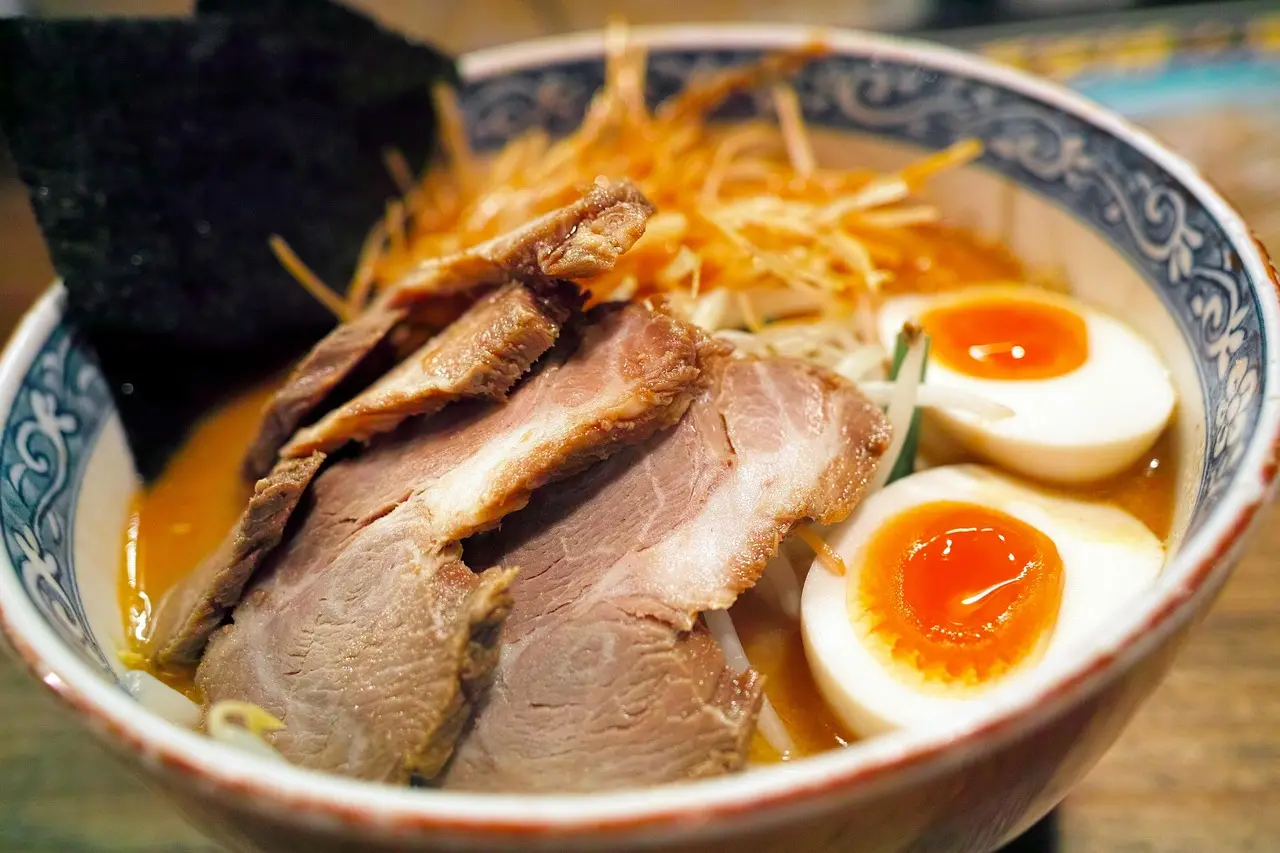
A deep bowl, a cloud of steam, springy yellow noodles coiled in a glossy broth, a slab of tender pork, a soft egg with a jammy yolk, a sheet of nori leaning on the rim. Ramen is Japan's great comfort food, eaten at counters, in late-night stalls and, in instant form, in student flats everywhere. It's also a Chinese immigrant dish that Japan made its own, a postwar survival food and one of the most successful inventions of the 20th century.
Background
Ramen noodles are wheat noodles made with kansui, an alkaline water; the Ramen Museum notes that even the first Chinese-style noodles eaten in Japan used something similar 3. The bowl is built from noodles, broth, a seasoning base and toppings.
Japan has three big families of ramen: miso from Hokkaido, soy-sauce (shoyu) from Tokyo and the Kantō region, and creamy pork-bone tonkotsu from Kyushu 1. Sapporo's miso, Hakata's tonkotsu and Tokyo's shoyu-and-chicken bowls are the best-known city styles 2.
History
The name comes from Mandarin lamian, "pulled noodles", though ramen doesn't actually descend from northern hand-pulled noodles; its roots lie in southern Chinese, especially Cantonese, cooking 2.
The Shin-Yokohama Ramen Museum keeps a long timeline. It records Chinese-style noodles made with kansui-like water eaten in Japan in 1488, and a famous story that in 1697 the scholar Zhu Shunshui served the feudal lord Tokugawa Mitsukuni, known as Mito Kōmon, "soup noodles from his country" 3.
The real start came when Japan reopened to foreign trade in the 1860s 1. Chinese immigrants settled in Yokohama's port, and by 1887 about twenty Chinese restaurants there sold noodle soups that Japanese diners called Nankin soba, "Nanjing noodles" 1. In 1884 a restaurant in Hakodate advertised Nankin soba in the newspaper, possibly the first ad for Chinese noodles in Japan 3.
Then came Rairaiken. In 1910 Kan'ichi Ozaki, a retired customs official, opened a Chinese restaurant in Asakusa, Tokyo, hired cooks from Yokohama's Chinatown, and added toppings such as chashu pork and bamboo shoots 1. At its peak it served up to 3,000 customers a day 4. It closed in 1976 when no one in the family wanted to take it over, and the Ramen Museum later revived it with help from Ozaki's descendants 4. After the 1923 Great Kantō Earthquake, portable stalls spread ramen further 1.
The war turned ramen from a treat into a staple. After 1945 Japan faced severe rice shortages, and the American occupation brought cheap wheat flour 2. Millions of Japanese came home from China, and many opened ramen stalls 23. Cheap, filling and nourishing, ramen suited a hungry country 3.
In 1958 Momofuku Ando launched Nissin Chicken Ramen, the first instant ramen 3. Cup noodles followed in the 1970s, and the world now eats around a hundred billion servings of instant noodles a year 1.
Customs, rules and rituals
Even the name carries etiquette. Ozaki called his dish shina soba, "Chinese noodles". After the war the word shina carried the taint of Japanese imperialism, so people switched to chūka soba and then to ramen 2. Instant ramen helped "ramen" become the word everyone used 3.
There's a charming naming story from Sapporo, too. At the Takeya restaurant, opened in 1921, a Chinese chef is said to have called out when each bowl was ready, and customers misheard it as "ramen" 1. Allegedly. Like many food origin stories, it's told more than it's proven.
Ramen has become a pilgrimage. From 1984 towns such as Kitakata built their identity around local ramen, sparking a national hunger for regional styles 3. Today people queue at the Ramen Museum to eat at a reborn Rairaiken, where a bowl of handmade-noodle shoyu ramen costs 1,100 yen and only 100 are made a day 4.
Place in human experience
Ramen tells the story of modern Japan in one bowl. It arrived with Chinese migrants when the country opened up 1. It changed names as politics changed 2. It fed a defeated, hungry nation on American wheat 2 and gave returnees from China a living 23.
It's also a story of class. Ramen began as cheap food from carts and stalls 13, and in instant form it became the meal of students and late-night workers worldwide 1. Yet today chefs and towns treat it as fine craft, and people cross the country for a particular city's bowl 3.
And it's a story about identity. A dish once labelled "Chinese noodles" is now one of the first foods people name when they think of Japan. Ramen was never purely Japanese, or purely Chinese. It's what happens when cooks from two countries share a kitchen for a century.
So when you pull the lid off a cup of instant noodles at midnight, tip your hat to a customs officer in Asakusa, a chef in Sapporo and Momofuku Ando. Then add an egg.
Sources
- "Ramen", The Japanese Table, Kikkoman Food Forum. https://www.kikkoman.com/en/foodforum/the-japanese-table/32-4.html
- "Ramen", Wikipedia, Wikimedia Foundation. https://en.wikipedia.org/wiki/Ramen
- "History of Ramen", Shin-Yokohama Raumen Museum. https://www.raumen.co.jp/rapedia/study_history/
- "Japan's first-ever ramen restaurant reopens after 44 years", Japan Today. https://japantoday.com/category/features/food/japan%E2%80%99s-first-ever-ramen-restaurant-reopens-after-44-years