Pasta
There's a moment when pasta is almost done: you fish out one strand, bite it, and feel that tiny firm core give way. Drain, toss in sauce, and dinner is…
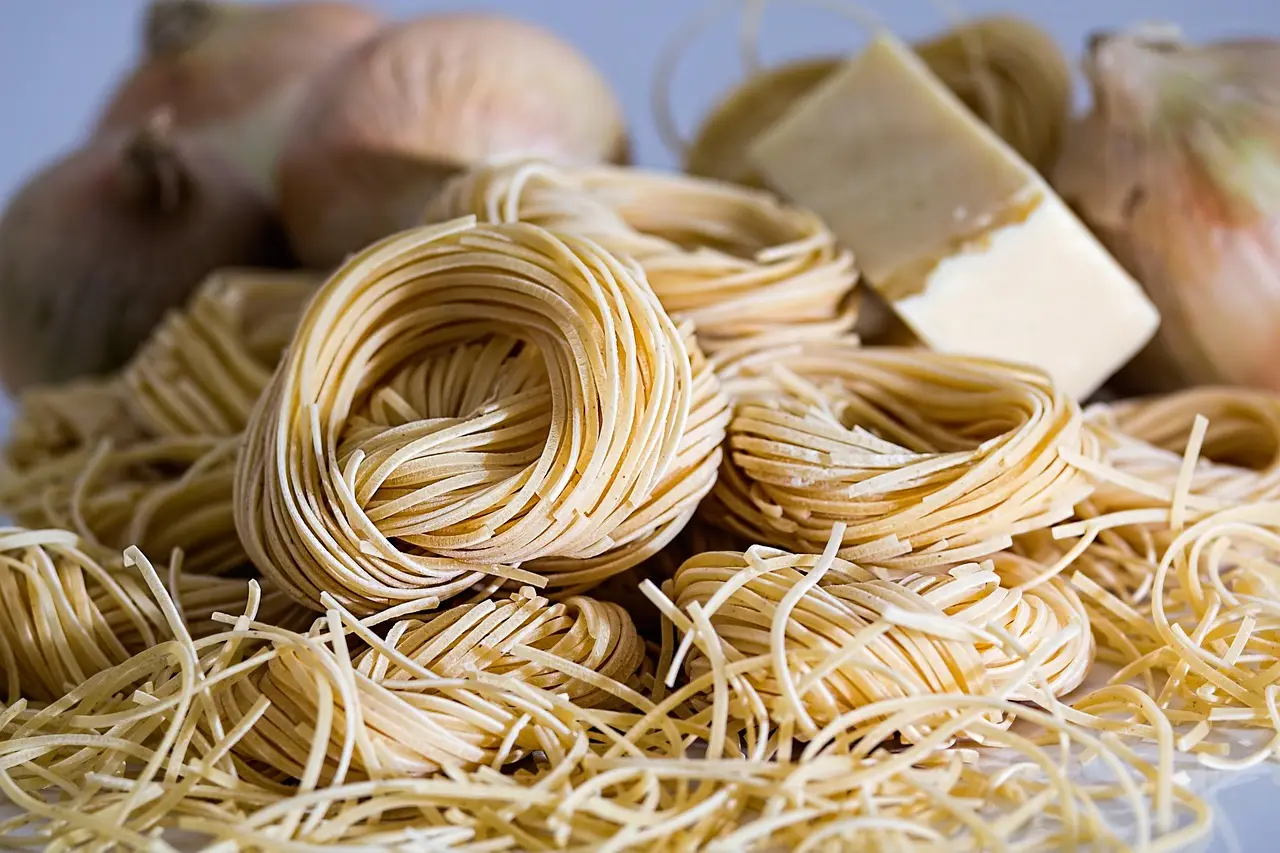
There's a moment when pasta is almost done: you fish out one strand, bite it, and feel that tiny firm core give way. Drain, toss in sauce, and dinner is ten minutes away. Pasta is dough made from wheat and water (sometimes egg), shaped, dried or fresh, and boiled. Italy made it famous, but its story runs along the Silk Road, through Arab Sicily, across the Atlantic and down to East Africa.
Background
Italians eat about 23.5 kg of pasta each a year, against roughly 9 kg for Americans 1. Second place in the world goes, surprisingly, to Tunisia, at about 35 pounds (16 kg) a head 4.
Mediterranean makers settled on durum wheat because its high gluten holds a shape and keeps well when dried 2. That's why a packet of dried spaghetti keeps so happily in the cupboard.
History
First, let's bury a myth. Marco Polo did not bring pasta home from China. His book mentions a tree that gave a flour for pasta-like food, probably the sago palm 3. Meanwhile a Genoese soldier already owned "macaronis" in the 1270s, while Polo was still travelling 3. Many historians now call the Polo story a myth 1.
The real trail is longer. Ancient Romans ate lagana, thin sheets of fried dough, mentioned by the poet Horace 1. Wheat noodles were prominent in Han dynasty China and spread along the Silk Road through Central Asia to Persia by about the 4th or 5th century 1. Arab cooks carried noodles called itriyya west to Sicily and Spain 1. In 1154 the geographer al-Idrisi described Sicilian countryside workshops making "vast quantities" of itriyya for export 1. The Jerusalem Talmud even debates whether boiled dough counts as unleavened bread under Jewish law, the earliest known mention of boiling it 2.
Medieval Italian pasta tasted very different: sweet, savoury and spicy all at once 3. Then came Naples. By the late 1600s Neapolitans, once nicknamed "leaf-eaters", had become "macaroni-eaters" because meat was scarce and wheat was cheap 3. Mechanical presses and kneading machines in the 1700s made pasta cheap enough for workers 3.
Tomato arrived late. Italians first treated it as exotic, and the first recipe for spaghetti with tomato sauce appears in 1844 3. So the dish many people think of as eternal Italian is younger than the railway.
Pasta then crossed oceans. Thomas Jefferson fell for it in Paris in the 1780s and shipped cases home 2. In the late 19th century Italian migrants, many from Naples, made it everyday food in the United States 2.
Customs, rules and rituals
Every pasta-eating culture has its rules, and they don't agree.
Italians want it firm. Tunisians like theirs cooked well past al dente 4. Tunisia's love began in the early 20th century, when more than 100,000 Italians lived there, about three-quarters of them Sicilian 4. Pasta pushed couscous aside as the everyday staple because it was quicker 4. Tunisian cooks dilute tomato paste for sauce and season it with tabil and harissa. Makarouna arbi, "Arab pasta", comes with chicken, potatoes and chickpeas, and tiny nwassar squares steam in a couscoussier 4. Restaurant owner Myriam Ben Farhat says her family eats pasta five times a week 4.
In Somalia, Eritrea and Ethiopia, pasta arrived through Italian colonial rule, a violent occupation from the late 19th century into the 1940s 5. Somali cooks made it their own: baasto suugo suqaar comes with a meaty tomato sauce spiced with xawaash (cinnamon, cumin, cardamom), and a banana on the side, chopped and mixed through for sweetness 5. Ethiopian diners sometimes eat spaghetti with injera and stew 5. "We like flavorful food," says Leyla Mohamed of Jubba restaurant in San Jose 5.
Place in human experience
Pasta is the great democratiser. In Naples it turned meat-poor workers into "macaroni-eaters" 3, and machines in the 1700s made it something everyone could afford 3. It fed migrants who carried it to America and North Africa 24.
It's also a story of who gets to own a dish. Italy holds the crown, but Sicily's pasta came with Arab trade 1, Tunisia's with Sicilian migrants 4, and East Africa's with an army 5. Each place rewrote the recipe: harissa in Tunis, banana in Mogadishu. Food historians at National Geographic note that medieval sweet-spicy pasta slowly gave way to vegetable-based sauces 3, proof that the "authentic" version keeps moving.
So whether you like yours firm with tomato, soft with harissa or with a banana on the side, you're right. Pasta has always belonged to whoever is boiling the water.
Sources
- "Pasta", Wikipedia, Wikimedia Foundation. https://en.wikipedia.org/wiki/Pasta
- "Uncover the History of Pasta", PBS Food. https://www.pbs.org/food/stories/uncover-the-history-of-pasta
- "Daily life: pasta in Italy and the Neapolitan diet", National Geographic History, July–August 2016. https://www.nationalgeographic.com/history/magazine/2016/07-08/daily-life-pasta-italy-neapolitan-diet/
- "Tunisia's Pasta Obsession", TASTE. https://tastecooking.com/tunisias-pasta-obsession/
- "How Colonialism Brought a New Evolution of Pasta to East Africa", KQED Bay Area Bites. https://www.kqed.org/bayareabites/138982/how-colonialism-brought-a-new-evolution-of-pasta-to-east-africa