Tamarind
Tamarind is a knobbly brown pod that hangs from a huge tropical tree, and inside it sits a sticky, sweet-sour pulp that tastes a bit like a date that has…
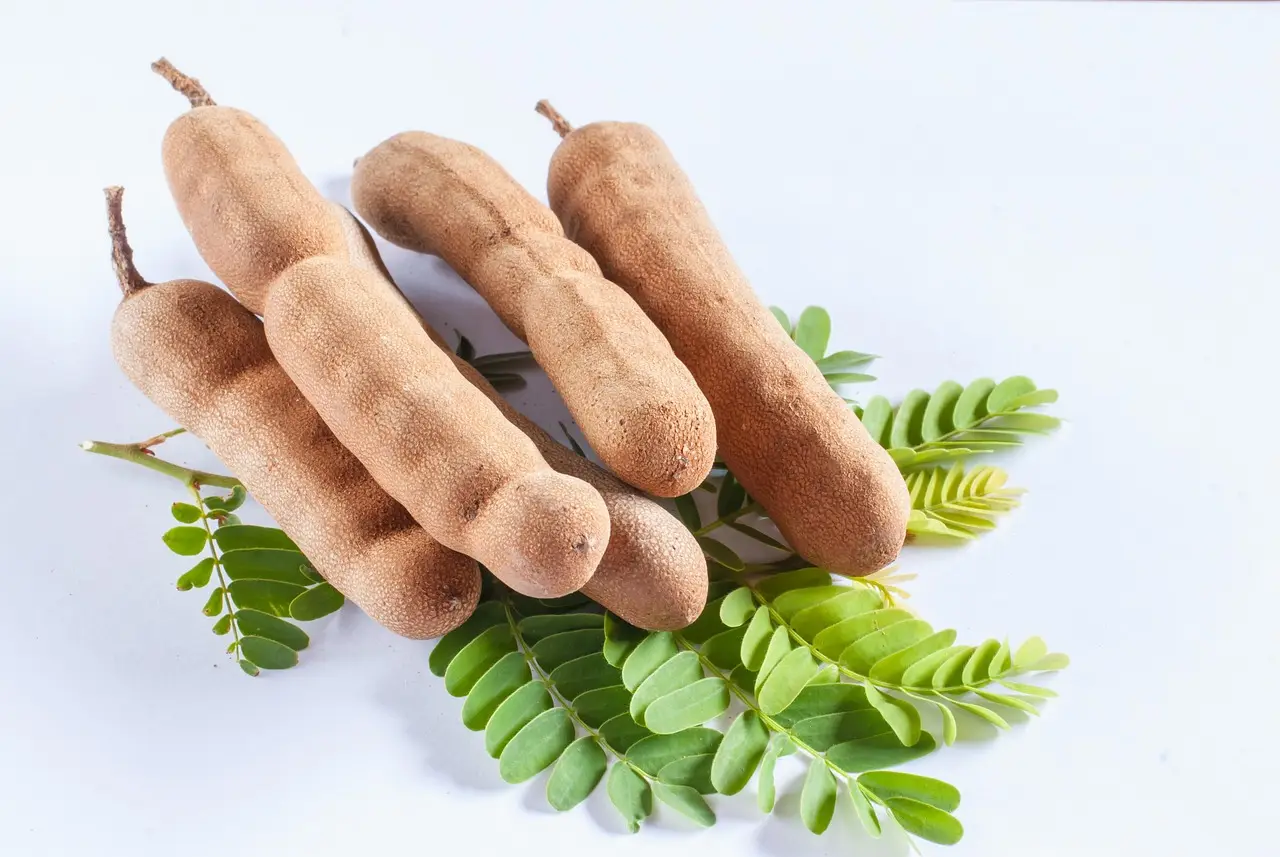
Tamarind is a knobbly brown pod that hangs from a huge tropical tree, and inside it sits a sticky, sweet-sour pulp that tastes a bit like a date that has been to finishing school in a lemon grove. The BBC describes it as less sweet and more sour than a date 4. Cooks from India to Mexico to Syria use it to make food tangy, and it hides in places you might not expect, like Worcestershire sauce 4. It matters because few ingredients have travelled so far, under so many names, while keeping one simple job: adding sour.
Background
The tamarind tree grows slowly, lives long and can reach 24 to 30 metres, with feathery leaves that fold up at night 1. Young pods are green and fiercely acidic. As they ripen, the pulp turns brown and the shell dries into a brittle case you can crack with your thumb 1. A mature tree can drop 150 to 225 kilograms of fruit a year 1.
Cooks buy it as whole pods, pressed blocks or concentrate; a lump of block soaked in water gives a sharp liquid for curries, chutneys and dals 4. Nothing goes to waste. Young leaves and flowers go into curries in India 1, and Indian vegetable carts sell tender spring leaves, sour and slightly chalky, ready to cook with mutton 6. Seeds, once soaked and boiled, become edible, and in 1942 two Indian scientists found the kernels full of a gel that sets jam better than fruit pectin 1, 2.
History
Here is the great tamarind mix-up. Its botanical name, Tamarindus indica, points to India, but the tree is native to tropical Africa and grows wild across Sudan 1. It reached India so long ago that many people assumed it started there 1. From India it travelled to the Persians and Arabs, who called it tamar hindi, "Indian date", after the date-like dried pulp. That gave English its "tamarind" 1. The 1911 Encyclopaedia Britannica reads the name the same way: proof it entered medieval trade from India 3.
The fruit was known to the ancient Egyptians and to the Greeks by the fourth century BC 1. Arab traders carried it from India to Europe, where it gained a reputation as medicine 2. Tamarind pulp went on to appear in the British and American pharmacopoeias as a laxative and a cooling remedy for fevers 1.
Tamarind also crossed the Atlantic. Spanish and Portuguese colonists brought it to Mexico and Central America in the 16th century, where it became a staple of the kitchen 7. Today Mexico grows it on more than 4,000 hectares 1, and a Guatemalan valley has so many big trees one stretch is simply called "El Tamarindal" 1.
Customs, rules and rituals
Every region has its own way with tamarind. In the Bahamas, children roast not-quite-ripe pods, called "swells", in hot coals until they burst, then dip the sizzling pulp in wood ash and eat it 1. In Jamaica, Cuba and the Dominican Republic, sugared tamarind balls are a market sweet, and in Puerto Rico street vendors pour tamarind syrup over shaved ice 1. In the Philippines it sours the soup sinigang 7.
During Ramadan, tamarind juice, tamr hindi, is one of the drinks that greet the end of the fast across the Middle East 5. Vendors carry a copper pot of it on their backs, cups strung around their waists, and some clang two copper discs to announce they have arrived 5.
Jewish kitchens adopted it too. According to The Nosher, Jewish merchants brought tamarind along the Silk Road from India to Aleppo in the seventh century 8. Syrian Jewish families still make a dark tamarind syrup called ou, often a year's supply at a time, for stuffed vine leaves and sweet-sour meatballs served at holiday tables 8. In India, Baghdadi, Cochin and Bene Israel Jewish communities each have tamarind dishes of their own 8.
Place in human experience
A tree this generous gathers stories. Julia Morton's classic survey records that some African peoples treat the tamarind as sacred, that some in Myanmar see it as the home of the rain god, and that some Hindu families marry a tamarind tree to a mango tree before eating the mango's fruit 1. In Malaya, a little tamarind and coconut milk went into a newborn's mouth, and elephants got the bark and fruit to make them wise 1. There is also an old belief that sleeping under a tamarind is bad for you, probably because its fallen leaves eat away at cloth in wet weather 1.
The tree is a whole toolkit. Pulp mixed with sea water polishes brass and copper 1, and in Buddhist homes and temples in Myanmar it shines brass shrine statues 7. Its hard wood has made furniture, mortars and pestles 1. In West Africa, a tamarind infusion goes into the dye for goat hides 1.
Above all, tamarind tracks people. An African fruit named for India, carried by Arab traders, planted by colonists in the Americas and cooked in Jewish, Muslim, Hindu and Buddhist kitchens: few foods carry so many passports. Chances are there is a jar in your fridge already, quietly sharpening the Worcestershire sauce.
Sources
- Julia F. Morton, "Tamarind", in Fruits of Warm Climates (1987), Purdue University Center for New Crops and Plant Products. https://www.hort.purdue.edu/newcrop/morton/tamarind.html
- Emmy De Caluwé, Kateřina Halamová and Patrick Van Damme, "Tamarindus indica L.: A review of traditional uses, phytochemistry and pharmacology", Afrika Focus 23 (1), 2010, Ghent University. https://biblio.ugent.be/publication/990834/file/1017918.pdf
- "Tamarind", Encyclopaedia Britannica, 11th edition (1911), via Wikisource. https://en.wikisource.org/wiki/1911_Encyclop%C3%A6dia_Britannica/Tamarind
- "Tamarind recipes", BBC Food. https://www.bbc.co.uk/food/tamarind
- "Ramadan: Five thirst-quenching drinks from across the Middle East", Middle East Eye. https://www.middleeasteye.net/discover/ramadan-five-drinks-thirst-quenching-middle-east
- "Here's what you can cook with tender tamarind leaves", The Hindu, 2018. https://www.thehindu.com/life-and-style/food/heres-what-you-can-cook-with-tender-tamarind-leaves/article23695502.ece
- "Tamarind", Wikipedia. https://en.wikipedia.org/wiki/Tamarind
- "Tracing the Jewish History of Tamarind, From India to Syria and Beyond", The Nosher, My Jewish Learning. https://www.myjewishlearning.com/the-nosher/tracing-the-jewish-history-of-tamarind-from-india-to-syria-and-beyond/