
Tea
Tea: from a Chinese legend to billy tea and morning tea. Its history, rituals and customs, plus how to buy, brew and store it in Australia.
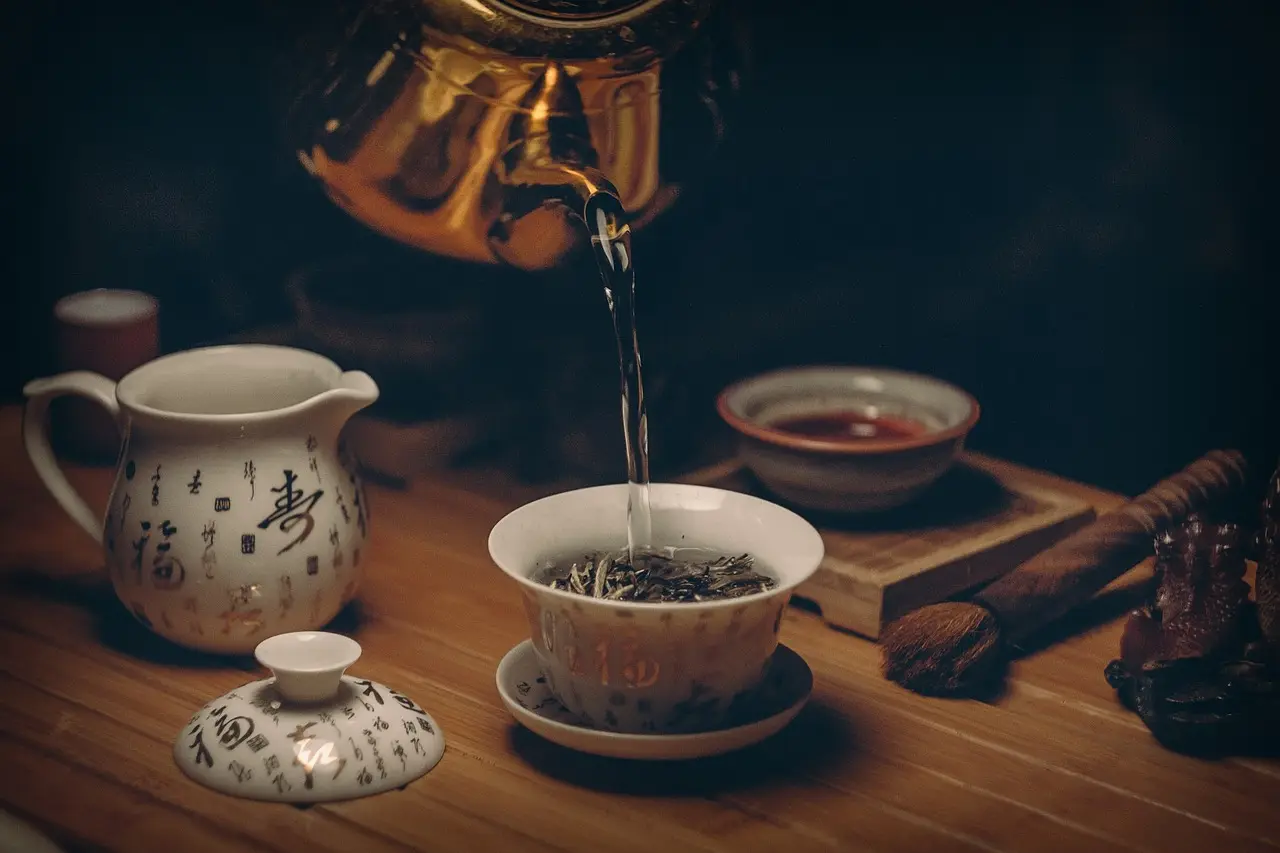
Put the kettle on. Few phrases do more work in an Australian house. Tea, the dried leaf of Camellia sinensis, is the world's most popular drink after plain water 1. It began in the hills where China, India and Myanmar meet, travelled with traders and smugglers, and arrived here with the First Fleet 135. Somewhere along the way, it became the name of a meal, a break and a ceremony.
Background
Tea is an evergreen shrub that first grew in the borderlands of south-western China, north-east India and northern Myanmar 1. Green, yellow, white, oolong, black and dark teas such as pu-erh all come from the same plant; processing makes the difference 1. The UK Tea and Infusions Association counts about 1,500 cultivars of Camellia sinensis 2.
China grew about 14.5 million tonnes in 2022, roughly half the world's crop, followed by India, Kenya and Sri Lanka 1. Turkey drinks the most per person, more than ten cups a day 1.
The word itself tells a trade story. English got "cha" from Portuguese traders in the 1590s, then "tea" from Dutch traders in the seventeenth century 1.
History
Legend says tea began in 2737 BC, when leaves blew into water the Chinese emperor Shen Nung was boiling under a tree 3. The hard evidence comes later: the earliest physical traces of tea drinking date to the Han dynasty, around the second century BC, and a 59 BC document called "The Contract for a Youth" contains the first known mention of boiling tea 1.
Under the Tang dynasty, tea became an everyday drink. Between 760 and 762 CE, Lu Yu wrote The Classic of Tea, the world's first known book on the subject, covering growing, tools, brewing and drinking 4. For Lu Yu, tea stood for the harmony of the universe 4.
Britain got its first tea advertisement in a London newspaper in 1658, offering "China Drink, called by the Chinese, Tcha" at a coffee house 3. When the Portuguese princess Catherine of Braganza married Charles II in 1662, she brought her tea habit to court 13. Heavy taxes followed, and by the late eighteenth century smugglers brought in perhaps 7 million pounds of tea a year, close to the legal trade 3.
Tea sailed into Australia aboard the First Fleet in 1788 5. Alfred Bushell opened a tea shop in Queensland in 1883, and the Cutten brothers planted the first commercial tea plantation at Bingil Bay in 1884 5.
Customs, rules and rituals
- Japan. The tea ceremony, chanoyu, grew from Zen Buddhism and prizes wabi (humility, restraint, simplicity) and sabi (the beauty of imperfection) 6.
- Korea. Records from the eighth century describe Silla and Gaya royals holding tea ceremonies in palaces and temples 6.
- Britain. Anna Russell, Duchess of Bedford, is credited with afternoon tea. In the 1830s or 1840s, she asked for tea and snacks to tide her over until a late dinner 7. Working families ate "high tea", a heartier meal at the high dining table 7.
- The bush. To "boil the billy" means to make tea in a billycan over a fire. The word appears in a Tasmanian newspaper in 1848, and the billy became a symbol of the goldfields and bush life 8.
Place in human experience
Tea has always been about company. Victorian afternoon tea was as much about being seen with the right cups, manners and friends as the drink itself 6. In the nineteenth century, temperance campaigners pushed tea as a substitute for alcohol 3.
Australia took the habit and made it ordinary in the best way. "Tea" here can mean dinner, "morning tea" is the mid-morning break, and "smoko" covers a worker's break 7. We drank about 14,000 tonnes of it a year by 2000 5. Most locally grown tea is black, from northern New South Wales and Queensland, with some green tea grown in Victoria's Alpine Valleys 5.
How to buy, store and use it
- Buy it. Teabags, loose leaf and Australian-grown brands share the tea and coffee aisle at Coles, Woolworths and Aldi; Asian grocers stock green, oolong and pu-erh. Ninety-seven and a half per cent of British tea goes through teabags, so don't feel fancy-shamed 2.
- Store it. Keep it in a cool, dry place, away from strong-smelling or perfumed food 9.
- Brew it. Use freshly boiled water and one bag or one rounded teaspoon of leaf per cup 9. Black tea likes water at 90–98°C for three to four minutes; green tea prefers about 80°C for two to four 9.
- Milk it. Milk in first or last is personal preference. In a mug, take the bag out before adding milk 9. About 10% of British tea drinkers use plant milk 2.
Sources
- "Tea", Wikipedia. https://en.wikipedia.org/wiki/Tea
- "Tea FAQs", UK Tea and Infusions Association. https://www.tea.co.uk/tea-faqs
- "History of Tea", UK Tea and Infusions Association. https://www.tea.co.uk/history-of-tea
- "The Classic of Tea", Wikipedia. https://en.wikipedia.org/wiki/The_Classic_of_Tea
- "Tea in Australia", Wikipedia. https://en.wikipedia.org/wiki/Tea_in_Australia
- "Tea ceremony", Wikipedia. https://en.wikipedia.org/wiki/Tea_ceremony
- "Tea (meal)", Wikipedia. https://en.wikipedia.org/wiki/Tea_(meal)
- "Billycan", Wikipedia. https://en.wikipedia.org/wiki/Billy_tea
- "How to make a perfect brew", UK Tea and Infusions Association. https://www.tea.co.uk/make-a-perfect-brew