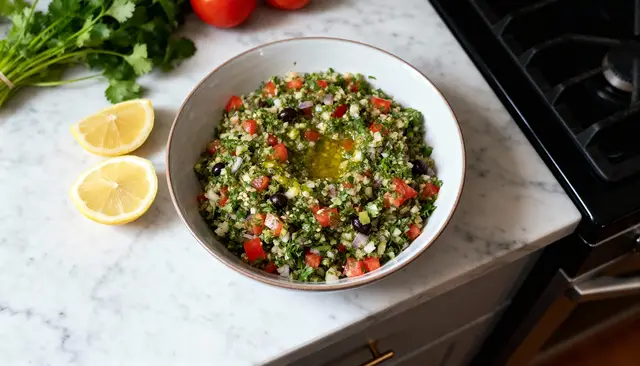
Chopping Vegetables
Before the pan gets hot, there's the board. The tap-tap-tap of a knife through an onion is probably the most familiar sound in any kitchen on earth, and…
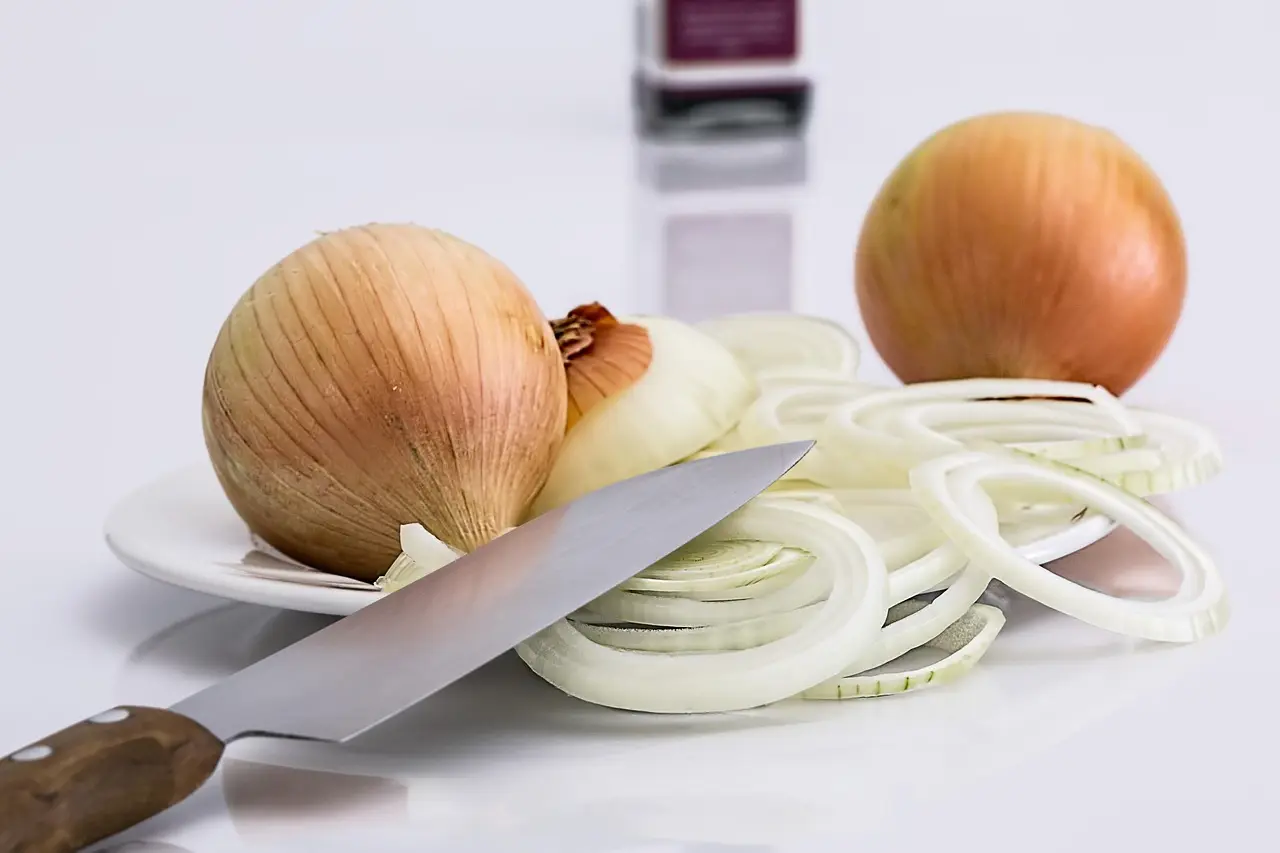
Before the pan gets hot, there's the board. The tap-tap-tap of a knife through an onion is probably the most familiar sound in any kitchen on earth, and it's one of the oldest things humans do with food. Chopping looks humble. But philosophers have written parables about it, Confucius had opinions on it, Japanese chefs turned it into a ceremony, and French cooks gave every size of dice its own name. Grab a carrot; there's a lot riding on it.
Background
Chopping does three jobs at once. It makes food cook evenly, it gets flavour out faster, and it makes things easier to eat. French cooks know the second one well: a fine dice called brunoise goes into stocks and soups because all that extra surface area pushes flavour into the liquid quickly 9.
It's also about looks. A brunoise is carrot, celery, leek or turnip cut into cubes about 3 mm across, or as tiny as 1 to 2 mm in France, and the rule is that every cube matches. Cooks blanch them, chill them in iced water to set the colour, and scatter them over a clear consommé like confetti 9.
History
Cutting food is older than our species. The Smithsonian's Human Origins Program dates the earliest stone toolmaking to at least 2.6 million years ago. Those first toolkits held hammerstones, cores and sharp stone flakes with good cutting edges 1. By about 1.76 million years ago, early humans were shaping big flakes into handaxes and other "large cutting tools" 1.
Here's the surprising bit. In 2016 the scientists Katherine Zink and Daniel Lieberman tested what slicing and pounding do to chewing. They found that by simply slicing meat and pounding tough roots, early humans would have chewed food into particles 41 per cent smaller, needed about 5 per cent fewer chews a year, and used 12 per cent less chewing force 2. Their conclusion: stone tools plus meat, more than cooking, probably let our ancestors evolve smaller teeth and jaws 2. In a very real way, cutting helped shape our teeth and jaws.
Fast forward to ancient China, where knife work became a mark of refinement. The Analects records that Confucius "did not dislike to have his rice finely cleaned, nor to have his minced meat cut quite small," and that "he did not eat meat which was not cut properly, nor what was served without its proper sauce" 3. Chinese cooks still judge a dish partly by its knife work, alongside ingredients, cooking time and seasoning 5.
In Japan, kitchen knives grew out of Chinese double-bevelled blades. Japanese smiths then developed the single-bevel edge that remains the classic style, and in the late 19th century absorbed French and German knife ideas too 10. Sakai, near Osaka, has been a sword-making centre since the 14th century and became famous for kitchen knives; today Seki, in Gifu, is called the home of modern Japanese cutlery 10. The santoku, the all-rounder many home cooks own, dates from the 1940s, and its name means "three virtues": it does the work of a fish knife, a vegetable knife and a meat knife in one 10.
Customs, rules and rituals
Chinese table manners carry a neat consequence of all that knife work. Knives on the dining table are considered inappropriate 5. Everything is cut in the kitchen into pieces you can lift with chopsticks, so the cook does the cutting and the diner never has to.
Japan went further and made cutting sacred. Hōchōdō, "the way of the knife", is a Shinto ritual offering that began in Heian-period court cuisine. The oldest school traces itself to the courtier Fujiwara no Yamakage in the 9th century 7. A chef in ancient court dress fillets a fish or bird with only a knife and long metal chopsticks, never touching it by hand 7. The Ikama school in Kyoto has passed the ritual down through 29 generations, and its head performs on a cutting board two metres long 6. Food historian Isao Kumakura notes that medieval samurai counted the culinary arts alongside scholarship and mathematics, and that showing off your knife skills in front of guests was part of a gentleman's training 6.
French professional kitchens gave the world mise en place, "putting into place": the chopped vegetables, sauces and spices all set out before service starts 8. Some cooks treat it almost as a faith. "I know people that have it tattooed on them," one Culinary Institute of America student told NPR 8. A CIA instructor explained the aim: every part of a dish sits in one corner of the station "so their hand literally moves inches" 8.
Place in human experience
The most famous chopping story in the world isn't about vegetables at all, but it's worth telling. In the Zhuangzi, an ancient Chinese Daoist classic, Prince Hui watches his cook carve an ox, every movement "in perfect harmony", like a dance 4. The cook explains that a good cook changes his chopper once a year because he cuts, and an ordinary cook once a month because he hacks. His own blade has lasted nineteen years and thousands of oxen, because he follows the natural gaps instead of forcing through bone 4. The prince replies that from the cook's words he has "learnt how to take care of my life" 4.
That's the quiet magic of chopping. It's repetitive, rhythmic and close to meditative. Cooks describe mise en place as a way to clear the mind and focus on only what matters right now; students say they end up organising their whole lives that way 8. And when Kumakura writes about Japan's counter restaurants, he describes the pleasure guests take in watching food being prepared in front of them, a tradition he links back to those old knife ceremonies 6.
So next time you dice an onion, you're joining a very long line: early humans with stone flakes, Confucius sending back badly cut meat, Kyoto chefs in court robes, line cooks with their tattoos. Mind your fingers.
Sources
- "Early Stone Age Tools", Smithsonian Institution Human Origins Program. https://humanorigins.si.edu/evidence/behavior/stone-tools/early-stone-age-tools
- Katherine D. Zink and Daniel E. Lieberman, "Impact of meat and Lower Palaeolithic food processing techniques on chewing in humans", Nature 531 (2016): 500–503. https://www.nature.com/articles/nature16990
- James Legge (trans.), The Chinese Classics, Vol. 1: Confucian Analects, Book X, ch. VIII, Project Gutenberg. https://www.gutenberg.org/ebooks/4094
- Herbert A. Giles (trans.), Chuang Tzu: Mystic, Moralist, and Social Reformer, ch. III, Project Gutenberg. https://www.gutenberg.org/ebooks/59709
- "Chinese cuisine", Wikipedia. https://en.wikipedia.org/wiki/Chinese_cuisine
- Isao Kumakura, "Kappo: Fine Cuisine at a Counter", Food Forum, Kikkoman Corporation (archived). https://web.archive.org/web/20131106113329/http://www.kikkoman.com/foodforum/thejapanesetable/08.shtml
- "Hōchōdō", Wikipedia. https://en.wikipedia.org/wiki/H%C5%8Dch%C5%8Dd%C5%8D
- "For A More Ordered Life, Organize Like A Chef", The Salt, NPR, 11 August 2014. https://www.npr.org/blogs/thesalt/2014/08/11/338850091/for-a-more-ordered-life-organize-like-a-chef
- "Brunoise", Wikipedia (citing Herbst and Herbst, The New Food Lover's Companion). https://en.wikipedia.org/wiki/Brunoise
- "Japanese kitchen knife", Wikipedia. https://en.wikipedia.org/wiki/Japanese_kitchen_knife