Basil
Brush past a basil plant on a hot afternoon and the whole garden smells like summer: sweet, peppery, a little like cloves. That clove note is real, by the…
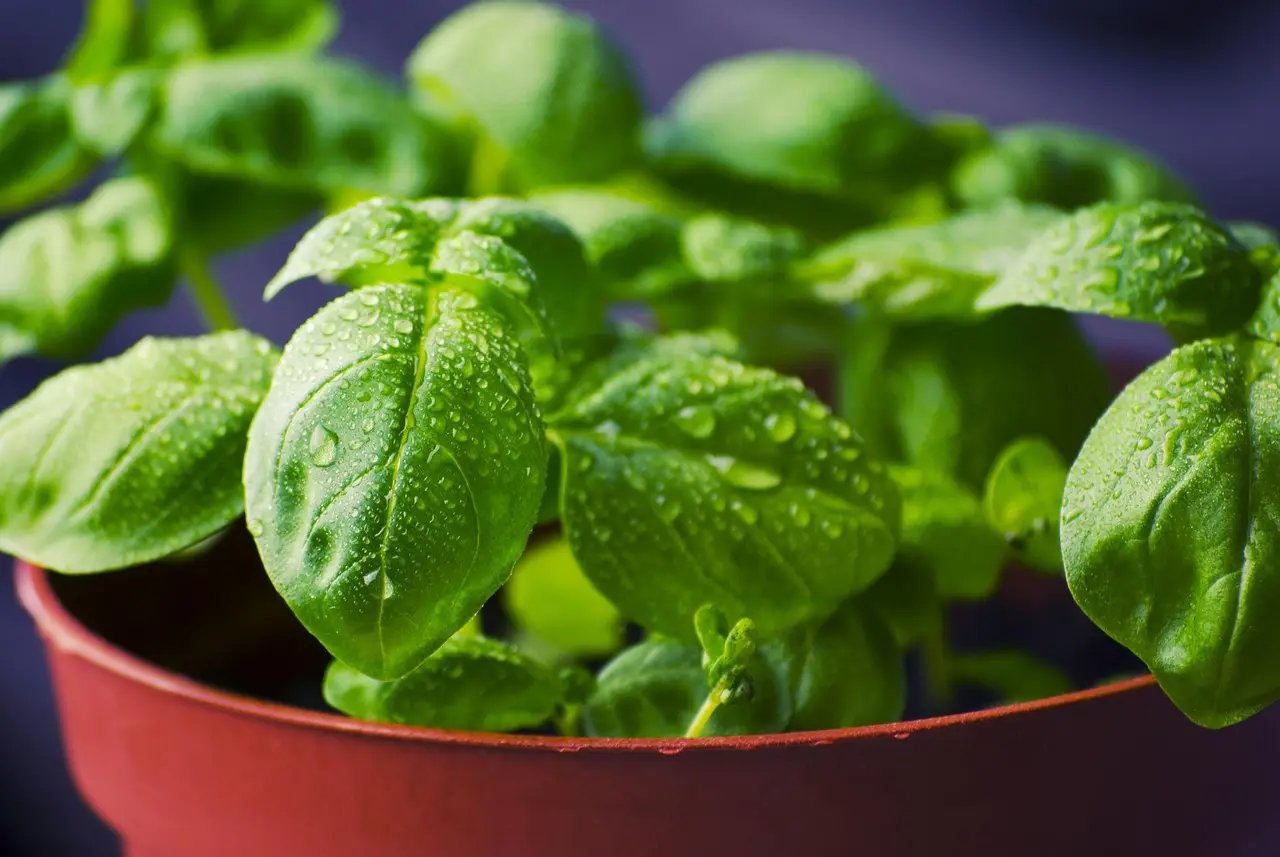
Brush past a basil plant on a hot afternoon and the whole garden smells like summer: sweet, peppery, a little like cloves. That clove note is real, by the way. It comes from eugenol, the same compound found in cloves 1. Basil grows wild from India and Sri Lanka across Southeast Asia to northern Australia, and cooks have carried it everywhere since 1. It goes into pesto in Genoa and stir-fries in Bangkok, it stands in a pot in Hindu courtyards and at Orthodox altars, and once it even hid a severed head in a famous love story. Not bad for a herb you can grow on a windowsill.
Background
Basil (Ocimum basilicum) belongs to the mint family. There are at least 60 varieties, and they cross-pollinate so freely that botanists still argue about how to sort them 1. The big-leafed "basil" most Western cooks know is sweet or Genovese basil. Its cousins include Thai basil, lemon basil, African blue basil and small-leafed Greek bush basil 1.
Then there's holy basil, or tulsi (Ocimum tenuiflorum, also called O. sanctum), a separate species with a hot, bitter, clove-like taste. It probably first grew in north central India 2.
Basil hates the cold. In most gardens it lives for one summer, then dies with the first chill 1. Nicholas Culpeper, writing his famous English herbal in 1653, already knew this: the root "perishes at the approach of Winter", so you sow it again each year 3.
History
The name is grand. "Basil" comes from the Greek basilikón phytón, the royal or kingly plant, possibly because it went into perfumes for kings 1. The French still call it l'herbe royale 1.
Then things got strange. The Latin name sounded like "basilisk", the mythical serpent whose glance could kill, and people came to believe basil was an antidote to its venom 1.
Not everyone loved it. Culpeper's entry reads like a gossip column. Basil, he says, is "the herb which all authors are together by the ears about, and rail at one another (like lawyers)". Galen and Dioscorides thought it unfit to eat; Pliny and the Arab physicians defended it 3. Culpeper repeats a French doctor's claim that a man who sniffed basil too often grew a scorpion in his brain, and notes that basil and rue refuse to grow near each other. He ends with: "I dare write no more of it" 3.
Italian cooks were braver. Genoa started growing its own basil in the nineteenth century, and the crop soon spread along the Ligurian coast 4. Today "Basilico Genovese" holds a Protected Designation of Origin. Growers must follow strict rules, and the consortium boasts that the leaves have no minty notes at all. This is the basil behind true Genoese pesto 4.
Customs, rules and rituals
Tulsi in the Hindu home. In Hinduism, tulsi is worshipped as a goddess, and every part of the plant counts as sacred, right down to the soil it grows in 2. A Hindu household is thought incomplete without one, usually in a decorated clay pot in the courtyard 2. Families tend it with morning and evening rituals, and some drink tulsi tea or eat a leaf as part of worship 2. Vaishnavas, devotees of Vishnu, are sometimes called "those who bear the tulsi around the neck", because they wear prayer beads carved from tulsi wood 5. Each year, in the month of Kartik, Hindus celebrate Tulsi Vivah, a ceremonial wedding of the tulsi plant 5.
Basil at the altar. On 14 September, Orthodox churches celebrate the Elevation of the Holy Cross, marking Empress Helen's discovery of the Cross in Jerusalem in 326 AD. The Cross sits on a tray ringed with flowers or sprigs of basil in the middle of the church 6. Greek, Bulgarian, Serbian, Macedonian and Romanian Orthodox churches also use basil to sprinkle holy water, and pots of basil often sit beneath the altar 1. Some Greek Orthodox Christians even avoid eating basil because of its link to the legend of the Cross 1.
Basil and fasting. In Kashmir, people often break the Ramadan fast with babre beole, a sweet drink made with swollen basil seeds 1. Soaked basil seeds turn jelly-like, which is why they bob around in Indian falooda too 1.
Place in human experience
Basil sits at a crossroads of the sacred and the everyday. In a Hindu courtyard, a tulsi plant does two jobs at once. Its clove-scented leaves keep mosquitoes and flies away, and that same scent is held to link the household to the divine 2. Cohen's review describes the plant as connecting the people who tend it with nature itself 2.
It has also been a plant of love, and of grief. In Boccaccio's fourteenth-century Decameron, a young woman named Isabella loses her lover, Lorenzo, to her murderous brothers. She digs up his body, buries his head in a pot of basil, and tends it until she wastes away 7. John Keats turned the tale into the 1818 poem Isabella, or the Pot of Basil, and Pre-Raphaelite painters, including Millais, Holman Hunt and Waterhouse, painted it again and again 7. It's a gruesome story, but you can see why basil fits: a tender plant that needs daily care is a fine picture of devotion.
Love shows up in kinder ways too. In Portugal, sweethearts give each other pots of bush basil, with a poem and a paper carnation, on the feasts of Saint John and Saint Anthony 1.
Royal perfume, snake antidote, scorpion hatchery, goddess, love token, grave marker. Basil has been all of these. For most of us now, it's the green leaf that makes a tomato taste like itself. Grow a pot. Pinch the tips. You're joining a very long line.
Sources
- "Basil", Wikipedia, https://en.wikipedia.org/wiki/Basil
- Marc Maurice Cohen, "Tulsi - Ocimum sanctum: A herb for all reasons", Journal of Ayurveda and Integrative Medicine (2014), via PubMed Central, https://pmc.ncbi.nlm.nih.gov/articles/PMC4296439/
- Nicholas Culpeper, The Complete Herbal (1653), "Garden Bazil, or Sweet Bazil", Project Gutenberg, https://www.gutenberg.org/ebooks/49513
- "Basilico Genovese DOP", Consorzio di Tutela del Basilico Genovese DOP, https://www.basilicogenovese.it/en/
- "Ocimum tenuiflorum", Wikipedia, https://en.wikipedia.org/wiki/Ocimum_tenuiflorum
- "Elevation of the Holy Cross", OrthodoxWiki, https://orthodoxwiki.org/Elevation_of_the_Holy_Cross
- "Isabella, or the Pot of Basil", Wikipedia, https://en.wikipedia.org/wiki/Isabella,_or_the_Pot_of_Basil