
Basmati rice
Open a bag of good basmati and you can smell it before the water boils: something like popcorn, something like pandan, faintly sweet. Cook it well and the…
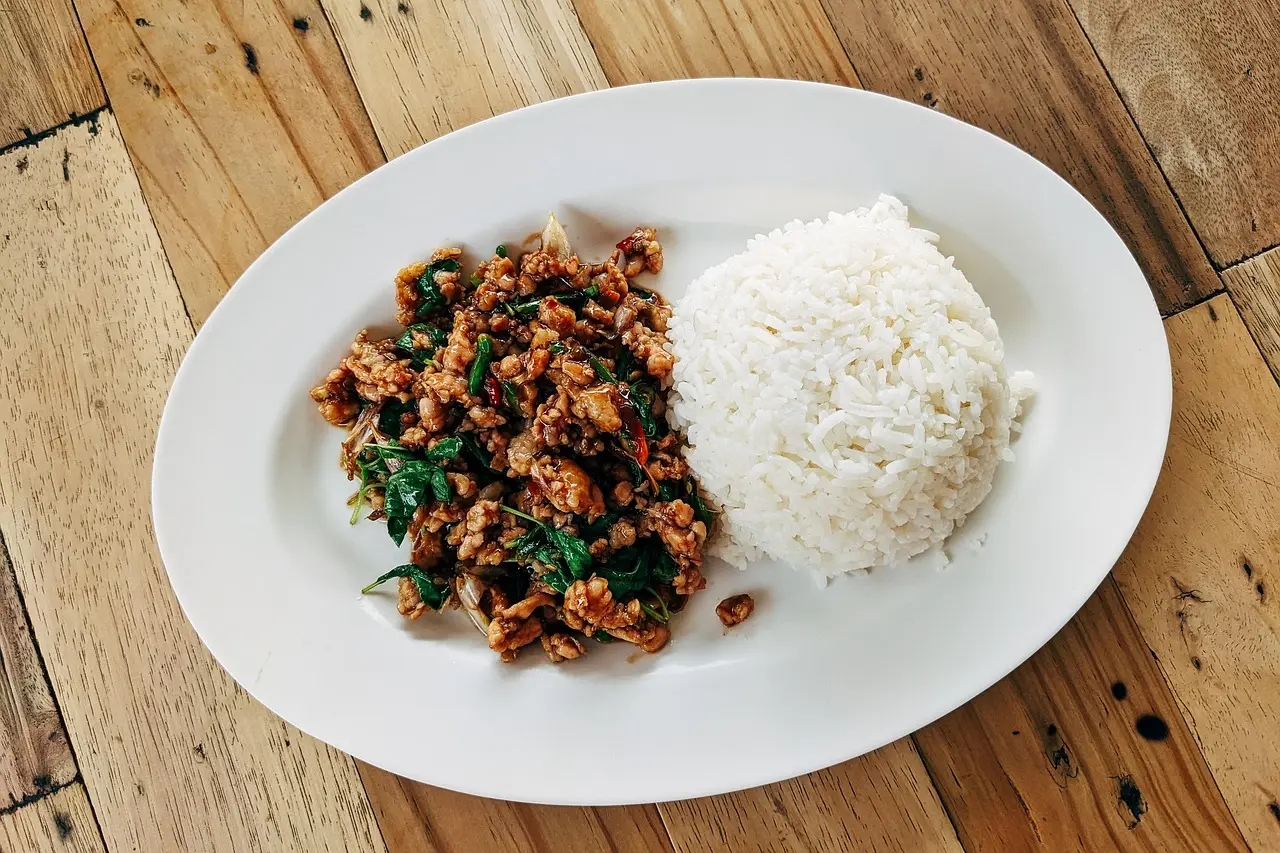
Open a bag of good basmati and you can smell it before the water boils: something like popcorn, something like pandan, faintly sweet. Cook it well and the grains stretch long and fall apart from each other like they've had a polite disagreement. This is the long-grain rice of the Himalayan foothills and the Punjab, the rice behind pulao and festive biryani, and one of the few foods two countries have taken to court over 135.
Background
The name means "fragrant", from Hindi bāsmatī, and some trace it further back to Sanskrit roots for "fragrance" and "ingrained" 1. So the rice was named for its smell before anyone measured anything about it.
Scientists have since caught the smell red-handed. It comes mostly from one compound, 2-acetyl-1-pyrroline, which basmati carries at about twelve times the level of ordinary rice 1. Fragrance in rice traces back to a recessive gene, badh2, which may first have shown up in the sub-Himalayan belt 3.
Shape matters just as much. Pakistan's application for protected status in Europe sets a minimum grain length of 6.5 millimetres, at least three and a half times as long as it is wide 4.
A tip straight from the chemistry: soak it for about 30 minutes. That cuts cooking time by around a fifth and keeps more of the aroma in the grain rather than in your kitchen air 1.
History
Nobody knows exactly when farmers first picked out basmati. Long-grain rice found near Udaipur and dated to roughly 2000–1600 BC might be an ancestor, but "might" is doing a lot of work there 3.
The word itself first appears in a love story. In 1766 the Punjabi poet Waris Shah wrote Heer Ranjha, a verse romance, and basmati turns up in it, the earliest record of the name 12. Agricultural historian Y. L. Nene later concluded that farmers in what are now India and Pakistan had shaped basmati into a distinct variety at least 250 years ago 7.
The Mughals loved fragrant rice too, though not under this name. The Ain-i-Akbari, the great survey of Emperor Akbar's empire, lists a scented rice called mushkin as the priciest grain in provinces such as Lahore, Multan, Delhi and Agra 2.
Then there's the homesick king. After the First Anglo-Afghan War (1838–1842), the British exiled the Afghan ruler Dost Mohammad Khan to Mussoorie, above Dehradun. His household brought seed of an Afghan rice, said to be from Kunar province, so the court could keep eating its beloved pulao. That rice became Dehradun basmati, still counted among the finest 61. Few cooks can say their rice exists because a king missed dinner.
In 1947 Partition split basmati's Punjab heartland between two new countries 1. Later, Indian scientists bred Pusa Basmati 1, a shorter plant that kept most of basmati's cooking magic while roughly doubling the yield 1.
Customs, rules and rituals
Basmati is celebration rice. Across India and Pakistan it carries the biryanis of weddings and big family occasions 5. Because it sells at the top of the rice market, it's often the rice you save for when it counts 3.
Where it grows, it shows up in more than meals. Researchers Subhash Chander Ahuja, Uma Ahuja and Siddharth Ahuja collected basmati sayings, songs and prayers from Himachal Pradesh, Punjab, Uttarakhand, Uttar Pradesh and Bihar. Uttarakhand had the most. In these traditions basmati appears in similes and prayers and even serves as a way to teach life lessons 2.
The kitchen ritual follows the grain: rinse off the surface starch, soak, then cook by absorption or boil and drain, so those long grains stay whole 1.
Place in human experience
Basmati is a reminder that a smell can be an identity. Poets named it before officials did 12, and for the people who grow it, the name carries their place and their past.
It is also a story about who gets to own a heritage. In 1997 the Texas company RiceTec won a United States patent on basmati rice lines and grains. India called it biopiracy and fought back; RiceTec lost or withdrew most of its claims, including the right to call its rice basmati, and now sells it under names such as Texmati 137. India argued that basmati belongs to a place and its people, the way Champagne belongs to a corner of France, and largely won 3.
Then the neighbours fell out. India applied for exclusive protected status in the European Union; Pakistan objected and filed its own claim, published by the European Commission in 2024, which itself notes basmati also grows in parts of India 45. For farmers on the Pakistani side the stakes felt huge. Mill owner Ghulam Murtaza told reporters India's move was "like dropping an atomic bomb on us" 5. Pakistan's rice exporters have argued for a joint claim, since the world knows basmati comes from both countries 5.
Strip away the lawyers and it's simple. Basmati tastes of where it comes from, and both sides of the border grew up on it.
Sources
- "Basmati", Wikipedia, https://en.wikipedia.org/wiki/Basmati
- Subhash Chander Ahuja, Uma Ahuja and Siddharth Ahuja, "History and folklore of basmati rice", Journal of Cereal Research (ICAR), 2019, https://epubs.icar.org.in/index.php/JWR/article/view/95207
- "Basmati: The Queen of Perfumed Rice", Rice Today, International Rice Research Institute, https://ricetoday.irri.org/?p=22458
- European Commission, Implementing Decision C/2024/2995 on the publication of the application for the name 'Basmati' (PGI), EUR-Lex, 2024, https://eur-lex.europa.eu/eli/C/2024/2995/oj
- "Steam rises as India and Pakistan take basmati battle to EU", Arab News (AFP), https://arabnews.pk/node/1872476
- "From Basmati Rice to Cricket, Dehradun's Afghan Connection", LiveHistoryIndia, https://livehistoryindia.com/story/places/dehraduns-afghan-connection
- "Basmati" (report from The Hindu), Institute for Agriculture and Trade Policy, https://www.iatp.org/node/29231